The Dispatch Layer Is the Part of AI Agents I Trust
I trust the control layer around an agent more than the model itself. The part that routes work, scopes tools, and forces proof is where reliability starts.
I don't trust a general AI agent with my repo, my inbox, or my money. I trust a dispatch layer.
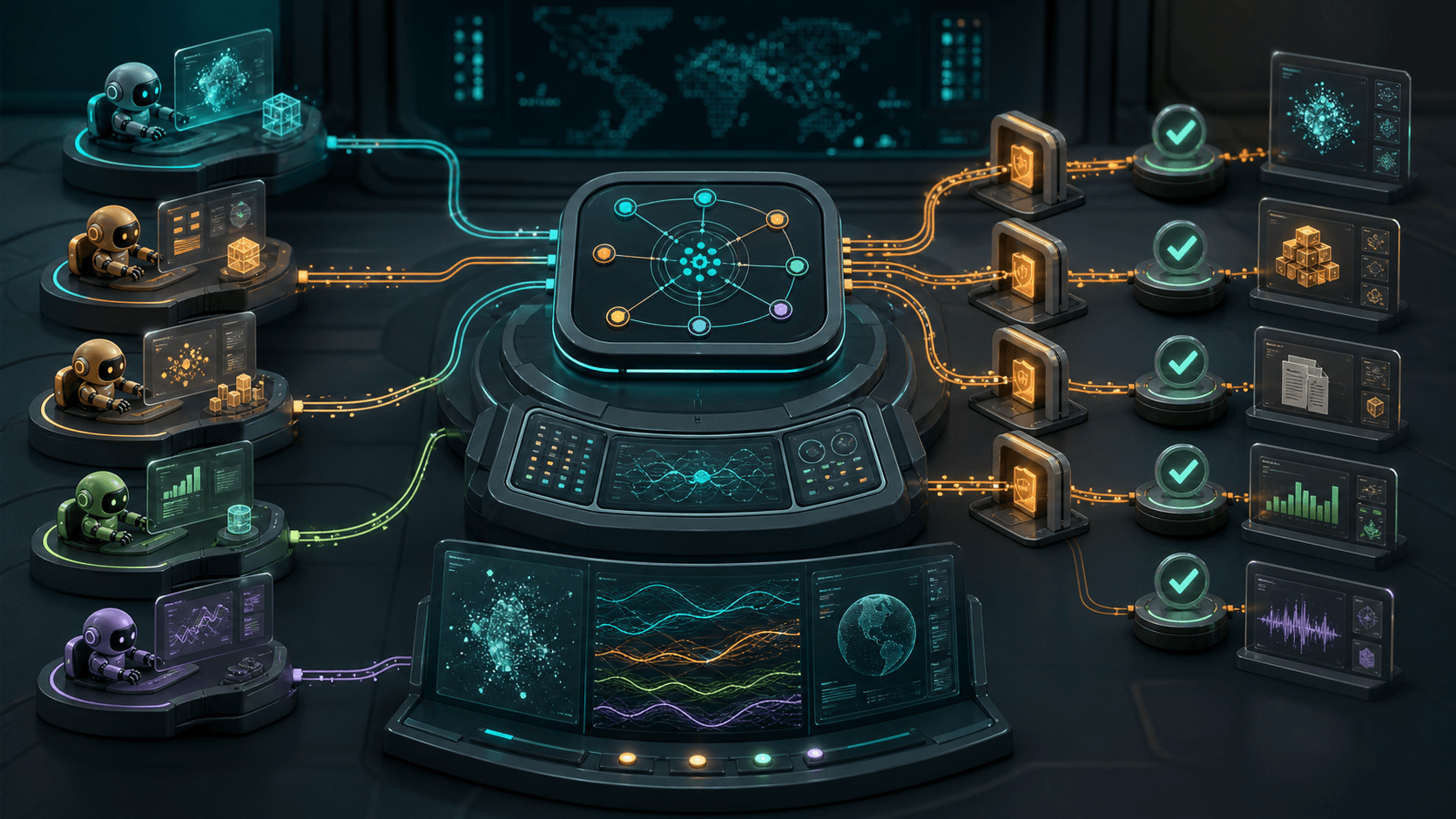
That's my name for the boring part. The layer that decides which worker gets the job, what context it sees, what tools it can touch, what has to be proven, and when a human has to step back in. The blank chat box is the least trustworthy version.
In December 2024, Anthropic published "Building effective agents" after working with teams building these systems in production. Their split is the cleanest one I've seen. Workflows are LLMs and tools orchestrated through predefined code paths. Agents are systems where LLMs dynamically direct their own processes and tool usage. Same models. Different control.
That distinction matters because control is where trust lives. Anthropic's routing pattern classifies an input and sends it to a specialized follow-up task. Its orchestrator-workers pattern uses a central LLM to break a task down, delegate, and synthesize. That's basically dispatch.
OpenAI's current agent docs describe the same shape in more mechanical language. In the Responses function-calling flow, your application receives function calls, executes them, returns the output, and calls the model again. Their guardrails guide says human review should pause the run before side effects like edits, shell commands, or sensitive MCP actions. Again, same story. The useful part is not "the model thinking." It is the loop with ownership.
Why do I trust that layer more than the model itself? Because the model still misses too much.
The public benchmarks are not subtle about this. TheAgentCompany says the most competitive agent completed 30% of simulated workplace tasks autonomously. Tau-bench says state-of-the-art function-calling agents succeeded on under 50% of tasks and, in retail, their pass^8 dropped below 25%. METR's March 2025 work is even better as a gut check. Frontier agents are improving fast. Their task horizon has been doubling around every seven months. But the same post says current models still succeed less than 10% of the time on tasks that take humans more than about four hours. Better than last year. Not close to "just let it run."
So I don't want one sprawling agent improvising through research, code edits, shell commands, and deploys on my behalf. I want dispatch.
Route. Scope. Check. Escalate.
If the job is narrow and checkable, dispatch can hand it to a specialized worker with a tight prompt and the smallest tool set that works. If the job crosses a risk line, dispatch can pause. If the output needs proof, dispatch can require a test result, a diff, a citation, a screenshot, a checksum. If the worker drifts, dispatch can retry, fall back, or hand it to a different worker.
That sounds less magical than "autonomous agent." Good. I trust less magic here.
This is also why the best agent systems feel more like operations than intelligence. A good dispatcher knows the difference between "summarize this page," "search these sources," "patch this file and run typecheck," and "send the email." Those are not one task. They should not share the same prompt, the same permissions, or the same definition of done.
When I use The Harness every day, this is the part I actually feel. Not the model IQ. The workflow around it. The small worker with one lane. The approval gate before something expensive. The evidence trail after something consequential. The ability to say "no, this one stays human." Same reason I wrote You Can't Watch the Work Anymore. If the system takes action where you can't see the work happen, the dispatcher is the part that decides how that hidden work gets boxed in.
The trust test I use is simple. If I removed the dispatch layer and replaced it with one giant prompt, would I still feel good about the system touching real stuff?
Usually, no.
That's the answer.
I trust small workers with tight scopes. I trust a loop that can stop. I trust approvals, traces, and proof. I trust the part of the system that knows which job should never have been handed to the model in the first place.
I trust dispatch.
This article reflects the state of AI tooling as of July 2026. Specific products, docs, and benchmark numbers may have shifted.
Sources
- Anthropic: Building effective agents (19 December 2024) (opens in new tab)
- OpenAI API Docs: Agents SDK guide (opens in new tab)
- OpenAI API Docs: Guardrails and human review (opens in new tab)
- Xu et al. "TheAgentCompany: Benchmarking LLM Agents on Consequential Real World Tasks" (2024, arXiv:2412.14161) (opens in new tab)
- Yao et al. "Tau-bench: A Benchmark for Tool-Agent-User Interaction in Real-World Domains" (2024, arXiv:2406.12045) (opens in new tab)
- METR: Measuring AI Ability to Complete Long Tasks (19 March 2025) (opens in new tab)