Light Is a Drug You Take Through Your Eyes
In 2002, scientists discovered a hidden photoreceptor that doesn't help you see. It tells your body what time it is. You're dosing it wrong every single day.
Your eyes do something you've never been told about. They tell time.
Not metaphorically. Not by glancing at a clock. Your retinas contain a class of cells that have nothing to do with vision. They exist to measure how bright it is outside and report that information directly to the master clock in your brain. And for the vast majority of your waking hours, you are feeding them the wrong signal.
The Cells Nobody Knew About
For most of the 20th century, scientists assumed two types of photoreceptors handled everything the eye did. Rods for dim light. Cones for color. That was the complete inventory.
Then in 2002, three labs published back-to-back papers in Science that blew the model apart. Samer Hattar at Johns Hopkins, David Berson at Brown University, and Ignacio Provencio at Uniformed Services University each independently identified a new class of retinal cells called intrinsically photosensitive retinal ganglion cells (ipRGCs). These cells contain their own photopigment, melanopsin, and they wire directly to the suprachiasmatic nucleus (SCN), the master clock discovered through lesion studies by Robert Moore and Irving Zucker in 1972.
ipRGCs make up only 1-2% of your retinal ganglion cells. They don't help you see images. They are slow, integrating light over minutes rather than the milliseconds your rods and cones operate on. What they measure is irradiance. Overall brightness. They answer one question for your brain: is it daytime or not?
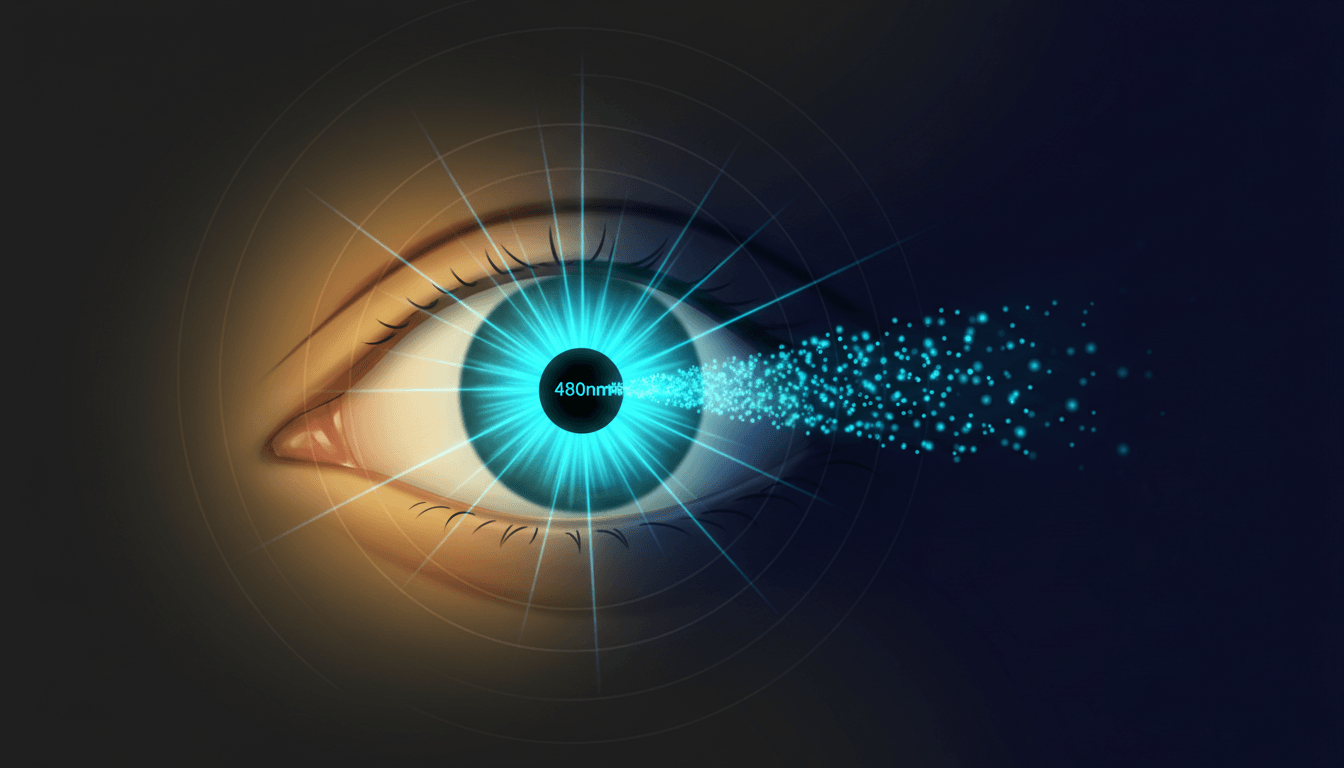
And they're most sensitive to short-wavelength light around 480 nanometers. Blue light.
Remember that number.
Light as a Timing Signal
Charles Czeisler's lab at Harvard did the foundational work. His 1986 paper in Science was the first to definitively show that bright light could reset human circadian rhythms. Later studies from his group showed that even ordinary room light at 100 lux suppresses melatonin and shifts your phase. Bright light at 10,000 lux is far more powerful.
Here's the scale that matters. Outdoor daylight ranges from 10,000 to 100,000 lux. A typical office sits at 300 to 500 lux. Your phone screen at night puts out 40 to 80 lux.
You're spending your days in biological twilight and your nights staring at an artificial sun.
Timing matters as much as intensity. Jamie Zeitzer at Stanford showed in a 2000 Journal of Physiology study that light before your core body temperature minimum (around 4-5 AM for most people) delays the clock. Pushes your whole cycle later. Light after that minimum advances it. Pulls you earlier.
That's why morning light is the single most effective circadian intervention that exists. It hits your system when the clock is maximally sensitive to advancing signals. Not supplements. Not blue-light glasses. Actual photons hitting your retinas at the right time.
The Indoor Problem
A 2017 study from Satchin Panda's group found that office workers received sufficient circadian-stimulating light for only about 30 minutes per day. Thirty minutes. Your biology needs hours of bright light to maintain a stable rhythm, and you're giving it a fraction of that.
Growing up in Alaska, I experienced the extreme version of this. Winter days with barely any light. Summer days that never ended. Your body notices. Everyone's body notices, even in places with normal day lengths, because almost nobody spends meaningful time outside anymore.
Then the other half of the problem. You come home from your dim office, and you spend the next 4-5 hours flooding your retinas with blue-enriched LED light from phones, monitors, and televisions. The exact wavelength your ipRGCs are most sensitive to. The exact signal that tells your SCN it's still daytime.
You are telling your master clock it's noon at 11 PM.
Kenneth Wright at the University of Colorado ran an elegant experiment published in Current Biology in 2013. He sent participants camping for a week. Natural light only. No electronics. No artificial light after sunset. After seven days, their melatonin onset shifted 1.4 hours earlier. The late-shifted schedule that indoor living had created just disappeared.
One week. That's how fast your clock can recalibrate when you give it the right input.
The Dose Response
Light is a drug because your biology treats it like one. It has a dose (intensity in lux), a timing window (when relative to your temperature minimum), a frequency response (peak sensitivity at 480 nm), and side effects when you take it wrong.
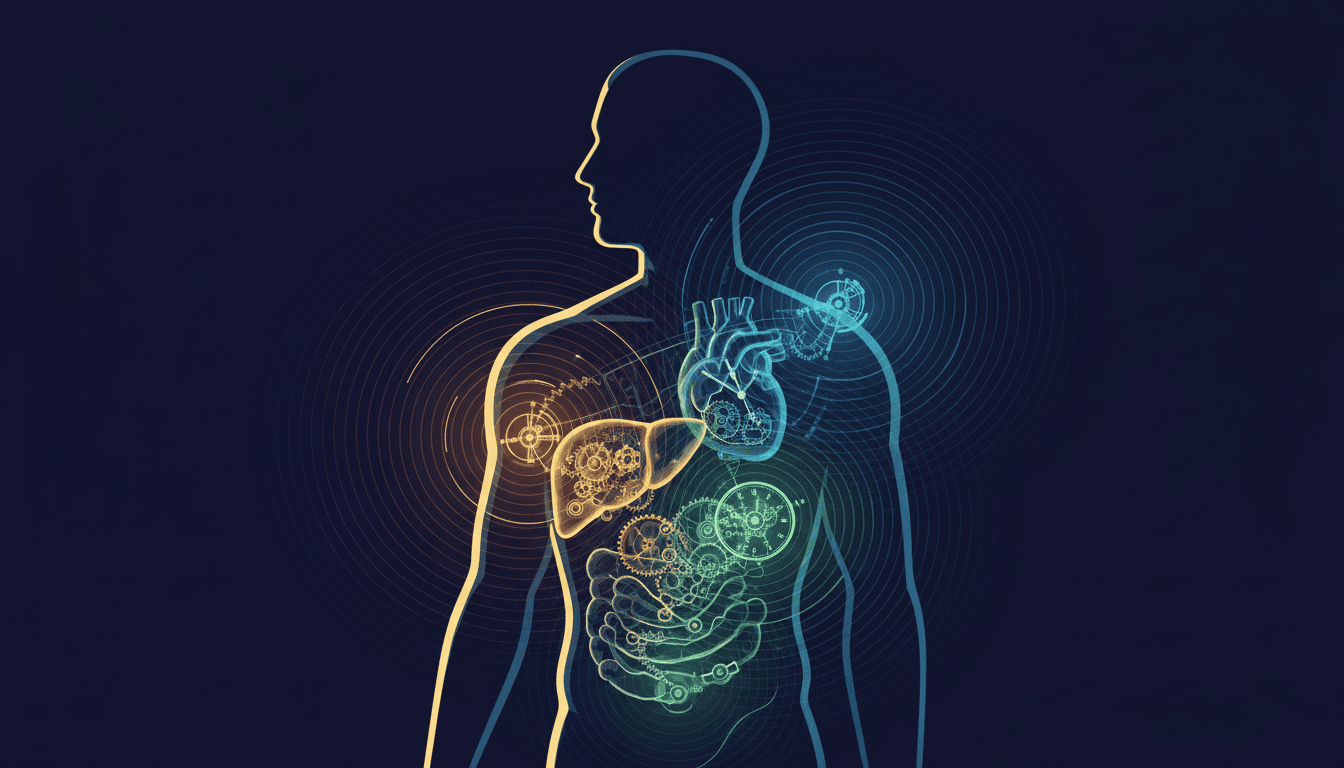
The human circadian pacemaker runs at almost exactly 24.2 hours. Without external time cues, you'd drift about 12 minutes later every day. Light is the dominant signal that keeps you locked to the 24-hour cycle. Feeding times matter. Social cues matter. Temperature matters. But light wins.
When the input is wrong, everything downstream shifts.
Satchin Panda's 2002 paper in Cell showed the circadian clock controls the transcription of roughly 10% of the genome. One in ten genes in your body cycles with the clock. Light is the primary input. You do the math on what happens when the signal is garbage.
What Actually Works
This isn't complicated. It just conflicts with how most people live.
Morning light. Get outside within an hour of waking. Not through a window (glass filters the relevant wavelengths). Actual outdoor light, even on a cloudy day, delivers 2,000 to 10,000 lux. Fifteen to thirty minutes minimum.
Daytime brightness. If you work indoors, sit near a window. Consider a 10,000 lux light therapy lamp at your desk. The goal is giving your ipRGCs a clear daytime signal for hours, not minutes.
Evening darkness. Dim lights after sunset. Warm-toned bulbs. Phone in night mode (though even reduced blue light at close range still hits your clock). The best option is less screen time after dark. I know. Nobody wants to hear that.
Wright's camping study is the proof of concept. Bright days and dark nights reset the entire system in a week. You probably can't go camping every week. But you can approximate the signal.
Your ipRGCs don't care about your sleep app. They don't care about your melatonin supplement. They measure photons. Give them the right photons at the right time, and the 20,000 neurons in your SCN will handle the rest.
That's the drug. Light. You're already taking it. You're just taking the wrong dose at the wrong time.
Sources
- Melanopsin-Containing Retinal Ganglion Cells: Architecture, Projections, and Intrinsic Photosensitivity (Hattar et al., 2002, Science) (opens in new tab)
- Phototransduction by Retinal Ganglion Cells That Set the Circadian Clock (Berson, Dunn, Takao, 2002, Science) (opens in new tab)
- Loss of a Circadian Adrenal Corticosterone Rhythm Following Suprachiasmatic Lesions in the Rat (Moore & Eichler, 1972, Brain Research) (opens in new tab)
- Circadian Rhythms in Drinking Behavior and Locomotor Activity of Rats Are Eliminated by Hypothalamic Lesions (Stephan & Zucker, 1972, PNAS) (opens in new tab)
- Bright Light Resets the Human Circadian Pacemaker Independent of the Timing of the Sleep-Wake Cycle (Czeisler et al., 1986, Science) (opens in new tab)
- Stability, Precision, and Near-24-Hour Period of the Human Circadian Pacemaker (Czeisler et al., 1999, Science) (opens in new tab)
- Sensitivity of the Human Circadian Pacemaker to Nocturnal Light: Melatonin Phase Resetting and Suppression (Zeitzer et al., 2000, Journal of Physiology) (opens in new tab)
- Entrainment of the Human Circadian Clock to the Natural Light-Dark Cycle (Wright et al., 2013, Current Biology) (opens in new tab)
- Coordinated Transcription of Key Pathways in the Mouse by the Circadian Clock (Panda et al., 2002, Cell) (opens in new tab)
- Panda S. The Circadian Code (2018, Rodale Books) (opens in new tab)
- Foster R, Kreitzman L. Circadian Rhythms: A Very Short Introduction (2017, Oxford University Press) (opens in new tab)
Part of the Body Clock series. Previous: Your Liver Doesn't Know What Time Zone You're In. Next: The Night Shift Problem: When Work Breaks the Clock.