You Can Train Your Stress Response Like a Muscle
Navy SEALs, Olympic athletes, and emergency surgeons all share a secret: they don't eliminate stress. They practice it. Controlled exposure to manageable stress builds tolerance for the real thing.
Navy SEAL candidates in BUD/S training spend five and a half days in near-continuous cold water immersion, sleep deprivation, and physical punishment. Hell Week. About 75% of candidates quit. The ones who survive aren't necessarily the strongest or the fastest. They're the ones whose stress response has been systematically trained to function under conditions that would shut most people down.
This isn't toughness mythology. It's a trainable biological adaptation.
The Inoculation Principle
Donald Meichenbaum formalized stress inoculation training (SIT) in the 1970s at the University of Waterloo. The concept borrowed directly from immunology. Expose someone to a manageable dose of stress. Let them develop coping responses. Gradually increase the dose. The result is a nervous system that handles greater stress without breaking down.
Meichenbaum's original protocol had three phases. Conceptualization, where you learn what stress actually does to your body. Skills acquisition, where you practice specific coping techniques. Application, where you face progressively harder stressors using those skills.
A 2014 review by Lilianne Staal at TNO Defence, Security and Safety in the Netherlands examined SIT across military and first-responder populations. The findings were consistent. SIT improved performance under operational stress, reduced anxiety symptoms, and increased self-efficacy. People who practiced being stressed got better at being stressed.
The U.S. military took this seriously. The Army's Comprehensive Soldier Fitness program, the Air Force's tactical combat casualty care simulations, the SEALs' entire selection pipeline. All built on the same principle. You don't wait for the real crisis to find out if someone can handle it. You manufacture smaller crises first.
What Changes in the Brain
Adriana Feder and colleagues at the Icahn School of Medicine at Mount Sinai published a 2009 review in Nature Reviews Neuroscience that mapped what resilience looks like at the neural level. They studied people who'd experienced serious trauma without developing PTSD. The resilient group showed enhanced prefrontal cortex regulation of the amygdala, greater capacity for fear extinction, and more adaptive use of cognitive reappraisal.
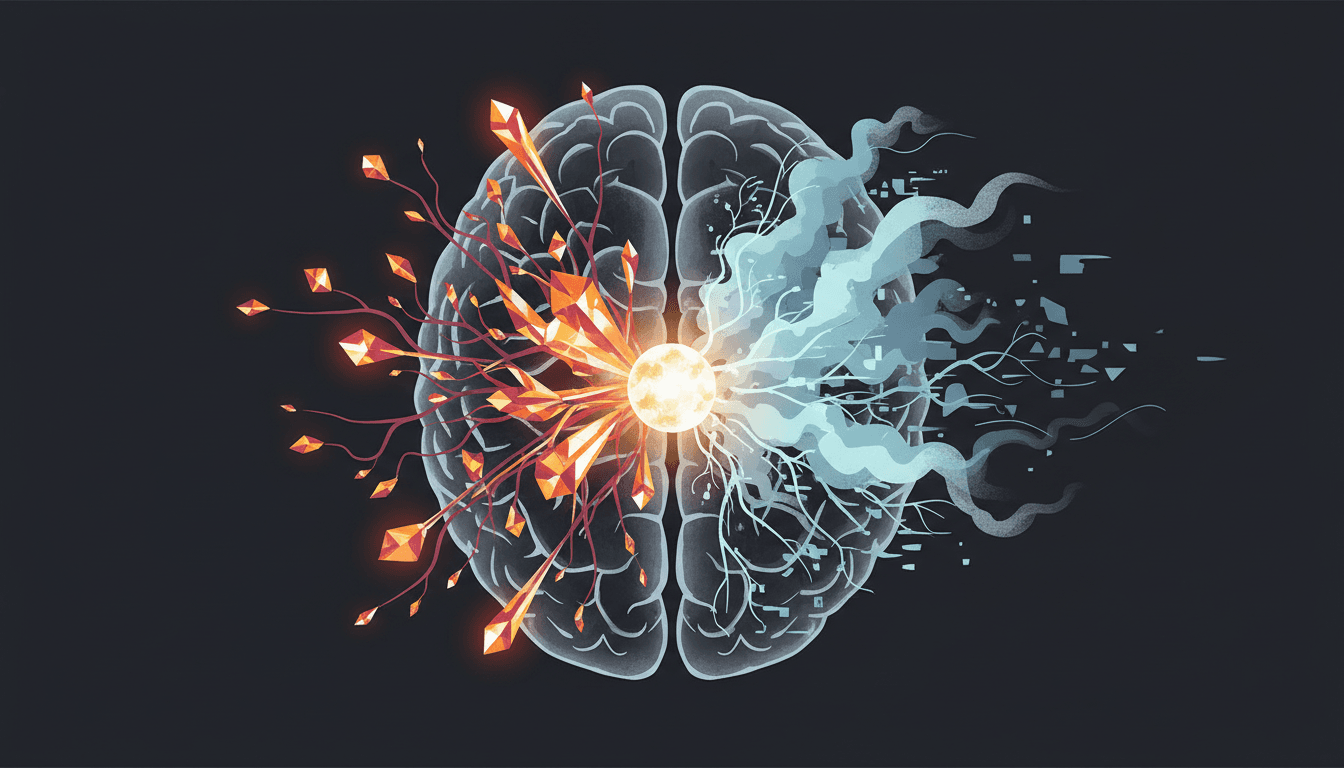
Your amygdala is the alarm system. Your prefrontal cortex is the executive that decides whether the alarm is worth listening to. In people who haven't been stress-trained, the amygdala fires and the prefrontal cortex gets overwhelmed. Alarm goes off, nobody's at the control panel.
In resilient individuals, the prefrontal cortex stays online. It receives the alarm signal and makes a judgment call. Real threat or false alarm. Escalate or stand down. That circuit doesn't just appear. It gets built through repeated exposure to manageable stress followed by successful coping.
Fear extinction is particularly interesting. It's not forgetting the fear. It's learning a new association that competes with the old one. "This situation used to mean danger, but I've been through it multiple times and I'm fine." Each successful exposure strengthens that competing memory. The fear doesn't disappear. It gets overridden by evidence.
This is the neurobiology behind everything from exposure therapy for phobias to an athlete performing under pressure. Same mechanism. Different contexts.
Deliberate Practice Is Stress Inoculation
Anders Ericsson spent decades studying expert performance. His actual research identified something specific about how experts train. They don't just practice. They practice at the edge of their ability, where failure is likely and adjustment is constant.
That's stress inoculation by another name.
The violinist who plays pieces slightly beyond their current skill. The surgeon who trains on progressively harder simulations. The programmer who tackles problems just past what they can comfortably solve. Each session is a controlled dose of performance stress. Each recovery builds tolerance for the next dose.
Sian Beilock at Dartmouth tested this directly. Students who practiced math problems under time pressure, wrote about their test anxiety before an exam, or performed in front of small audiences before large ones all showed less choking when the stakes were real.
The mechanism connects to what Alison Brooks at Harvard found in her 2014 research. People told to reappraise anxiety as excitement before a stressful performance did measurably better than people told to calm down. The stress inoculation framework explains why. If you've practiced performing while stressed, your brain has evidence that stress and performance can coexist. The arousal signal doesn't trigger a shutdown. It triggers a familiar pattern.
Jeremy Jamieson at the University of Rochester showed the same thing with standardized tests. Students taught to view their stress arousal as helpful scored higher on the GRE. Their cardiovascular profiles shifted from threat to challenge. Same stressor. Different biological response. Because the interpretation changed.
Beyond the Military
The stress inoculation principle operates everywhere.
The hormesis research shows this at the cellular level. Edward Calabrese at the University of Massachusetts Amherst documented that low-dose exposure to toxins, radiation, and physical stress triggers adaptive responses that leave organisms stronger than baseline. A 2015 study in JAMA Internal Medicine by Timo Laukkanen and colleagues in Finland found that frequent sauna use (4-7 times per week) was associated with a 40% reduction in all-cause mortality compared to once-a-week use. Heat stress, applied repeatedly, builds systemic resilience.
Cold exposure. Fasting. High-intensity exercise. Difficult conversations. Public speaking. Same curve. The thing that's uncomfortable in the short term builds capacity in the long term. Not because suffering is noble. Because your biology is adaptive.
The Dose Matters
The Yerkes-Dodson law, published in 1908, established something anyone who's ever crammed for an exam already knows. Some stress helps performance, too much destroys it. The relationship is an inverted U. Too little arousal and you're bored, disengaged, sloppy. Too much and you're panicked, rigid, choking. The peak is in the middle.
Yuri Hanin's Individual Zones of Optimal Functioning model added an important nuance in 1997. The optimal zone varies by person. Some athletes perform best at high arousal. Some perform best relatively calm. The zone isn't fixed. And it can be expanded through training.
That expansion is the whole point of stress inoculation. You're not trying to eliminate the stress response. You're widening the window in which your stress response enhances rather than degrades performance.
Writing code under a tight deadline used to shut me down. Pressure triggered anxiety, anxiety fragmented attention, worse code increased the pressure. A doom loop.
What changed wasn't removing the deadlines. It was accumulating enough reps performing under deadline pressure that my brain stopped treating it as a threat. The arousal still shows up. My heart rate still increases when a deploy needs to happen fast. But now that signal maps to focus mode instead of panic mode. Same hardware. Different trained response.
Stress-Proof vs. Stress-Trained
You don't become stress-proof. You become stress-trained.
Stress-proof implies the stress doesn't register. Stress-trained means it registers, you process it, and you perform anyway. Because you've done it before. Because your prefrontal cortex has evidence that this is survivable. Because your body knows the difference between a real threat and a growth opportunity.
Mindset, connection, practice. Cold water, hard conversations, tight deadlines. They all work through the same mechanism. Controlled dose. Successful coping. Stronger baseline.
That's not positive thinking. That's accumulated biological evidence, stored in your nervous system, available on demand.
Sources
- Stress Inoculation Training (Meichenbaum, 1985, Pergamon Press) (opens in new tab)
- Stress inoculation training in military operations (Staal, 2004, TNO Defence, Security and Safety) (opens in new tab)
- Psychobiology and molecular genetics of resilience (Feder, Nestler, & Charney, 2009, Nature Reviews Neuroscience) (opens in new tab)
- Choke: What the Secrets of the Brain Reveal About Getting It Right When You Have To (Beilock, 2010, Free Press) (opens in new tab)
- Get excited: Reappraising pre-performance anxiety as excitement (Brooks, 2014, Journal of Experimental Psychology: General) (opens in new tab)
- Turning the knots in your stomach into bows: Reappraising arousal improves performance on the GRE (Jamieson et al., 2010) (opens in new tab)
- Hormesis: The dose-response revolution (Calabrese & Baldwin, 2003, Annual Review of Pharmacology and Toxicology) (opens in new tab)
- Association between sauna bathing and fatal cardiovascular and all-cause mortality events (Laukkanen et al., 2015, JAMA Internal Medicine) (opens in new tab)
- The relation of strength of stimulus to rapidity of habit-formation (Yerkes & Dodson, 1908) (opens in new tab)
- Emotions and athletic performance: Individual zones of optimal functioning model (Hanin, 1997) (opens in new tab)
Part of the Stress Paradox series. Previous: Your Stress Response Has a Social Setting.