Meet Tyler: My AI Personal Assistant
Imagine having the world's best psychologist, therapist, and health coach available to you 24/7. This is what the power of AI can now do and why I've never been more optimistic about the future.
Most people use AI like a search engine with a personality. You open ChatGPT, ask a question, get an answer, close the tab. Next time you open it, you're starting from zero. It doesn't know you. Doesn't remember what you told it yesterday. Definitely doesn't know that you have 2 project deadlines next week and you've been doing mental math in the shower about how you're going to make them.
Chatbots have made improvements in memory, with projects and longer chat history capabilities, but I wanted something different. Something that actually knows me and can proactively assist me in all areas of my life. So I built Tyler.
What Tyler Actually Knows
Tyler knows my finances. Not "Justin has a budget" in some vague sense. It knows my exact account balances, what bills are due this week, and what I'm making at each of my jobs and clients. When I ask "can I afford this?" it's not guessing. It has the numbers and will give me an honest opinion whether I can fit it in my budget.
Tyler knows my relationships. Every significant person in my life has a profile that gets updated over time. What's going on with them, context about the dynamic, conversation history. When I mention someone by name, Tyler already knows who they are and what's been happening lately. I never have to explain backstories. Which is good, because over a lifetime there's a lot of relationships and backstories.
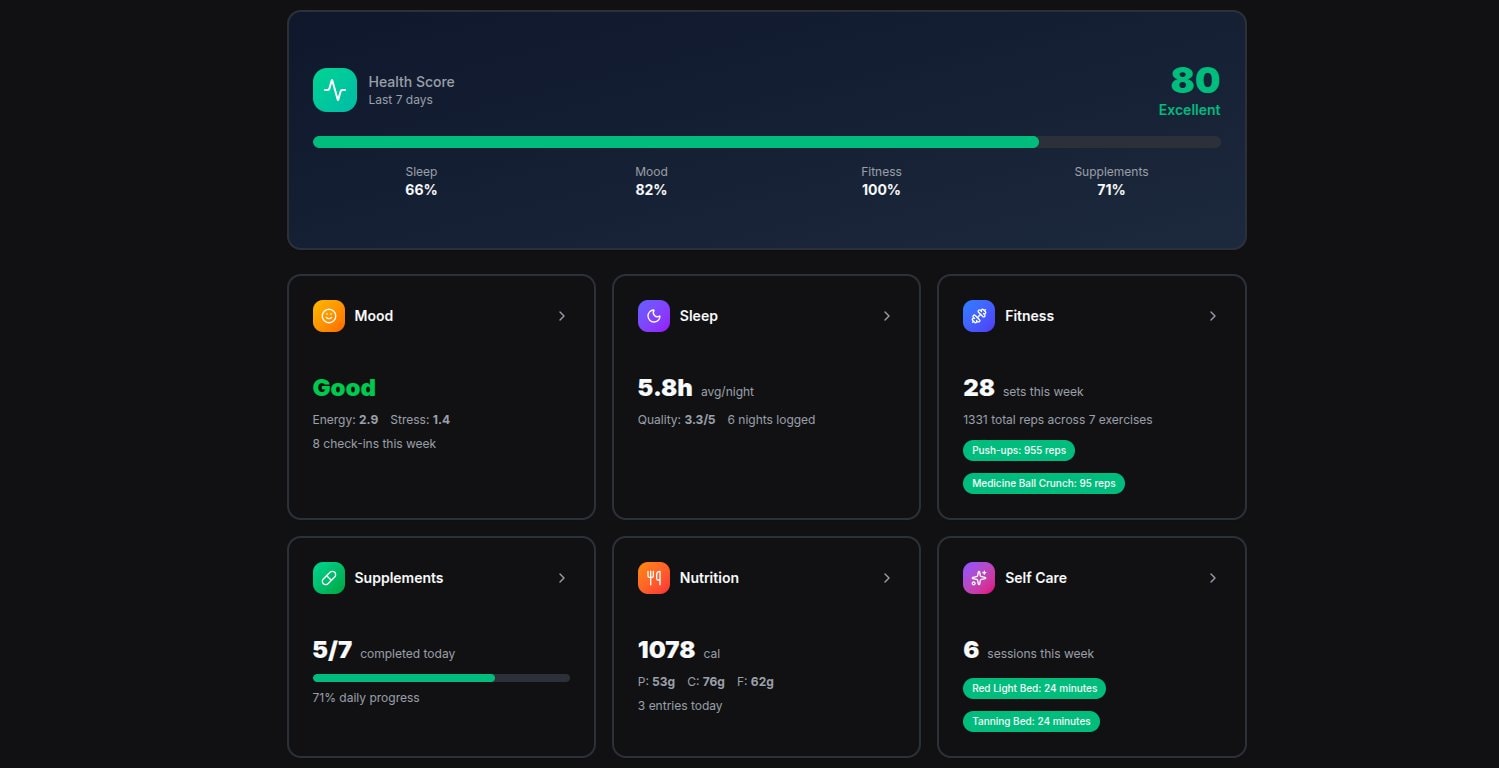
Tyler knows my goals, my projects, my health, my schedule, my patterns. It knows I'm 13 months sober. It knows I'm building a software business while working at a tanning spa. It knows exercise is the single biggest lever for my mood based on weeks of tracking personal data.
This isn't a list of facts on a settings page somewhere. It's deep, structured context that loads automatically based on what we're talking about. Tyler updates its memory after every conversation and gets to know me more as we work together.
What a Day With Tyler Looks Like
I wake up to a message. Morning briefing. What's on my calendar, any reminders I set, a quick check on my goals. I didn't ask for it. It just shows up.
During the day I message Tyler from my phone. "How much did I spend this week?" Instant answer with a breakdown. "What do you think about setting up a meeting with so-and-so?" Full context loaded, advice based on the actual history. "Can you draft social posts for the new article?" Done. Customized for each social media platform. Ready for me to review.
Midday I get a habit check. Mood tracking, supplements, food logging. If I've been slipping, Tyler calls it out. Evening, there's a reflection. What got done today, what's carrying over.
None of this requires me to open an app or navigate to some screen. Tyler runs in the background, reaching out at the right times. It's like having a expert in every field who works 24/7 for you for free.
The Context Problem
Here's maybe the most annoying issue with AI. The models are already smart enough. ChatGPT, Claude, Gemini, they can all reason and write and problem-solve at a high level. The bottleneck isn't intelligence. It's context.
When you ask ChatGPT for financial advice, it doesn't know your finances. Relationship advice? Doesn't know the people involved. Career advice? Doesn't know all the intricate details of your job. You spend half the conversation just explaining your situation before you even get to the question.
Tyler solves this. Mention money and my financial data is already loaded. Mention a person and their full history is there. Mention a project and Tyler knows the codebase, the goals, where I left off.
Every conversation starts at 90% instead of zero.
Tyler on My Phone
Tyler lives on my computer. But I'm not always at my desk. So I set it up so I can message Tyler on Telegram like I would any friend.
Same personality. Same knowledge. Same access to everything. Just a different interface.
I can be at work, pull out my phone, and ask Tyler something. Response streams back in real time. This is where it stops feeling like a tool and starts feeling like a person. I'm not "using an AI product." I'm texting Tyler.
Not a Chatbot. A Perspective.
I didn't just give Tyler a list of rules. I gave it a worldview, my worldview.
Life is serving God through growth & evolution. Stagnation is the enemy. And we're all running modern software on 50,000-year-old hardware, which explains basically every dumb decision I've ever made (and I've made a lot of them).
So when my anxiety spirals about something that hasn't even happened yet, Tyler can name that. Your brain is doing threat detection for a scenario that doesn't exist. That's the hardware/software mismatch. That's not some generic chatbot response. That's a perspective built on how I see the world.
Tyler has real opinions too. If something is a bad idea, it says so. No "it depends" hedging. No fake enthusiasm. Direct. Warm, but direct. Like a friend who actually knows what's going on in your life and isn't afraid to say "yeah that's dumb, don't do that."
What This Costs
Anthropic's Claude Max plan is $200/month. For the average person, that's not nothing. I built this just using Claude Code. No need for anything as crazy as the openclaw tool that has taken the internet by storm, just some creative thinking.
But for what I get? A personal AI that knows my finances, my relationships, my goals, my patterns, my schedule, my health, and my psychological tendencies? That's the best $200 I spend each month. And I'm someone who thinks about every dollar.
On a pay-per-token basis, what Tyler does would cost thousands. Complex sessions with dozens of actions. Background tasks running all day. Cron jobs, data syncing, proactive check-ins. The flat rate is what makes this viable for someone who isn't a tech executive.
Why I Built This
Modern life is complex. Our brains did not evolve to manage the digital world we live. Technology makes life move faster every day. With AI this will only escalate and life will have subtle changes constantly, while many of us are still learning to navigate our current life. On top of this I'm still rebuilding the foundation of my life after crumbling from struggles with addiction.
This isn't theoretical. I'm not some Silicon Valley engineer with a cushy salary writing about AI from a home office. I'm a 30-year-old self-taught developer who learned to code by watching youtube videos in 2021 and somehow turned that into an actual career within 6 months. That's not a flex, my brain just happens to speak computer almost as a first language. (Okay maybe it's a small flex.)
When your life is complicated, when you're juggling multiple jobs and recovery and finances and relationships and trying to build something on the side, you need something that can hold all of that context at once. My brain can't. It's 50,000-year-old hardware, remember?
Tyler isn't finished. It evolves every week as I add more integrations and understand how to work with AI most efficiently. But it already has made an impact on my life and lifted several heavy weights off of my mind. Right now this type of tool is only possible with a good understanding of computers. But as AI software improves, this will become available to everyone and at more affordable prices. Anyone willing to put in the work will have maybe the biggest window of opportunity that has ever existed to get ahead in life.
I couldn't be more excited for the future, and I hope you are too.