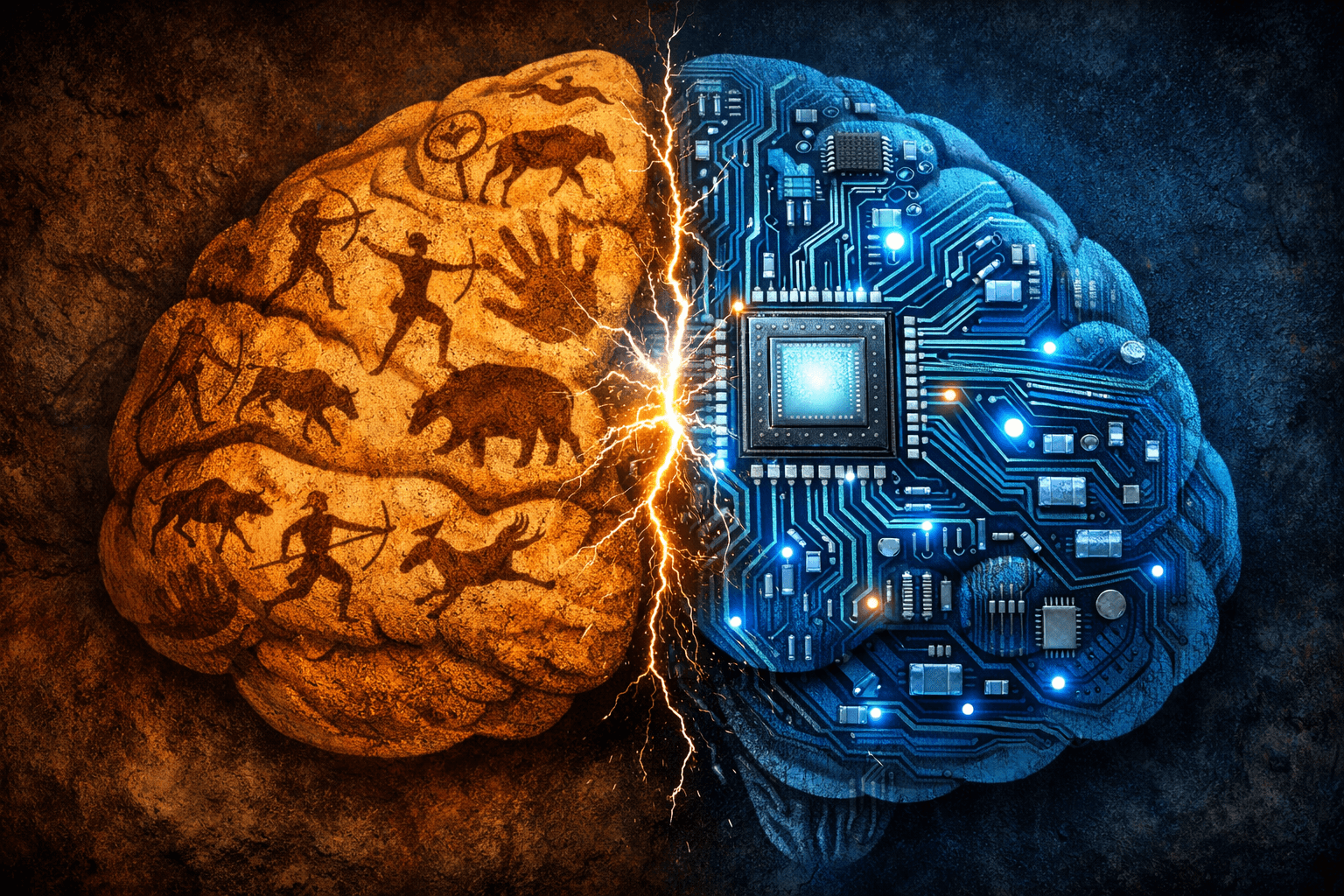
The Hardware/Software Mismatch: Why Your Brain Works Against You
"We are running modern software on 50,000-year-old hardware. Understanding the problems between our biology and modern life is the first step to overcoming them.
Your brain is approximately 50,000 years old. Not your specific brain. The design. The architecture. The wiring that determines how you react to threats, process rewards, make decisions, and interact with other humans. That hardware was optimized for a very specific environment: small tribal groups, physical danger, scarce resources, and a lifespan of maybe 35 years.
You are running that hardware in 2026.
You have a smartphone that connects you to 8 billion people. You make hundreds of decisions a day about things your ancestors never conceived of. You sit in a chair for 8 hours processing abstract information on a glowing screen. You eat food engineered to be more rewarding than anything that existed in nature. You compare yourself to curated highlight reels from strangers on the other side of the planet.
The anxiety, the procrastination, the bad decisions, the feeling that something is wrong even when nothing is, that's not a character flaw. It's a hardware/software mismatch.
Five Mismatches That Cause Bugs in Your Life
1. Anxiety: Threat Detection Without Threats
Your fight-or-flight system was designed for predators. Rustling in the bushes. A rival tribe approaching. Physical, immediate, life-threatening situations.
That same system fires when your boss sends a vague Slack message that says "Can we talk?" Your heart rate spikes. Your palms sweat. Your brain floods with cortisol. You spend the next two hours running worst-case scenarios about getting fired.
The biological response is identical. The actual threat level is not. Your brain can't tell the difference between a lion and a passive-aggressive email. It just knows something triggered the alarm, and now it's going to make sure you're ready to fight or run.
I used to deal with this constantly. I'd catch myself spiraling about something that hadn't happened, building elaborate scenarios about how a conversation might go wrong or a situation might blow up. Even aware of this outdated programming, I still catch myself throwing errors from time to time.
My journal entry from January says it clearly: "getting carried away with ideas about the future based on completely made up potential events in my head." I know it's happening. Knowing doesn't stop the hardware from running the program.
2. Worst-Case Scenarios: Paranoia as a Feature
On the savanna, the person who assumed the shadow was a predator survived more often than the person who assumed it was nothing. Paranoia was a survival advantage. The cost of a false positive (you ran from a shadow) was low. The cost of a false negative (you ignored a real predator) was death.
Your brain inherited that bias. It defaults to worst-case thinking because worst-case thinking kept your ancestors alive.
In 2026, this means you lie awake at 3am imagining how an email you sent might be interpreted. Your brain is running threat assessment on a digital message. The stakes are approximately zero. Your nervous system doesn't care. It's running the same protocol it would run if a predator were outside your shelter.
3. Procrastination: Rational Risk Avoidance
Your brain strongly prefers immediate rewards over delayed ones. Rest now versus fitness in six months. Comfort now versus financial security in five years. Pleasure now versus career advancement in three years.
This wasn't irrational for most of human history. Tomorrow genuinely wasn't guaranteed. If you might die next week from an infection, a predator, or a tribal conflict, prioritizing immediate reward is the smart bet. Why sacrifice today for a future that might not come?
Your future is almost certainly coming. You're probably going to be alive in five years. But your brain doesn't believe that on a deep level. The hardware still thinks next week is uncertain. So it pushes you toward the thing that feels good right now and away from the thing that pays off later.
This isn't laziness. It's outdated risk calculation.
4. Decision Fatigue: Too Many Choices for the Hardware
A hunter-gatherer made maybe 50 meaningful decisions in a day. Where to forage. When to move camp. Whether that berry is safe to eat. The brain's decision-making capacity was calibrated for this volume.
You make hundreds of decisions before lunch. What to wear. What to eat. Which route to take. Which emails to answer first. Which Slack messages need responses. Whether to take that meeting. What to say in that meeting. Each decision costs a small amount of cognitive energy, and there's a finite supply.
By the afternoon, you're making worse decisions. Not because you got dumber, but because the hardware is depleted. The CEO who makes brilliant strategic calls at 9am is choosing pizza for dinner at 7pm because the decision-making budget is spent.
This is why simplifying your life actually works. It's not productivity theater. It's reducing the load on hardware that wasn't designed for this many choices.
5. Social Comparison: 150 People vs. 8 Billion
Humans evolved in groups of about 150 people. In that context, knowing where you stood socially was useful information. Being aware of your relative status helped you navigate alliances, find mates, and avoid conflicts.
Instagram gives you real-time comparison to 8 billion people. You see the best moments of everyone's life, presented with professional lighting and careful editing. Your brain processes this the same way it processed social data in a tribe of 150: as a direct measure of your relative position.
The result is that you feel inadequate compared to a dataset that doesn't represent reality. You're measuring yourself against a fiction. Your brain doesn't know it's a fiction. It just sees signals that suggest you're falling behind your "tribe," and it generates anxiety accordingly.
This Is Not a Character Flaw
I want to be clear about what this framework does and doesn't say.
It doesn't say you're broken. It doesn't say you're weak. It doesn't say you need to be fixed. It says you're running hardware that was designed for a different environment, and the mismatch creates predictable problems.
That distinction matters. When you think anxiety is a personal failing, you add shame on top of the anxiety. Now you're anxious AND ashamed of being anxious. The shame doesn't help. It makes everything worse.
When you understand that your brain is doing exactly what it was designed to do, just in the wrong context, the shame drops away. You're not broken. You're mismatched. And mismatches can be addressed.
The Fix Isn't More Willpower
Here's where most self-improvement advice goes wrong. It tells you to try harder. Be more disciplined. Wake up earlier. Push through the resistance.
That's like trying to run modern software on a 2005 computer by pressing harder on the keyboard. The hardware is the constraint. Pressing harder doesn't change the hardware.
Willpower is a finite resource. It depletes over the course of a day, just like decision-making capacity. Building your life around willpower means building on a foundation that runs out every afternoon.
The actual fix is building external systems that work with your biology instead of against it.
Automate the things your brain is bad at. Your brain is terrible at remembering to follow up, staying consistent with habits, tracking finances, and managing dozens of relationships. It wasn't designed for any of that. So build systems that do it: automatic reminders, recurring transfers, habit trackers, CRMs, calendars with alerts.
Free your brain for what it's actually good at. Your brain is extraordinary at connecting ideas, reading social situations, creating things, solving novel problems, and building relationships. The less time it spends on administrative overhead, the more energy it has for the work only a brain can do.
This is why I built Tyler. My AI assistant handles the things my brain can't do reliably: tracking finances, remembering relationship context, managing daily notes, monitoring habits, surfacing relevant information at the right time. It's not replacing my thinking. It's handling the bookkeeping so I can think about things that matter.
Personal Context
I'm not writing this from a place of having figured it all out. I've dealt with anxiety spirals that took over entire days. I lost my best friend Riley to suicide when I was 20, and that loss triggered years of alcohol abuse and terrible habits.
The hardware/software mismatch explains so much of that journey. The anxiety that leads to self-medication. The brain that seeks immediate chemical relief instead of long-term healing. The social comparison that makes you feel like you're the only one struggling while everyone else has it together.
Understanding the mismatch didn't fix everything. But it removed the layer of shame that was making everything harder. I'm not a broken person who made bad choices. I'm a person running outdated hardware in a demanding environment, and I've built systems and mental frameworks to close the gap.
That reframe has been one of the most useful ideas to help create change in my life and has made self improvements
Building the Bridge
The gap between what your brain was designed for and what your life demands isn't going away. The world is getting more complex, not less. More decisions, more information, more social comparison, more abstract work.
You can fight your biology, which works until your willpower runs out around 2pm. Or you can build systems and mental hacks that account for your biology and work around its limitations.
Personal software I build, my repetitive diet, my simple wardrobe preferences, defaulting the color black for any purchase if I have to choose. is ultimately about the same thing: reducing the cognitive load on hardware that wasn't designed for this environment. Automating what my brain is bad at. Freeing up resources for what my brain is good at.
The first step isn't a new app or a productivity system. The first step is just understanding the mismatch. Once you see it, you can practice identifying the problems that come with it quicker. Once you understand why your brain fights your goals, you can stop blaming yourself and start building around the problem.