The New Industrial Revolution
The AI revolution isn't like the Industrial Revolution. It's faster, more accessible, and the biggest winners won't be the ones with the most capital.
In 1811, a group of textile workers in Nottingham, England started breaking into factories at night and smashing machines. They called themselves Luddites. History remembers them as people who hated technology.
That's not what happened.
The Luddites were skilled craftsmen. They'd spent years learning to weave. Then factory owners bought machines that could do the same work with untrained labor at a fraction of the cost. The craftsmen didn't hate the machines. They hated that the machines were being used to replace them with cheaper workers while the factory owners got rich.
Sound familiar?
The Pattern Repeats
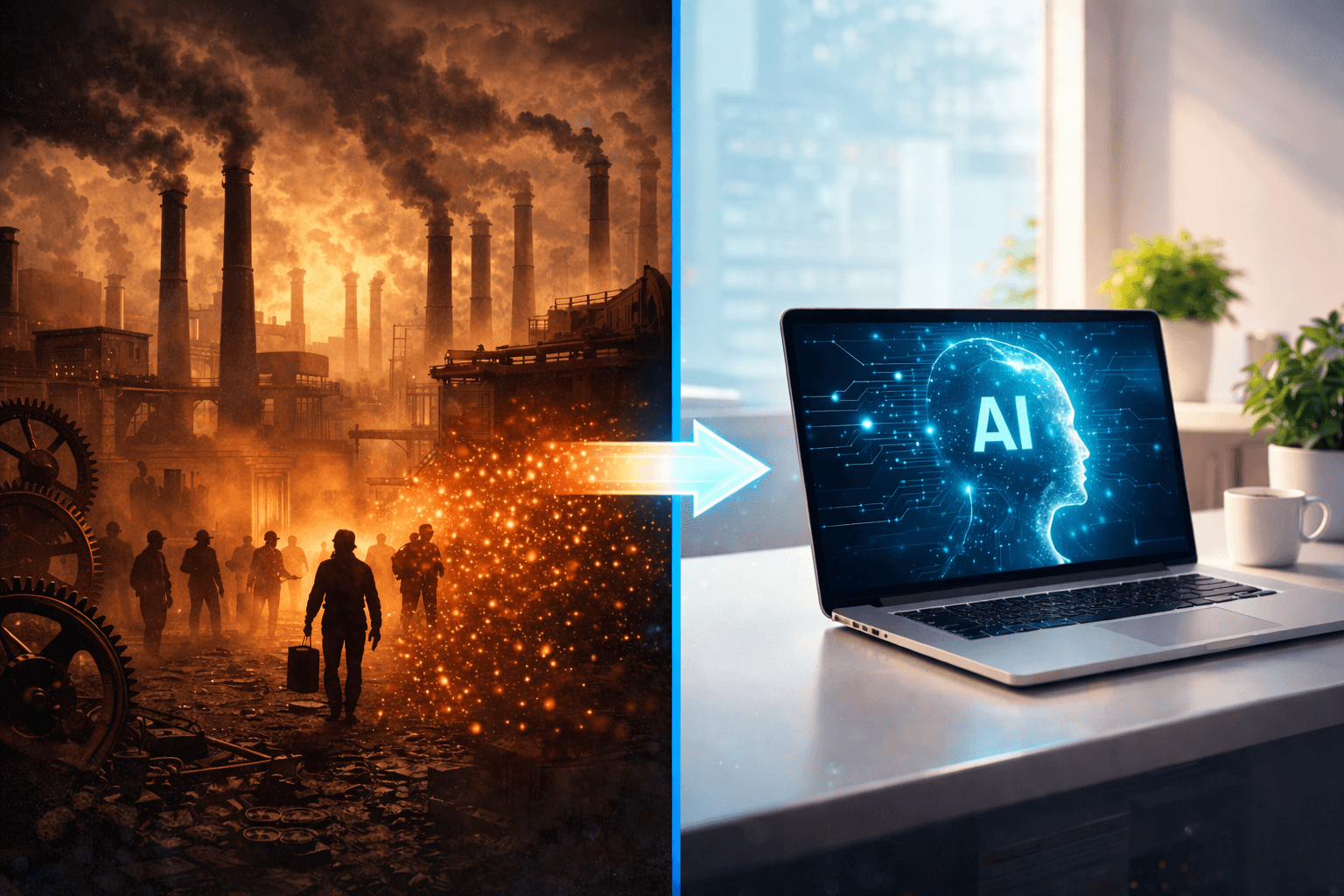
Every major technological shift follows the same script. New technology arrives. People panic. Jobs disappear. New jobs appear. The people who adapt early win. The people who resist get left behind. And the people who were already in power mostly stay in power.
The Industrial Revolution mechanized muscle. Machines replaced what human bodies could do. Spinning, weaving, lifting, hauling. If your job was physical labor, a machine could probably do it faster and cheaper.
The AI revolution is mechanizing thought. AI replaces what human minds do. Writing, analyzing, organizing, deciding, coding. If your job is information work, AI can probably do parts of it faster and cheaper.
Same pattern. Different target.
But This Time the Barrier Is Gone
The Industrial Revolution required capital. You needed a factory. You needed machines. You needed raw materials and supply chains and workers to operate everything. The barrier to entry was enormous. That's why the Industrial Revolution mostly benefited people who already had money. Factory owners got richer. Workers got displaced, then slowly absorbed into new roles over decades.
The AI revolution requires a laptop and an internet connection.
That's not an exaggeration. I'm one developer. I built a lead generation platform with 1.4 million records across 15+ states. I built a personal AI assistant that manages my schedule, finances, and daily operations. I built an educational platform. All with AI tooling, from a desk in Idaho.
No factory. No investors. No team of 50. Just me and the tools that exist right now.
The Industrial Revolution concentrated power. The AI revolution distributes it. Anyone who learns to use these tools can build things that would have required an entire company five years ago. That's not how the last revolution worked. That's new.
The Numbers
The scale of what's happening is hard to overstate.
AI has already created 1.3 million new jobs in just two years, according to LinkedIn data. Roles like AI Engineer grew 143% year over year. Prompt Engineer grew 135%. These jobs didn't exist three years ago.
AI-related business investment surged 18% in the first half of 2025, contributing over 1 percentage point to GDP growth. PwC projects AI adoption could boost global GDP by 15 percentage points over the next decade.
The World Economic Forum estimates 97 million new jobs will be created by AI globally. Not eventually. Now.
For comparison, the Industrial Revolution's job creation played out over 100 years. The information revolution took about 40. The AI revolution is compressing that same cycle into 10 to 20 years.
What the Luddites Got Right
Here's the part most people miss about the Luddites. They weren't wrong that the machines would destroy their livelihoods. They were right. Hand spinning employed up to 20% of women and children in 1770s Britain. Within decades, machines did the same work with a tenth or a hundredth of the labor. Those jobs were gone and they weren't coming back.
The Luddites were wrong about one thing: they thought destroying the machines would solve the problem. It didn't. The British government made machine-breaking a capital crime in 1812. Some Luddites were executed. The machines stayed.
The lesson isn't "don't worry, technology always works out." It doesn't always work out for everyone. The lesson is that fighting the technology is never the winning move. The winning move is learning to use it before your competition does.
The textile workers who learned to operate the new machines kept working. The ones who learned to maintain and repair them did even better. The ones who learned to build them became the next generation of entrepreneurs.
The same thing is happening right now with AI. The people learning to use these tools are pulling ahead. The people waiting for things to "settle down" are falling behind. And the gap is widening fast.
The Opportunity Window
During the Industrial Revolution, there was a window. A period where the old economy was dying and the new one hadn't fully formed yet. In that window, people with initiative could build something from nothing. General stores, repair shops, manufacturing operations, entire supply chains. The people who moved during that window became the establishment of the next era.
We're in that window right now.
AI tools are powerful but underutilized. Most businesses haven't adopted them yet. Most workers don't know how to use them beyond asking ChatGPT to write an email. The gap between "what's possible" and "what's being done" is massive.
That gap is the opportunity.
If you're a small business owner, the AI tools available today can give you capabilities that only Fortune 500 companies had five years ago. Automated lead generation. Intelligent customer follow-up. Real-time analytics. Custom software built in days instead of months. The playing field hasn't just leveled. It's tilted in favor of small, fast operators who adopt early.
If you're a worker, the premium on AI skills is real and growing. Workers with AI literacy command significantly higher wages. A 70% year-over-year increase in US job postings require AI skills. Learning to work with AI isn't optional anymore. It's the new version of learning to use a computer in the 1990s. Except the timeline is compressed and the stakes are higher.
The Real Difference
The Industrial Revolution took a century to fully transform society. It displaced millions of workers who had to find new roles in an economy that was slowly building itself. The transition was brutal for a lot of people. Poverty, exploitation, child labor, dangerous working conditions. It took decades of labor movements and regulation to make the new economy work for regular people.
The AI revolution is moving faster, but with one critical advantage: the tools are accessible to everyone. You don't need to own a factory. You don't need capital. You don't need permission from an employer to start learning.
The Industrial Revolution asked: do you have money? If yes, you could build a factory and profit. If no, you worked in someone else's factory.
The AI revolution asks: are you willing to learn? If yes, you can build things that were impossible for a single person to build before. The answer to that question is entirely up to you.
The machines are here. They're not going away. The only question is whether you learn to use them or watch someone else do it first.