You Don't Have a Spotlight in Your Head
Attention isn't a beam that illuminates the world. It's a volume knob that controls which prediction errors your brain takes seriously.
The most famous psychology experiment of all time involves a gorilla.
In 1999, Daniel Simons and Christopher Chabris at Harvard asked people to watch a video of two teams passing a basketball. Count the passes by the team in white. Halfway through, a person in a gorilla suit walks into frame, beats their chest, and walks off.
About half the participants didn't see it.
Not "didn't notice" in the vague sense. They genuinely did not perceive a gorilla standing in the middle of their visual field for nine full seconds. When told afterward, some accused the researchers of switching the video.
The standard explanation. Attention works like a spotlight. You point it at the basketball, and the gorilla falls outside the beam. Clean metaphor. Easy to picture.
It's also wrong.
Precision, Not Spotlights
The predictive processing framework gives a better answer. Your brain isn't shining a light on some things and leaving others in darkness. It's adjusting the volume on different channels of prediction error.
Harriet Feldman and Karl Friston laid this out in their 2010 paper "Attention, Uncertainty, and Free-Energy." Attention is precision-weighting on prediction errors. When you "pay attention" to something, you're turning up the gain on errors from that source. Those errors hit harder. They update your model more aggressively.
When you're not paying attention, the errors from that source still exist. Your brain just assigns them low precision, so they barely register.
The gorilla data was hitting your retina the whole time. Your visual cortex was generating prediction errors about it. But because your precision-weighting was cranked up on "white shirts passing a basketball" and cranked down on everything else, those errors never reached the threshold for conscious updating.
The data was there. The weight wasn't.
Andy Clark calls this one of the most counterintuitive implications of the predictive brain in "The Experience Machine." You don't miss things because they're filtered out before they reach you. You miss them because your brain decides, in real time, how seriously to take each stream of error. Attention isn't selection. It's prioritization.
Your Name in a Crowded Room
Now flip it. Loud party. Multiple conversations. Music. You're deep in a discussion and paying zero attention to the group behind you.
Then someone in that group says your name.
You hear it instantly. Like a switch flipped.
Colin Moray demonstrated this in 1959 at the Quarterly Journal of Experimental Psychology. He had people listen to different audio in each ear and focus on only one channel. About 33% of participants detected their own name in the unattended channel. Almost no one detected any other word.
The spotlight model has no good answer for this. If attention is a beam pointed at one ear, how does information from the other ear get through?
Precision-weighting handles it cleanly. Your brain maintains certain priors at permanently high precision. Your name is one. It's been reinforced tens of thousands of times since childhood. Even when you're allocating low precision to background noise, name-related errors carry enough baseline weight to break through.
You didn't "hear through the filter." There was no filter. Your brain just has a few channels that never fully turn down.
The Volume Knob Theory of Focus
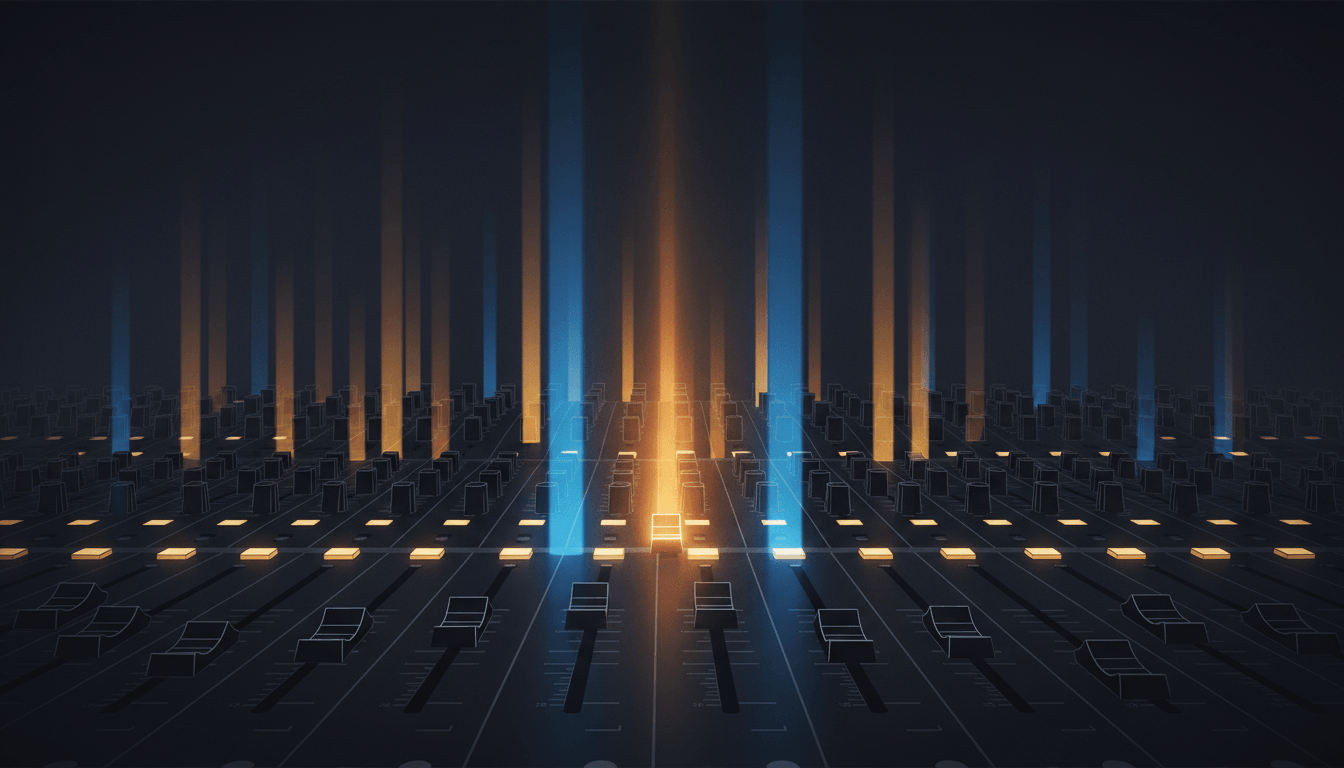
Think of your sensory experience as a massive mixing board. Hundreds of channels, all live. Visual data, sounds, touch, temperature, proprioception. All of it, all the time.
Attention is your brain's precision-weighting system adjusting the faders. Some channels get boosted, their errors drive real updates to your world model. Others get pushed to near-zero, their errors technically there but functionally irrelevant.
Jakob Hohwy frames this in "The Predictive Mind" as the brain's solution to an impossible problem. You can't process everything at full resolution. The computational cost would be absurd. So instead of filtering data out, you adjust how much each stream matters. Cheap, flexible, shiftable in milliseconds.
Anil Seth pushes it further in "Being You." Precision-weighting doesn't just control what you notice. It controls what you consciously experience. The gorilla isn't just unnoticed. For all practical purposes, it doesn't exist in your experience.
ADHD Is a Precision Problem
This framework reframes attention disorders.
ADHD isn't a broken spotlight. It's dysregulated precision-weighting. The brain has trouble holding high precision on task-relevant errors and keeps inappropriately boosting task-irrelevant ones.
You're trying to read a document. High precision should be on the text. Low precision on the ambient sounds, the chair, the notification that just popped up on your phone.
In ADHD, those weights keep shifting. The notification. The chair feeling. The conversation in the next room. All of them grabbing sudden precision boosts. Not because the person isn't trying to focus. Because the precision-weighting system isn't holding its settings.
Rebecca Lawson, Christoph Mathys, and Geraint Rees published computational evidence for atypical precision-weighting in a 2017 Nature Neuroscience paper. The study focused on autism, where adults overestimate sensory volatility. The same Bayesian framework applies to ADHD, but inverted. Not rigid precision, but volatile precision.
Dopamine is the link. Wolfram Schultz's landmark 1997 Science paper showed that dopamine neurons don't just signal reward. They signal prediction error. Dopamine encodes the difference between what you expected and what happened.
If dopamine is the currency of precision-weighting, then ADHD, which involves disrupted dopamine signaling, is literally a disorder of how the brain assigns importance to prediction errors.
That's why stimulants work. Ritalin and Adderall aren't vaguely "helping you focus." They're restoring the brain's ability to maintain precision-weighting. Keep task-relevant errors loud. Keep task-irrelevant errors quiet.
Meditation as Precision Training
Karl Friston's free-energy principle predicts that any system minimizing surprise should be able to improve its precision-weighting with practice. Meditation research bears that out.
Norman Farb and colleagues found in a 2007 Social Cognitive and Affective Neuroscience paper that mindfulness meditation shifted activity between two neural networks for self-reference. Meditators could decouple from the "narrative self" network (the one chewing on past and future) and engage the "experiential self" network (the one processing present-moment sensory data).
In precision-weighting terms, meditation trains you to manually adjust which errors get high precision. Boost the breath. Reduce the thought stream. Over and over. The mental equivalent of practicing scales. Antoine Lutz and colleagues confirmed this in a 2008 Trends in Cognitive Sciences review, finding long-term meditators showed enhanced ability to allocate and sustain precision on chosen targets.
I've noticed it in my own practice. Meditation doesn't empty your mind. The background channels don't go silent. You just get better at keeping the faders where you want them. Thoughts still come. You stop turning up their volume.
What This Changes
The spotlight metaphor made attention feel mysterious. Some force in your head shining a beam, and you either had control of it or you didn't.
Precision-weighting makes it mechanical. Your brain is running a mixing board. Every channel is always live. Attention is just the gain settings. Some automatic (your name), some trained (meditation), some chemically regulated (dopamine), some disordered (ADHD, anxiety).
Understanding the mechanism doesn't hand you instant control. But it tells you where the knobs are. And that your brain isn't broken when the gorilla walks by unnoticed. It's just running the mix you asked for.
Sources
- Gorillas in Our Midst: Sustained Inattentional Blindness for Dynamic Events (Simons & Chabris, 1999, Perception) (opens in new tab)
- Attention, Uncertainty, and Free-Energy (Feldman & Friston, 2010, Frontiers in Human Neuroscience) (opens in new tab)
- A Theory of Cortical Responses (Friston, 2005, Philosophical Transactions of the Royal Society B) (opens in new tab)
- Adults with Autism Overestimate the Volatility of the Sensory Environment (Lawson, Mathys & Rees, 2017, Nature Neuroscience) (opens in new tab)
- A Neural Substrate of Prediction and Reward (Schultz, 1997, Science) (opens in new tab)
- Attending to the Present: Mindfulness Meditation Reveals Distinct Neural Modes of Self-Reference (Farb et al., 2007, Social Cognitive and Affective Neuroscience) (opens in new tab)
- Attention Regulation and Monitoring in Meditation (Lutz et al., 2008, Trends in Cognitive Sciences) (opens in new tab)
- The Experience Machine: How Our Minds Predict and Shape Reality (Clark, 2023, Pantheon) (opens in new tab)
- The Predictive Mind (Hohwy, 2013, Oxford University Press) (opens in new tab)
- Being You: A New Science of Consciousness (Seth, 2021, Dutton) (opens in new tab)
- Some Effects of Unattended Messages: A Revision (Moray, 1959, Quarterly Journal of Experimental Psychology) (opens in new tab)
Part of the Prediction Machine series. Previous: Your Brain on Psychedelics Is Your Brain with the Filter Off. Next: You Are a Hallucination You Tell Yourself.