Why Forest Networks and the Internet Have the Same Shape
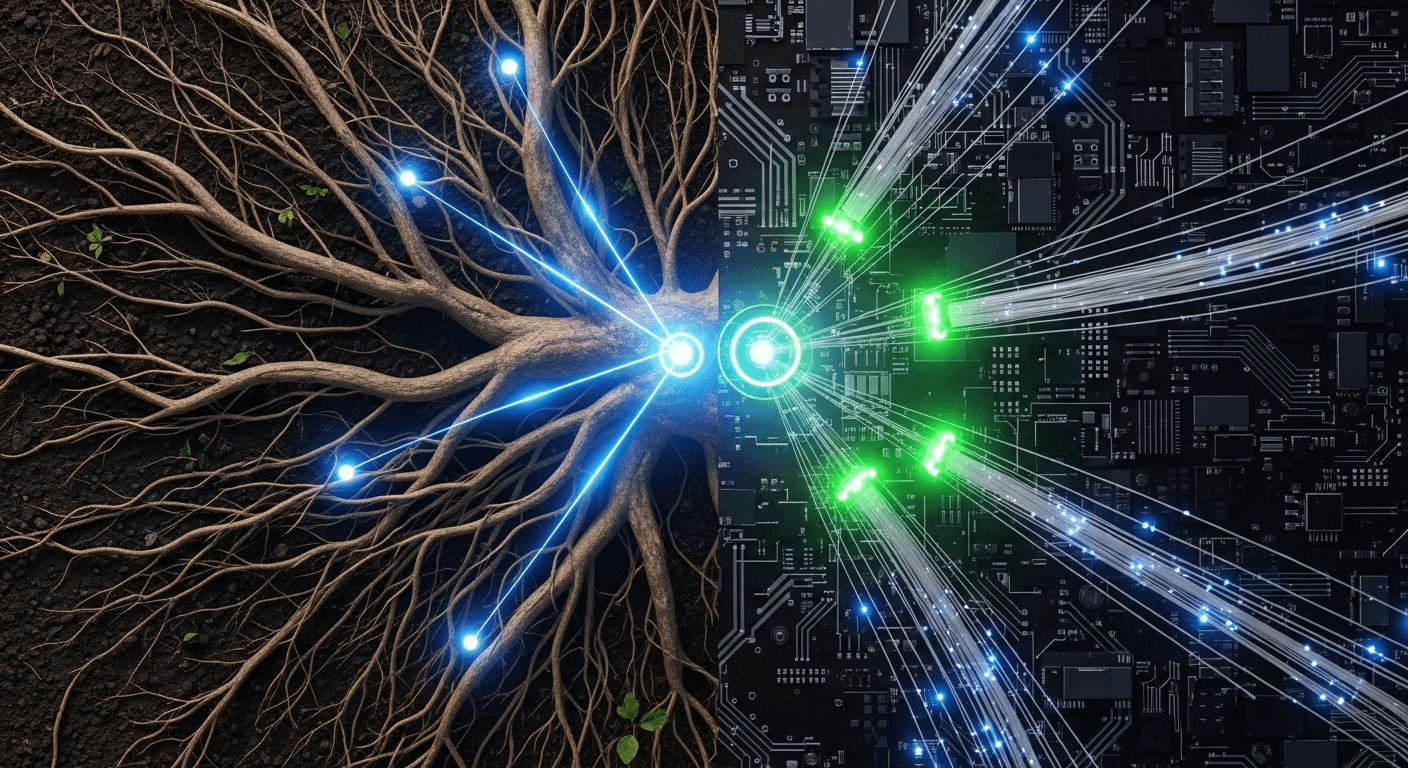
Nodes, edges, hubs, redundancy, adaptive routing. Both systems evolved the same architecture independently. That's not a metaphor. That's convergent engineering.
Strip both systems down to graph theory and the analogy becomes almost uncomfortably clean.
Nodes. Edges. Hubs with high degree. Long-tail distribution of connections. Short paths between distant points. Redundancy. Failure modes that cluster around high-degree connectors.
That is the internet. That is also a mapped forest mycorrhizal network.
What the Graph Looks Like Underground
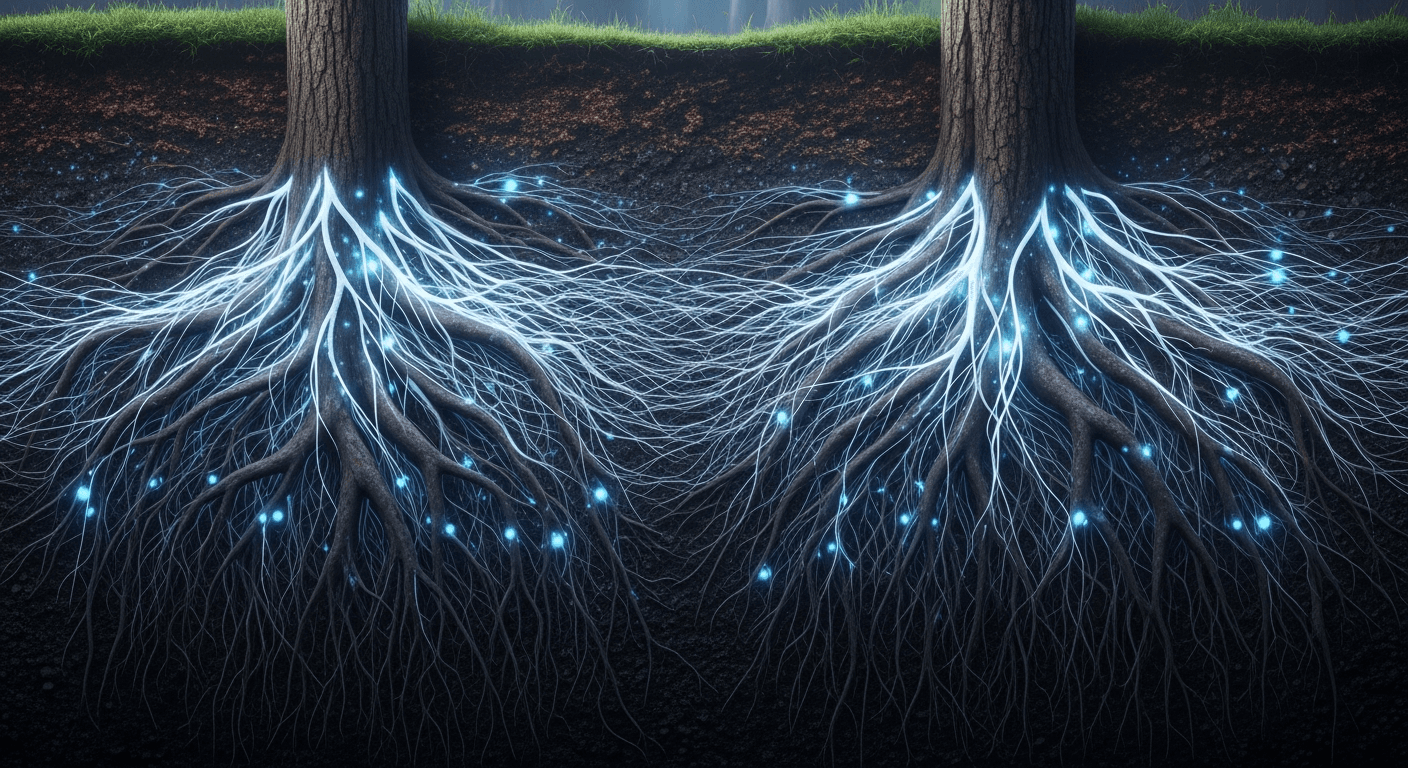
In a forest network, the nodes are individual plants, root tips, and fungal genets. The edges are the mycorrhizal links capable of moving carbon, water, nutrients, or chemical signals. Some edges are strong, carrying more material more often. Some are weak. Some are transient, depending on season and fungal lifecycle. Node degree is how many partners any given tree or fungal individual connects to.
When Beiler and colleagues mapped the ectomycorrhizal network connecting Douglas-fir trees in British Columbia in 2010, they found exactly what network scientists call a small-world, scale-free structure. A few nodes with very high degree. Many nodes with low degree. Short average path lengths between any two points. The internet has these same properties. So do airline routes, power grids, and social networks.
That architecture is not accidental in either case. It emerges when systems face the same optimization pressure: move things between many distributed points efficiently, without a central coordinator, while staying resilient to random failures.
Evolution found this solution hundreds of millions of years ago. Engineers found it in the 1960s.
The Multiplex Reality
The internet is not one network. It is a network of networks. Autonomous systems, internet service providers, peering arrangements, and CDN edges all layer on top of each other. One physical cable can carry traffic for a dozen different logical networks simultaneously.
Forests work the same way. One tree can be simultaneously connected to multiple fungal genets. Different fungal species can colonize the same root system. A forest stand is not one CMN but overlapping subnetworks with different topologies, different partner identities, and different transfer dynamics.
In network science terms, forests are multiplex systems. Analyzing them as one flat graph misses the structure. The layers interact and they can conflict. One fungal species may route carbon differently than another colonizing the same tree.
Where the Routing Analogy Gets Precise
A 2025 Nature study on arbuscular mycorrhizal fungal networks found that mycelium grows across host roots using a traveling-wave strategy. Rather than filling all available space evenly, the fungus expands in a wave pattern that balances exploration against maintenance cost. Network density stays below a ceiling that appears to be under fungal control.
That is not static plumbing. That is adaptive mesh provisioning. The infrastructure expands where returns justify expansion and pulls back where they do not.
In internet terms, this looks less like a fixed cable map and more like a software-defined network that dynamically allocates bandwidth based on demand signals. The topology changes with conditions.
The Layered Model
If you want a more precise parallel than "forest = internet," this is closer to accurate:
The fungal mycelium is the physical layer. It is the cable, the fiber, the copper. It carries everything but it is not neutral. It takes a metabolic fee from everything that moves through it.
Carbon and nutrient flows are the transport layer. Resources moving from source to sink based on concentration gradients, fungal routing decisions, and host demand.
Defense chemical signaling is the messaging layer. State information propagating through the network to connected nodes without any node having a global view.
Ecological feedback is the control plane. The network configuration changes over time based on which connections pay off, which hosts are stressed, which fungi outcompete others, and how disturbance reshapes the whole system.
That is a real systems architecture, not just a poetic comparison.
Where It Breaks Down
Packet addressing does not exist underground. The internet sends discrete, digitally addressed packets with headers, checksums, and acknowledgment protocols. Forest networks move analog gradients. Carbon flows down concentration differences. Water follows hydraulic pressure. There is no equivalent of an IP address.
The timescales are completely different. Internet packets move at fractions of a second. Forest resource transfers happen over hours, days, or seasons.
And the cost structure is reversed. In the internet, copying and routing data is nearly free. In forest networks, every transfer is metabolically expensive and physically embodied. The fungus does not move a carbon copy. It moves actual carbon, which it partly keeps.
These differences matter because they tell you what problems each system actually solves. The internet optimizes for speed, precision, and addressability. Forest networks optimize for resilience, cost-sharing, and long-run mutualism under uncertainty.
Same architecture. Different engineering priorities. Both shaped by what failure costs the system.
Sources
- Beiler, K. J. et al. "Architecture of the wood-wide web: Rhizopogon spp. genets link multiple Douglas-fir cohorts." New Phytologist 185(2), 543-553 (2010). (opens in new tab)
- Simard, S. W. et al. "Mycorrhizal networks: mechanisms, ecology and modelling." Fungal Biology Reviews 26(1), 39-60 (2012). (opens in new tab)
- "Traveling-wave strategy enables efficient resource acquisition of arbuscular mycorrhizal networks." Nature (2025). (opens in new tab)
Part of the Wood Wide Web series. Previous: The Woman Who Found the Forest's Hidden Hubs. Next: Trees Don't Talk. They Do Something More Interesting..