Trees Don't Actually Talk... Or Do They?
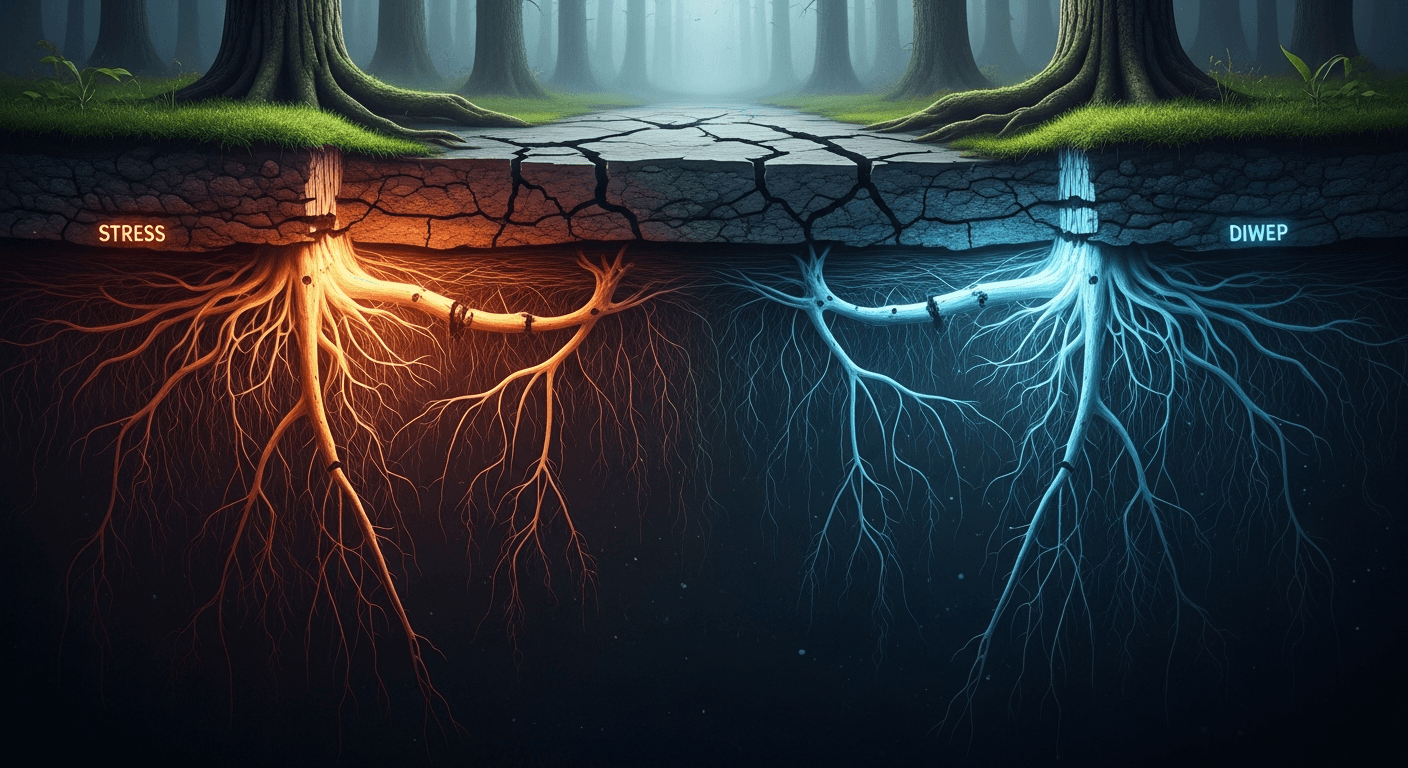
Plants exchange defense signals, carbon, and possibly electrical spikes through shared fungal networks. It's not language. But it's not nothing either.
"Trees are talking to each other underground."
You've heard some version of this. It's everywhere now. Documentaries, pop science books, TED talks. And like most headlines that feel too good, it's both more accurate and more wrong than it sounds.
Trees aren't talking. But what they're actually doing is strange enough that "talking" is almost forgivable as shorthand.
What's Actually Moving Through the Network
The strongest evidence is for two things: resource transfer and defense priming.
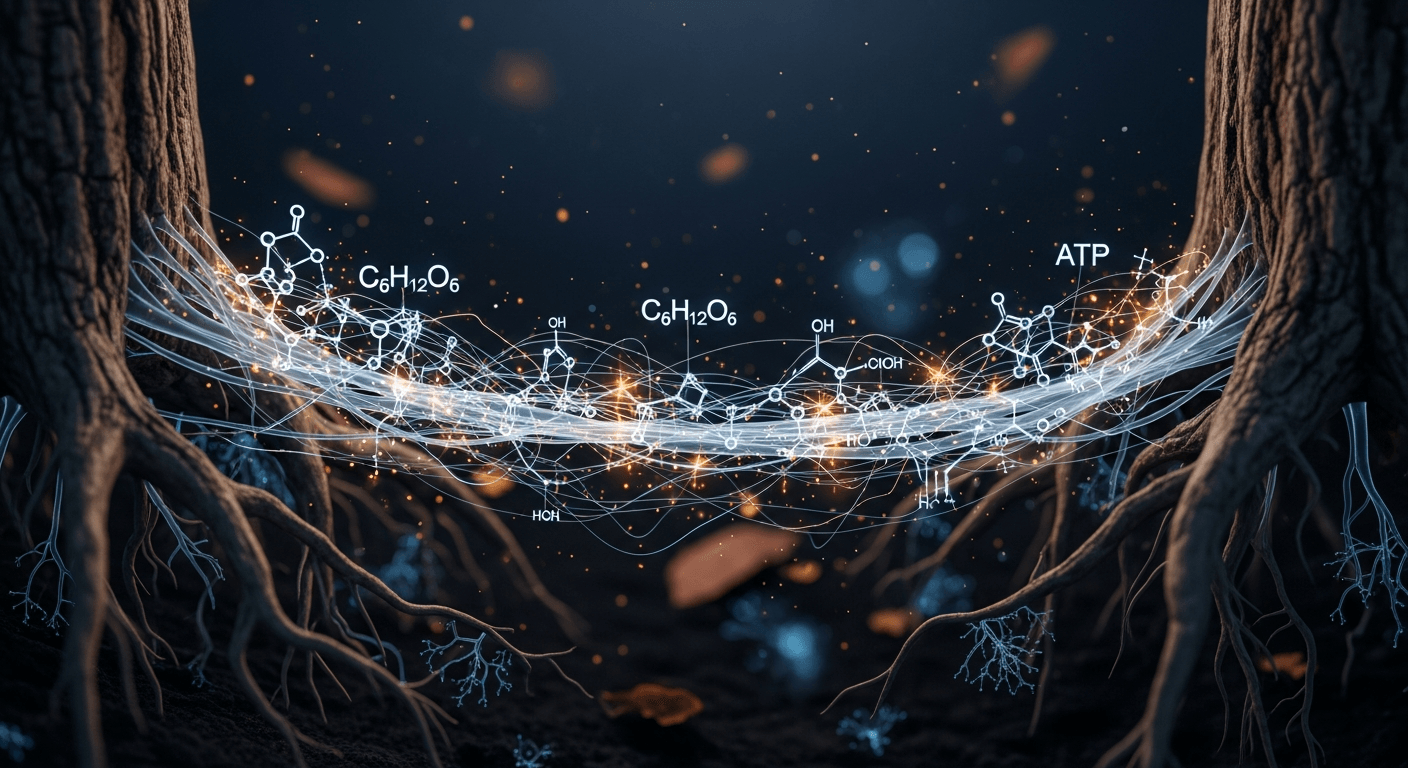
Resource transfer is the less controversial one. Carbon, phosphorus, nitrogen, and water move between connected plants through shared fungal networks. This has been measured in dozens of studies using isotopic tracers. You label one plant's carbon with a distinctive isotope, and eventually you find it in a neighboring plant that shares a fungal partner. The mechanism is real.
Defense priming is where things get more interesting.
In 2013, Zdenka Babikova and colleagues ran an experiment with broad bean plants connected by common mycelial networks. When aphids attacked one plant, the connected but unaffected neighbors changed their behavior. They increased production of volatile compounds that repel aphids and attract the wasps that eat aphids. The aphid attack hadn't reached them. The signal had.
That is not symbolic communication. It is closer to what distributed systems engineers call state propagation. One node's status changed the probability distribution of behavior in neighboring nodes before those neighbors encountered the threat themselves.
In 2014, a team led by Yuan-Yuan Song showed the same dynamic in tomatoes through arbuscular mycorrhizal networks. Herbivore or pathogen attack on one plant triggered defense-related changes in connected neighbors. In 2015, Song's group extended this to ectomycorrhizal tree systems: defoliation of Douglas-fir altered carbon transfer and induced stress-related responses in connected ponderosa pine.
What "Warning" Actually Means Here
The pop-science version has trees "warning" each other, implying intention. The biology is less romantic and more interesting.
When a plant is under attack, its chemistry changes. It ramps up production of certain compounds, shifts carbon allocation, modifies root exudates. Those changes propagate through the shared fungal network. A neighboring plant receives different chemistry at its roots than it would have otherwise. That altered chemistry can trigger its own defensive response.
No message was sent. No intention was involved. The network changed state in one place, and that change cascaded through connected nodes.
In cybersecurity terms, it looks like a warning packet that triggers local hardening. But there is no packet. There is no protocol. There is gradient-driven chemistry moving through a wet carbon substrate.
The result, a network-wide shift toward defensive states following a local attack, is functionally similar to what we'd call information propagation in digital systems. The implementation is completely different.
The Electrical Frontier
Carbon and chemistry are settled. What comes next is not.
Plants generate electrical signals. Fungi also produce electrical spikes, measurable voltage changes that propagate through mycelial networks. Andrew Adamatzky at the University of the West of England has spent years measuring these signals in living fungal cultures. His work shows that fungal networks produce spike trains whose patterns vary with environmental conditions: temperature, chemical exposure, touch, light.
In 2023, a paper in BioSystems made the case that living fungal networks behave as hybrid sensing-computing materials, capable of transforming environmental input into patterned electrical output. In 2024, Adamatzky's group demonstrated that electrophysiological signals from fungal mycelia could be used to drive sensorimotor control of a biohybrid robot.
The question that forest ecology hasn't answered yet is whether those electrical signals do anything meaningful in the context of trees sharing a mycorrhizal network. Can plant-generated electrical signals propagate through fungal hyphae to a neighboring root system in a way that produces a detectable response?
The honest answer is: plausible, actively investigated, not established to the same standard as carbon transfer or chemical defense signaling.
Adamatzky himself has been careful about this. The lab work on fungal electrophysiology is real. The ecological application to forest communication is a hypothesis with supporting evidence, not a confirmed mechanism.
What This Changes
Even without the electrical layer, what's established is already significant.
Forests aren't just assemblages of competing individuals. Connected plants share information-carrying chemistry in ways that can change each other's defensive behavior before a threat arrives. The network has emergent properties. Attack one node, and the rest aren't oblivious.
This should change how we think about forest resilience to pests and pathogens. A healthy, well-connected forest may be more collectively resistant than a fragmented one, not because trees are altruistic, but because network structure determines how widely a defense-priming signal can propagate before the threat does.
It also changes what "communication" means.
We tend to think of communication as intentional, symbolic, and quick. What forests do is none of those things. It's gradient-driven, chemical, and slow. But it achieves a recognizable function: changing the state of distant nodes based on local conditions.
If that's not communication, it's something close enough that the word isn't completely wrong. Just incomplete.
Sources
- Babikova, Z. et al. "Underground signals carried through common mycelial networks warn neighbouring plants of aphid attack." Ecology Letters 16(7), 835-843 (2013). (opens in new tab)
- Song, Y. Y. et al. "Interplant communication of tomato plants through underground common mycorrhizal networks." PLoS ONE 9(10): e108644 (2014). (opens in new tab)
- Song, Y. Y. et al. "Defoliation of interior Douglas-fir elicits carbon transfer and stress signalling to ponderosa pine neighbors through ectomycorrhizal networks." Scientific Reports 5, 8495 (2015). (opens in new tab)
- Mayne, R. et al. "Propagation of electrical signals by fungi." BioSystems 229, 104933 (2023). (opens in new tab)
- Mishra, A. K. et al. "Sensorimotor control of robots mediated by electrophysiological measurements of fungal mycelia." Science Robotics 9(93) (2024). (opens in new tab)
Part of the Wood Wide Web series. Previous: Why Forest Networks and the Internet Have the Same Shape. Next: Two Different Trees, One Network.