A Marketplace - Not a Charity, The Reality of Nature
The wood wide web story got away from the science. Forests have cooperation and competition. Fungi are economic actors. Kin effects are real but small. Here's what the data actually says.
The story went like this: forests are secret socialist communities. Trees share their carbon. Mother trees nurture their children. The wood wide web is a gift economy running underground.
It's a beautiful story. Parts of it are real.
The version that got popular is not.
What Toby Kiers Found
In 2011, Toby Kiers and colleagues published a paper in Science that should have tempered every "forests are generous" take immediately.
Kiers studied mycorrhizal exchange experimentally and found that the system runs on negotiated trade, not altruism. Plants reward fungal partners that deliver more phosphorus with more carbon. Fungi preferentially allocate resources to plant roots that pay more carbon. Both partners discriminate. Both sanction poor performers.
The phrase that stuck from the paper: "reciprocal rewards stabilize cooperation." Cooperation is real. But it's stabilized by incentives, not generosity. The moment a partner cheats, the other side notices and responds.
That is not a sharing economy. That is a market.
A biological market with switching costs, information asymmetry, and context-dependent contracts. But a market. The fungi are economic actors. The plants are economic actors. They cooperate because the terms are favorable, and the terms stay favorable because both sides can punish defection.
The Fungus Is Not a Cable
This is the part that gets missed most often in popular coverage.
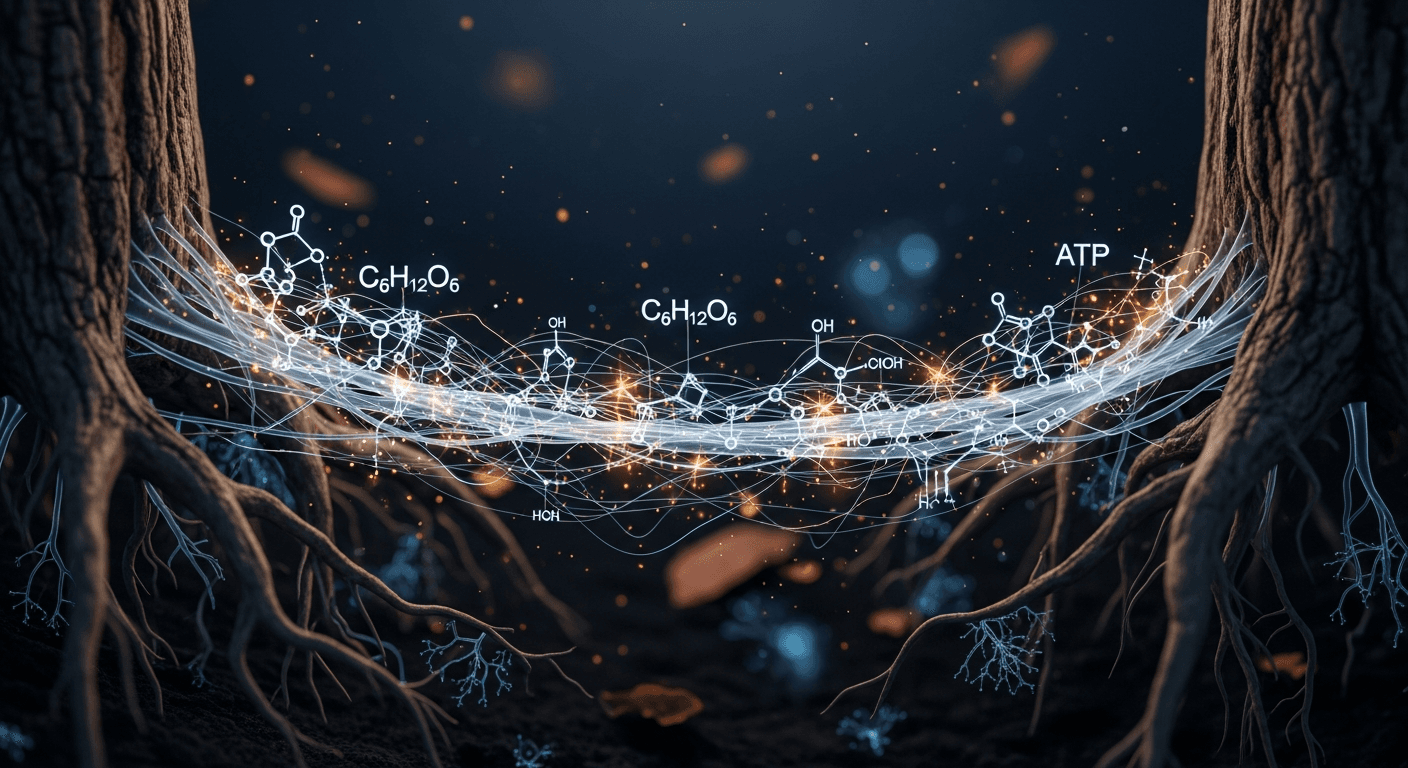
The fungal network is not neutral infrastructure. It is a participant. The fungi take a cut of everything that flows through them.
In the Pickles 2017 study on Douglas-fir seedlings, fungal lipids accounted for 60-70% of the enriched phospholipids after carbon was traced through the network. Most of the carbon that entered the system stayed in fungal biomass. The plants were not using a free relay service. They were paying a significant fee to a network operator that retains more than it passes on.
This changes the moral arithmetic of the wood wide web completely. The fungi are not doing trees a favor. They are running a profitable intermediary business. The carbon transfer between trees that everyone finds so moving is, in large part, a byproduct of fungi pursuing their own growth and resource management.
That doesn't make the network less interesting. It makes it more interesting. A distributed network maintained by self-interested intermediaries that nonetheless produces system-level resource redistribution is a remarkable emergent phenomenon. It just doesn't need to be heroic to be remarkable.
Kin Recognition: Real, But Small
The kin recognition story is a good example of how careful you have to be with effect sizes.
Brian Pickles and colleagues found that in some family groups, Douglas-fir seedlings transferred roughly three to four times more carbon-13 to related seedlings than to unrelated ones. That sounds significant. And in two of four tested families, the effect was statistically real.
The absolute amount? About 4 micrograms of extra carbon-13. In a system where transfer is already tiny, an effect that size is real without being consequential at the forest scale. The authors said as much.
Also: the effect appeared in two of four families tested. Not universally. Kin recognition, where it exists, is conditional, context-dependent, and small.
The popular version of this finding became "trees recognize their children and send them extra resources." What the data shows is more like: "in some genetically similar pairs, under some conditions, we detected a slightly elevated transfer rate that was statistically distinguishable from background."
Both statements are technically true. Only one is accurate. And maybe some tree families just had shitty siblings.
Competition Never Left
Here is what the kumbaya narrative obscures: connected trees still compete.
They compete for light. They compete for water. They compete for soil nutrients outside the fungal network. The mycorrhizal connection does not create a truce. It creates a parallel channel. Both channels operate simultaneously.
In some conditions, competition may actually intensify through the network. A large, well-established tree with more connections can draw disproportionately from the shared system. A smaller, less connected neighbor might be at a disadvantage not just above ground but below it.
Karst, Jones, and Hoeksema made this point explicitly in their 2023 review in Nature Ecology & Evolution. Common mycorrhizal network research has accumulated a positive citation bias. Studies finding cooperative effects got cited and built upon. Studies finding no effect, or finding competition, got ignored. The published record looked warmer than the reality.
Their analysis didn't argue the networks don't exist or that they don't matter. They argued that the inference from "networks exist" to "forests are cooperative communities" jumped several steps that the evidence hadn't actually justified.
The Rigorous Position
Here's what the data supports.
Mycorrhizal networks facilitate transfer between connected plants. The direction and magnitude of transfer depend on source-sink dynamics, fungal identity, species composition, nutrient status, season, and relatedness in some cases.
Fungi are participants, not cables. They take more than they pass on. The trade is negotiated and conditional.
Cooperation and competition coexist in the same network at the same time. Some flows are facilitative. Some are exploitative. Most are both simultaneously, depending on which plant and which fungus you're measuring.
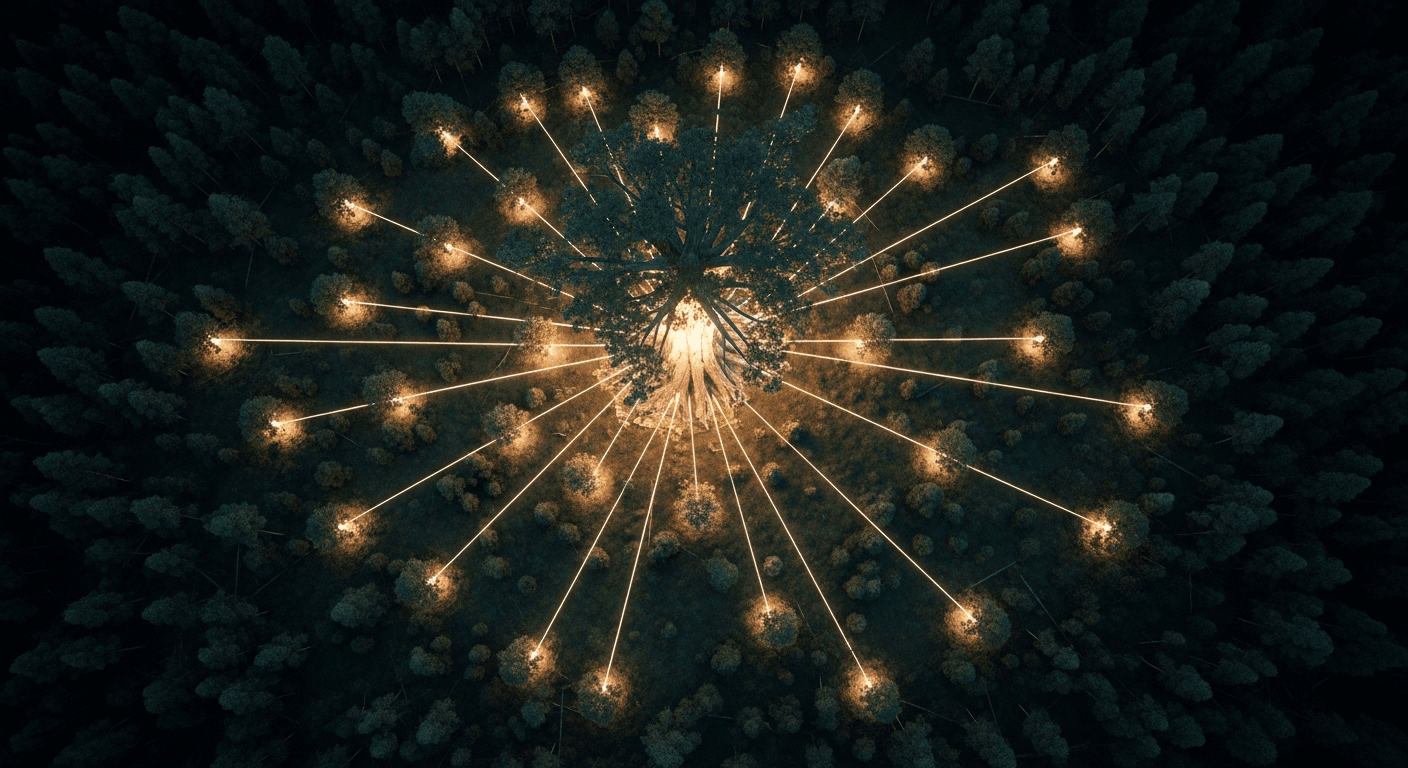
Hub nodes exist. Old trees are disproportionately connected. Their removal has structural consequences.
What the data doesn't support: forests as altruistic sharing communities with sentient elder trees making deliberate decisions to care for seedlings.
That story is satisfying because it reflects values we want to believe are natural. But it's not what's underground.
What's underground is messier and more realistic: a web of self-interested organisms whose interactions produce collective outcomes nobody planned, and whose cooperation is real precisely because it's conditional.
That's not less impressive. That's just honest.
Sources
- Kiers, E. T. et al. "Reciprocal rewards stabilize cooperation in the mycorrhizal symbiosis." Science 333(6044), 880-882 (2011). (opens in new tab)
- Pickles, B. J. et al. "Transfer of 13C between paired Douglas-fir seedlings reveals plant kinship effects and uptake of exudates by ectomycorrhizas." New Phytologist 214(1), 400-411 (2017). (opens in new tab)
- Karst, J., Jones, M. D., and Hoeksema, J. D. "Positive citation bias and overinterpreted results lead to misinformation on common mycorrhizal networks in forests." Nature Ecology & Evolution 7, 547-556 (2023). (opens in new tab)
- Beiler, K. J. et al. "Architecture of the wood-wide web: Rhizopogon spp. genets link multiple Douglas-fir cohorts." New Phytologist 185(2), 543-553 (2010). (opens in new tab)
Part of the Wood Wide Web series. Previous: Two Different Trees, One Network. Next: The Network That Predates Trees.