Your Body Has Two Stress Modes (One Builds You Up, One Breaks You Down)
The same stressor can trigger two completely different cardiovascular responses. The difference isn't the situation. It's how your brain appraises it.
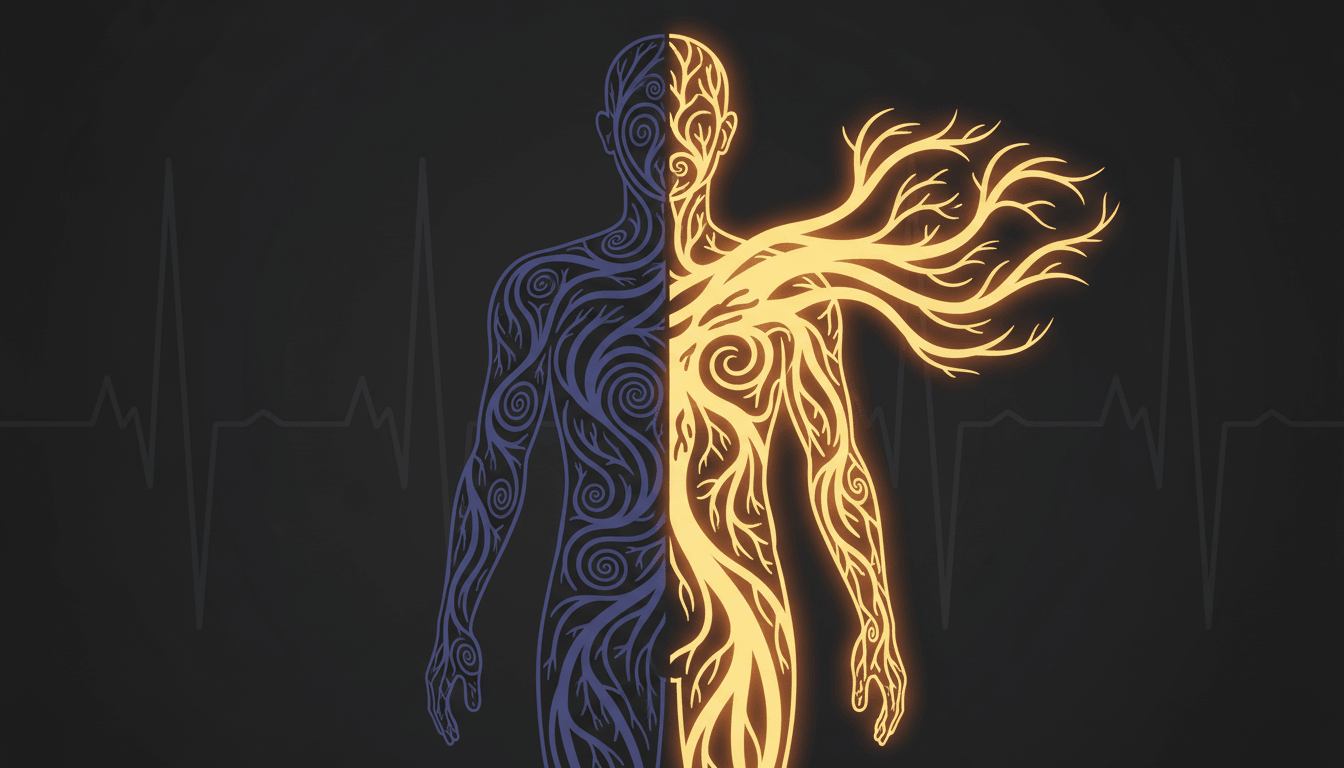
Your body doesn't have one stress response. It has two.
Same hormones. Same nervous system. Same person. But depending on how your brain reads the situation, your cardiovascular system does something completely different. One pattern looks like exercise. The other looks like heart disease.
Jim Blascovich and his team at UC Santa Barbara spent decades mapping this. Their Biopsychosocial Model of Challenge and Threat showed that "stressed" is not one thing. It's at least two things, and the difference between them is massive.
The Challenge State
When your brain decides you have the resources to handle what's in front of you, your body enters a challenge state. Your heart pumps harder and faster, increasing cardiac output. But here's the key part. Your blood vessels dilate. Total peripheral resistance drops.
More blood flow. Less constriction. Oxygen floods your muscles and brain efficiently. Your cardiovascular system looks almost identical to someone doing aerobic exercise.
On the hormonal side, cortisol rises. But so does DHEA, a neurosteroid linked to resilience, neural growth, and recovery. Researchers sometimes call the cortisol-to-DHEA ratio the "growth index." In a challenge state, that ratio favors DHEA. Your body is literally in a biochemical configuration that promotes growth.
The Threat State
When your brain decides the demands overwhelm your resources, everything flips. Cardiac output stays flat or drops. Blood vessels constrict. Peripheral resistance goes up.
Blood pressure spikes, but the oxygen delivery to your tissues is inefficient. Your body is working harder to accomplish less. The cortisol-to-DHEA ratio tips toward cortisol. This is the cardiovascular pattern associated with chronic disease, the one that shows up in studies linking "stress" to heart attacks and strokes.
Same person. Same stressor. Completely different biology.
The Variable Is Appraisal
Blascovich demonstrated this across hundreds of studies. Math tests. Athletic competition. Social evaluation. Public speaking. The stressor didn't determine the response. The person's appraisal of the stressor did.
When people evaluated their resources as sufficient to meet the demand ("I can handle this"), they entered a challenge state. When demands felt overwhelming ("This is too much"), they entered a threat state. The dividing line wasn't objective difficulty. It was perceived capacity.
Wendy Berry Mendes, who collaborated with Blascovich and now works at Yale, extended this into performance research. In a 2002 study, Mendes and colleagues showed that cardiovascular challenge responses during social interactions predicted better outcomes. Challenge states produced more flexible attention, better working memory, and superior decision-making. Threat states narrowed attention and impaired complex problem-solving.
In later work, Mendes found that people who showed challenge cardiovascular patterns during a speech task performed better and recovered faster afterward. Their cortisol came back to baseline quicker. The stress response cleaned itself up more efficiently when it ran in challenge mode.
This Changes What "Stress Management" Means
Most stress advice is about reduction. Breathe deeply. Meditate. Remove the stressor. Take a bath.
None of that is wrong. But it misses the more interesting lever.
If the same stressor can produce a growth-promoting cardiovascular response or a disease-promoting one, and the variable is how your brain appraises the situation, then the most powerful intervention isn't removing stress. It's changing appraisal.
Alia Crum at Stanford showed exactly this. In a 2013 study with Peter Salovey and Shawn Achor, Crum found that people's beliefs about stress, whether they viewed it as enhancing or debilitating, shaped their physiological responses. People with a "stress-is-enhancing" mindset showed more moderate cortisol responses and reported better performance under pressure. In a 2017 follow-up, Crum and colleagues demonstrated that stress mindset specifically influenced whether people showed challenge or threat cardiovascular patterns.
The belief changed the biology.
This connects directly to the Keller et al. study from 2012 that kicked off this series. Among the 28,753 adults they tracked, high stress only predicted increased mortality for people who also believed stress was harmful. The mechanism Blascovich and Mendes mapped, challenge versus threat appraisal, helps explain why. If you believe stress is damaging you, your brain is more likely to appraise stressful situations as threats. Threat appraisals produce the cardiovascular pattern that actually is damaging over time.
The belief becomes self-fulfilling.
Reappraisal Works Fast
Jeremy Jamieson at the University of Rochester ran one of the cleanest demonstrations of this. In a 2010 study, he had students about to take the GRE read a brief passage explaining that arousal during tests actually improves performance. That's it. Just a paragraph of information.
The students who read the reappraisal passage scored higher on the math section. Not by a little. Their salivary cortisol profiles shifted too. They showed the challenge pattern, not the threat pattern.
One paragraph of reframing. Measurable cardiovascular and performance changes.
Alison Wood Brooks at Harvard found something similar in 2014. She had people reappraise pre-performance anxiety as excitement. Not calm. Excitement. Saying "I am excited" instead of "I am anxious" before a stressful task improved performance across singing, public speaking, and math. The physiological arousal stayed the same. The appraisal changed. The performance changed.
This is not positive thinking. It's not pretending stress doesn't exist. The arousal is real. The cortisol is real. The sweating and the racing heart are real. But your brain's interpretation of that arousal, whether it means "I'm ready" or "I'm in danger," changes what happens next in your body at the vascular level.
What I Take From This
I used to interpret any stress response as a sign something was wrong. Heart rate up before a presentation? Bad. Nervous before shipping code? Problem. That interpretation wasn't neutral. It was actively pushing my body toward the threat pattern.
Now when I feel the arousal, I try to catch the appraisal. Not suppress the feeling. Redirect the interpretation. "This means my body is preparing to perform" instead of "This means something bad is about to happen."
It doesn't always work. The hardware still fires fast and the threat interpretation still shows up first sometimes. But the research from Blascovich, Mendes, Crum, Jamieson, and Brooks all points the same direction. The stress response is not one thing. Your interpretation is not decoration. It's a physiological lever that determines which cardiovascular program your body runs.
The goal was never to stop the stress response. The goal is to run the right version of it.
Sources
- Challenge and threat appraisals: The role of affective cues (Blascovich & Mendes, 2000)
- Challenge and threat during social interactions with White and Black men (Mendes, Blascovich, Lickel, & Hunter, 2002)
- Does the perception that stress affects health matter? The association with health and mortality (Keller et al., 2012)
- Rethinking stress: The role of mindsets in determining the stress response (Crum, Salovey, & Achor, 2013)
- The role of stress mindset in shaping cognitive, emotional, and physiological responses to challenging and threatening stress (Crum, Akinola, Martin, & Fath, 2017)
- Turning the knots in your stomach into bows: Reappraising arousal improves performance on the GRE (Jamieson, Mendes, Blackstock, & Schmader, 2010)
- Get excited: Reappraising pre-performance anxiety as excitement (Brooks, 2014)
- The Upside of Stress: Why Stress Is Good for You, and How to Get Good at It (McGonigal, 2015)
Part of the Stress Paradox series. Previous: 182,000 People May Have Died From a Belief. Next: The Stress Response Has a Built-In Repair System (You're Probably Not Using It).