Your Chronotype Isn't a Choice: You're Being Punished for Your Genetics
Whether you're a morning person or night owl is written into your DNA. Society treats one as virtuous and the other as lazy. The science says that's discrimination.
"Early to bed, early to rise, makes a man healthy, wealthy, and wise." Benjamin Franklin wrote that in 1735. Nearly 300 years later, we still treat it as moral truth.
It's not. It's genetic prejudice dressed up as a proverb.
In 2019, Samuel Jones and colleagues published one of the largest genetic studies ever conducted on sleep timing. They analyzed DNA and sleep data from 697,828 UK Biobank participants and identified 351 genetic loci associated with chronotype. Many of those genes are directly involved in the core molecular clock or in the retinal light-sensing pathways that entrain it.
351 locations in your genome. Not 351 lifestyle choices. Not 351 failures of discipline.
Whether you naturally wake at 5:30 AM or struggle to fall asleep before 1 AM is substantially hardwired. Heritability estimates for chronotype range from 12% to 42% depending on the study methodology. That's comparable to the heritability of BMI. Nobody calls overweight people lazy as a matter of official institutional policy. But we do exactly that to late chronotypes.
The Clock Genes Behind Your Wake Time
The molecular machinery that sets your internal time was first mapped in fruit flies. Jeffrey Hall, Michael Rosbash, and Michael Young spent decades identifying the genes and feedback loops that generate circadian rhythms in Drosophila. Their work on the period and timeless genes revealed a transcription-translation feedback loop that takes roughly 24 hours to complete. They won the Nobel Prize for it in 2017.
The human versions of these genes do the same thing. And mutations in them produce dramatic results.
In 2001, Ying-Hui Fu's lab at UCSF identified a single point mutation in the hPer2 gene in a family with Familial Advanced Sleep Phase Syndrome. These people fall asleep around 7:30 PM and wake naturally at 4:30 AM. Not because they're disciplined. Because their clock protein gets phosphorylated faster than normal, shortening their entire circadian cycle.
One amino acid change. That's the difference between "admirable early riser" and "normal person."
Joseph Takahashi's lab took the opposite approach. They used forward genetics in mice to find the Clock gene by screening thousands of animals for abnormal circadian behavior. The mutant mice they found had cycles that ran long, drifting later and later. Not lazy mice. Mice with a different allele.
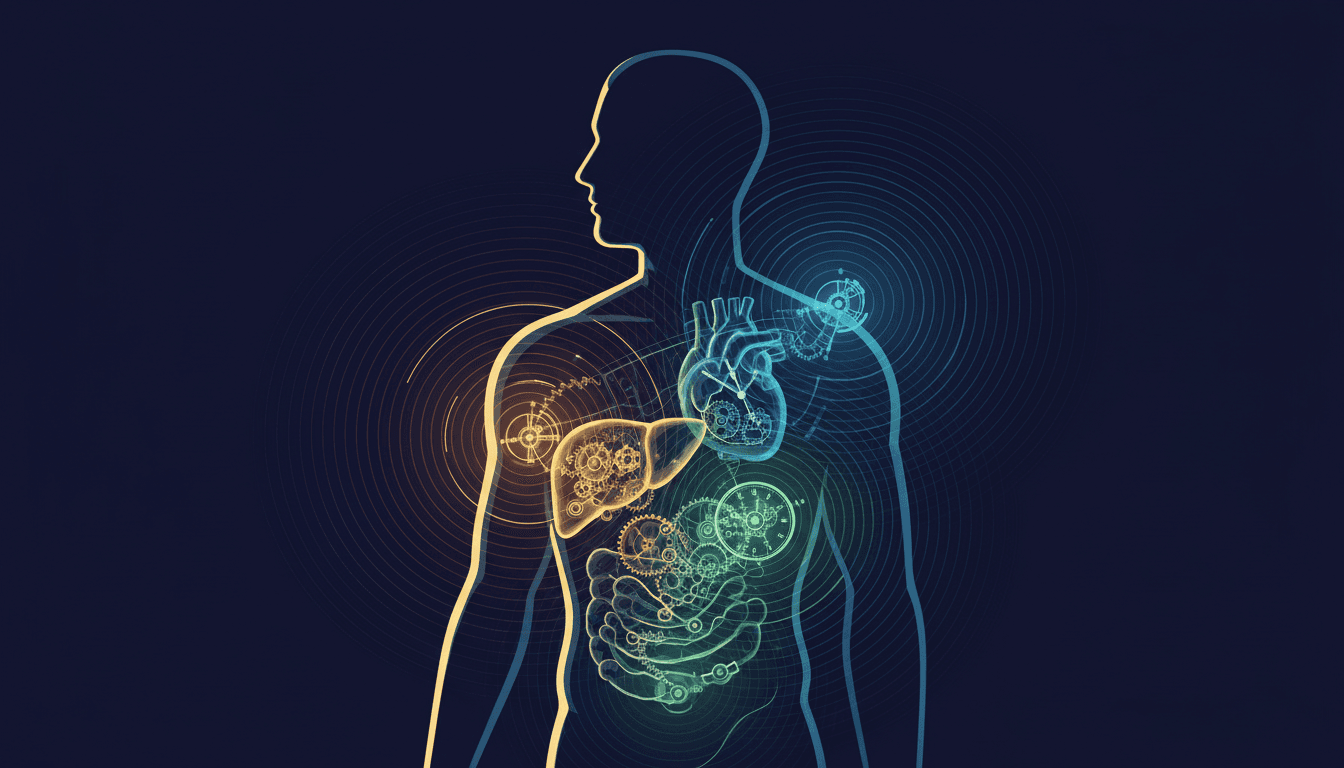
Satoshi Panda's 2002 study in Cell showed that the circadian clock doesn't just regulate sleep timing. It drives coordinated transcription of key metabolic pathways across organs. Your chronotype isn't just when you wake up. It's when your liver is ready to process food, when your immune system peaks, when your brain is primed for complex thought.
Forcing a late chronotype into an early schedule doesn't just cost them sleep. It misaligns every downstream process in their body.
The Teenage Problem
Chronotype isn't fixed across your life. It shifts predictably with age, and the data on this is massive.
Till Roenneberg, author of Internal Time and creator of the Munich Chronotype Questionnaire, collected sleep timing data from tens of thousands of people across the lifespan. The pattern is consistent. Children are early chronotypes. During puberty, the clock starts shifting later. It peaks in lateness around age 19-20 for women and 21 for men. Roenneberg actually uses this peak as a biological marker for the end of adolescence. Then it gradually shifts earlier for the rest of life.
This means a 16-year-old forced to start school at 7:30 AM is being asked to perform cognitively demanding work at the equivalent of 5:30 AM for a middle-aged adult.
We know this. The data is overwhelming. And we mostly ignore it.
The American Academy of Pediatrics recommended in 2014 that middle and high schools start no earlier than 8:30 AM. That was twelve years ago.
Kyla Wahlstrom at the University of Minnesota studied 9,000 students across 8 high schools in 3 states. When start times shifted from 7:35 AM to 8:55 AM, students got an average of one extra hour of sleep. Car crashes among 16-to-18-year-olds dropped by 65%. Attendance improved. Tardiness dropped. Grades went up.
In 2018, Gideon Dunster and colleagues published a study in Science Advances tracking Seattle public school students after the district delayed start times by 55 minutes. Students slept 34 minutes longer. Tardiness decreased. Grades improved by 4.5%.
Sixty-five percent fewer car crashes. That's not an educational debate. That's a public safety emergency we're choosing to ignore because adults don't want to adjust their commutes.
The Discrimination Nobody Talks About
Christoph Randler published a study in 2009 in the Journal of Applied Social Psychology showing that morning types scored significantly higher on proactivity measures. Morning people were rated as more conscientious, more agreeable, more likely to anticipate problems.
This got picked up everywhere. "Morning people are more successful!" Headlines wrote themselves.
But there was a problem. The assessments were given during morning hours. When researchers controlled for testing time, matching tasks to each person's chronotype, the performance gap disappeared. In some cases it reversed, with evening types outperforming on creativity and complex reasoning tasks.
The entire "morning people are better" narrative is an artifact of a society that tests, evaluates, and rewards people on a morning schedule.
Think about what this means structurally. Job interviews happen at 9 AM. School exams start at 8 AM. Performance reviews reflect work done during core hours of 9 to 5. Medical appointments default to morning slots. Corporate culture valorizes the person who's "in the office early" and side-eyes the person who does their best work from 10 AM to 7 PM.
Roughly 25% of the population has a chronotype that runs two or more hours later than the societal default. They're not lazy. They're not undisciplined. Their clock genes are set to a different time, and the world penalizes them for it.
Celine Vetter's 2015 study in Current Biology demonstrated this directly. When shift workers were assigned schedules that aligned with their individual chronotype rather than fighting it, they slept better, had less circadian disruption, and performed better on the job. The fix wasn't making people change. It was making the schedule fit the person.
The Mental Health Connection
Laura Lyall and colleagues published a large-scale study in 2018 in The Lancet Psychiatry examining the relationship between disrupted circadian rhythmicity and mental health. Using accelerometer data from over 91,000 UK Biobank participants, they found that greater circadian disruption was significantly associated with major depression, bipolar disorder, lower subjective wellbeing, greater mood instability, higher neuroticism, and worse cognitive function.
This wasn't just correlation. The core clock genes identified by Hall, Rosbash, and Young in flies have human homologs that are directly implicated in psychiatric conditions. Colleen McClung's 2007 review in Pharmacology & Therapeutics mapped out how circadian gene mutations in mice produce behaviors that mirror mania, depression, and anxiety.
Francesco Benedetti showed that morning light treatment accelerated the antidepressant effect of citalopram and developed chronotherapy protocols for bipolar depression. The treatment wasn't a new drug. It was aligning the patient's biology with their clock.
When we force late chronotypes into early schedules, we're not just making them tired. We're creating exactly the kind of circadian disruption that Lyall's study linked to mood disorders. Frank Scheer's 2009 study in PNAS showed that even short-term circadian misalignment produces adverse metabolic and cardiovascular changes. Roenneberg's 2012 research in Current Biology linked the resulting "social jet lag" to obesity.
We're generating disease by treating genetic variation as a character flaw.
What Would Change Look Like
The science on this is not ambiguous. Chronotype is genetic. Forcing misalignment causes measurable harm. Flexible scheduling improves outcomes.
Some schools have shifted start times later. The ones that did saw exactly what the research predicted. Better grades. Fewer crashes. Improved mental health. But most haven't, because the logistics are inconvenient for adults.
Some companies have moved toward flexible core hours. The ones that did found that late chronotypes weren't lazy. They were productive. Just on a different schedule.
Russell Foster, author of Circadian Rhythms: A Very Short Introduction, argues that chronotype-aware scheduling should be as standard as accommodating other biological differences. Satoshi Panda makes a similar case in The Circadian Code. The research exists. The recommendations exist.
Growing up in Alaska, I experienced extreme light environments. Summer meant near-constant daylight. Winter meant waking and coming home from school in darkness. As David Berson, Samer Hattar, and others showed in their 2002 studies on melanopsin-containing retinal ganglion cells, light is the primary signal that entrains your master clock. In a place where that signal swings from 22 hours of light to 4 hours across the year, you feel the power of the clock in your bones.
I've always been more of a night person. For most of my life I assumed that was a flaw. Something I should fix. Now I know it's 351 genetic loci doing exactly what they were designed to do.
The question isn't how to turn night owls into morning people. The question is why we built a society that demands it.
Sources
- Genome-Wide Association Analyses of Chronotype in 697,828 Individuals (Jones et al., 2019, Nature Communications)
- An hPer2 Phosphorylation Site Mutation in Familial Advanced Sleep Phase Syndrome (Toh et al., 2001, Science)
- Positional Cloning of the Mouse Circadian Clock Gene (King, Takahashi et al., 1997, Cell)
- Coordinated Transcription of Key Pathways by the Circadian Clock (Panda et al., 2002, Cell)
- Genetics and Molecular Biology of Rhythms in Drosophila (Hall & Rosbash, 2003, Advances in Genetics)
- The Molecular Control of Circadian Behavioral Rhythms in Drosophila (Young, 1998, Annual Review of Biochemistry)
- Examining the Impact of Later High School Start Times (Wahlstrom et al., 2014, University of Minnesota)
- Sleepmore in Seattle: Later School Start Times (Dunster et al., 2018, Science Advances)
- Association of Disrupted Circadian Rhythmicity with Mood Disorders (Lyall et al., 2018, The Lancet Psychiatry)
- Circadian Genes, Rhythms and the Biology of Mood Disorders (McClung, 2007, Pharmacology & Therapeutics)
- Morning Light Treatment Hastens Antidepressant Effect of Citalopram (Benedetti et al., 2003, Journal of Clinical Psychiatry)
- Adverse Metabolic and Cardiovascular Consequences of Circadian Misalignment (Scheer et al., 2009, PNAS)
- Social Jetlag and Obesity (Roenneberg et al., 2012, Current Biology)
- Aligning Work and Circadian Time in Shift Workers (Vetter et al., 2015, Current Biology)
- Melanopsin-Containing Retinal Ganglion Cells (Hattar et al., 2002, Science)
- Phototransduction by Retinal Ganglion Cells That Set the Circadian Clock (Berson, Dunn & Takao, 2002, Science)
- Roenneberg T. Internal Time: Chronotypes, Social Jet Lag, and Why You're So Tired (2012, Harvard University Press)
- Panda S. The Circadian Code (2018, Rodale Books)
- Foster R, Kreitzman L. Circadian Rhythms: A Very Short Introduction (2017, Oxford University Press)
Part of the Body Clock series. Previous: When You Eat Matters More Than What You Eat. Next: Your Broken Clock Is Breaking Your Mind.