Why You Can't Remember Being Three
Most adults can't recall anything before age 3. Not because infant brains can't make memories, but because new neurons keep overwriting the old ones.
My earliest memory is a room. Brown carpet, a window I couldn't reach, and a feeling I can't name. I was maybe 3. Before that, nothing.
Most people are the same. Memories before age 3 or 4 don't exist. Before age 7 or 8, they're sparse. A birthday. A pet. Fragments.
This is called childhood amnesia, and Freud described it first in 1899. He thought it was repression. The real explanation is weirder. Your infant brain was too good at growing to hold onto what it learned.
The Neurogenesis Problem
Paul Frankland and Sheena Josselyn at the Hospital for Sick Children in Toronto proposed the leading theory in 2012. It comes down to one process. Neurogenesis. The rapid birth of new neurons in the hippocampus.
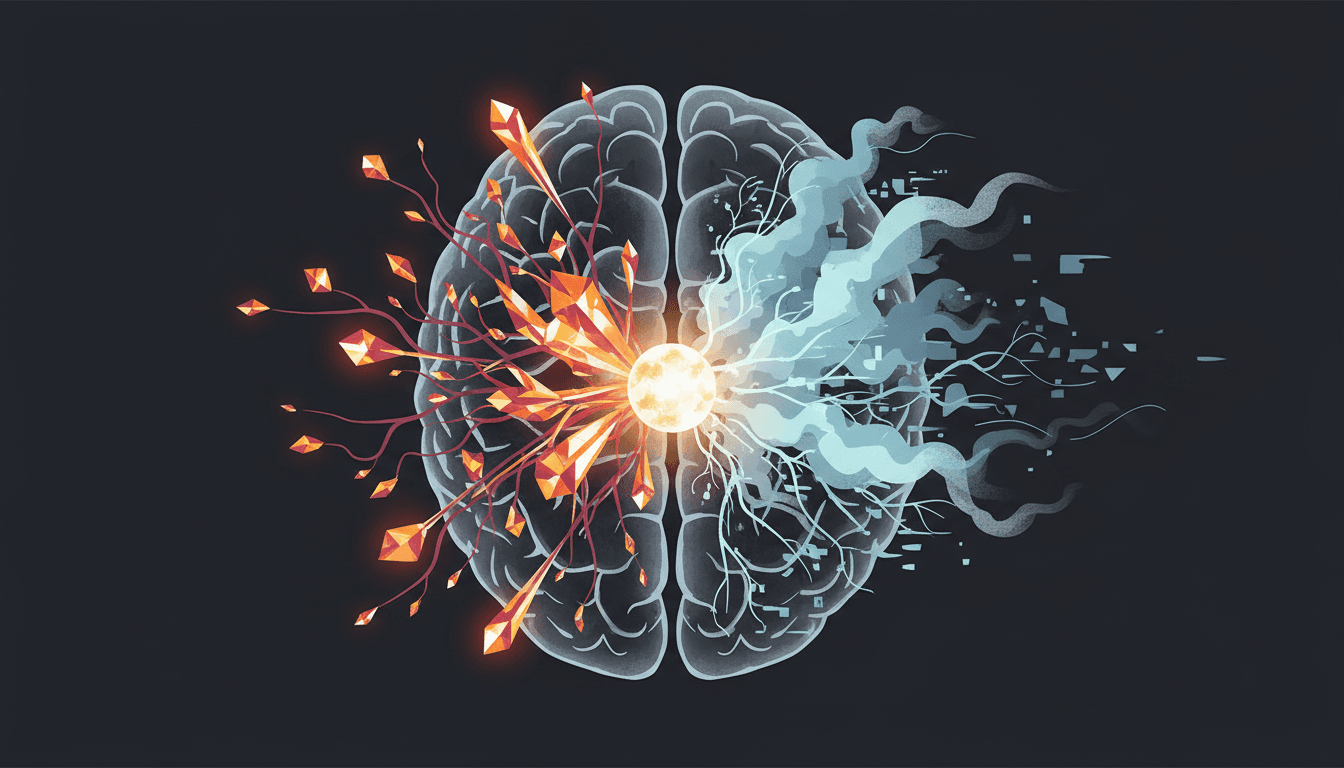
Infant brains produce new neurons at an extraordinary rate. This is part of what makes them such fast learners. New neurons mean new connections, new circuits, new capacity. But those new neurons don't just add to existing circuits. They integrate into them. And when they do, they disrupt the patterns that were already there.
Think of it like renovating a house while someone's living in it. The house gets better. But whatever was on the shelves keeps getting moved.
Frankland's team tested this directly. They gave infant mice a drug that suppressed neurogenesis in the hippocampus. The result: the mice retained their early memories as well as adult mice did. Slowing down the growth preserved what had already been stored.
Then they ran it in reverse. They increased neurogenesis in adult mice using exercise (which stimulates new neuron production in the hippocampus). The adults started losing previously formed memories. More new neurons, more forgetting.
Almost elegant. The same process that makes infant brains exceptional at learning (massive neurogenesis) is what prevents them from retaining specific memories long-term. The brain is optimizing for learning capacity at the expense of storage.
The Memories Were Made
Babies do form hippocampal memories. They're not operating on instinct and reflex alone.
A 2025 study used fMRI to scan infants between 4 and 25 months during a memory task. In babies older than about 12 months, hippocampal activity during the first viewing of an image predicted how long they spent looking at the same image when it appeared again. The hippocampus was encoding, recognizing, and driving behavior. Real memory, in real time.
The problem isn't formation. It's retrieval. The memories were stored, but by the time those babies grow into adults, the circuits that held those memories have been overwritten by years of neurogenesis.
Research in rats backs this up. Early memories leave behavioral "traces" that influence behavior later in life even though the animal can't consciously recall them. The information isn't gone. It's inaccessible. Childhood amnesia is a retrieval failure, not a storage failure.
How Far Back Can You Reach?
The age of your earliest memory isn't fixed. It varies by culture, parenting style, and how you were taught to talk about your experiences.
Research shows that elaborative parenting (parents narrating events, asking open-ended questions like "What did you do at the park today?", helping children construct stories about their experiences) correlates with earlier first memories. Kids who are coached to verbalize and organize their experiences develop the retrieval scaffolding that lets those memories persist.
Culture matters too. Studies comparing Western and East Asian populations find that Western participants tend to report earlier first memories, possibly because Western parenting styles emphasize individual experience and personal narrative more heavily. The memories might be equally available. The retrieval paths just develop differently.
This doesn't mean you can force early memories into existence through enough conversation. The neurogenesis-driven overwriting is biological, not cultural. But the scaffolding that helps some memories survive the renovation? That's shaped by how the people around you treated your experiences.
What It Means
I don't remember being three. Nobody does, really. But it's strange to think that my brain at three was actively forming memories (genuine hippocampal memories of people and places and events) and I'll never access them.
Those memories shaped me. The behavioral traces are in there. Emotional patterns, attachment styles, the things that feel safe or dangerous for reasons I can't explain. Running in the background like a program I can't read the source code for.
The period of your life that shaped you most is the period you remember least. Not because it didn't matter. Because your brain was growing too fast to keep the receipts.
Sources
- Frankland, P.W. & Josselyn, S.A. "Infantile amnesia: forgotten but not gone." Learning & Memory (2012) (opens in new tab)
- BrainFacts: Memory Study in Babies Hints at New Explanation for Infantile Amnesia (2025) (opens in new tab)
- Infantile Amnesia: A Critical Period of Learning to Learn and Remember. PMC (2017) (opens in new tab)
- The onset of childhood amnesia in childhood. PMC (2014) (opens in new tab)
- Infantile Amnesia can be Operationalized as a Psychological Meta Norm. Journal of Integrative Neuroscience (2025) (opens in new tab)
Part of the Rewrite series. Previous: You Can't Forget the Crash. You Can't Remember Your Lines.. Next: The More Your Phone Remembers, the Less You Do.