Is a Forest Smart? It Depends What You Mean by Smart.
Forests sense, adapt, and produce coordinated behavior without a central brain. That's not consciousness. But it might be a form of distributed computation worth taking seriously.
The question "are forests intelligent?" usually gets dismissed immediately. Trees don't have brains. Forests don't have nervous systems. The answer is obviously no.
But that answer is only obvious if intelligence means a centralized brain doing symbolic reasoning. If you loosen the definition, forests start to look more interesting. Not smarter than us. Different from us in a way that challenges our assumptions about what thinking requires.
What Intelligence Could Mean
There are at least two ways to use the word.
The first is what most people mean: consciousness, deliberate reasoning, self-awareness, symbolic thought. Brains. The kind of intelligence that requires a central processing unit and something it feels like to be inside.
The second is functional: the ability to sense local conditions, integrate signals from multiple sources, produce adaptive responses, and modify behavior based on past states. No consciousness required. Just computation.
By the second definition, some surprising systems qualify. Ant colonies. Immune systems. The internet itself. None of these have a command center. All of them produce coordinated, adaptive behavior from decentralized interaction.
Forest mycorrhizal networks fit this second category. Not the first.
What Forests Actually Do
Strip away the consciousness question and look at what's observable.
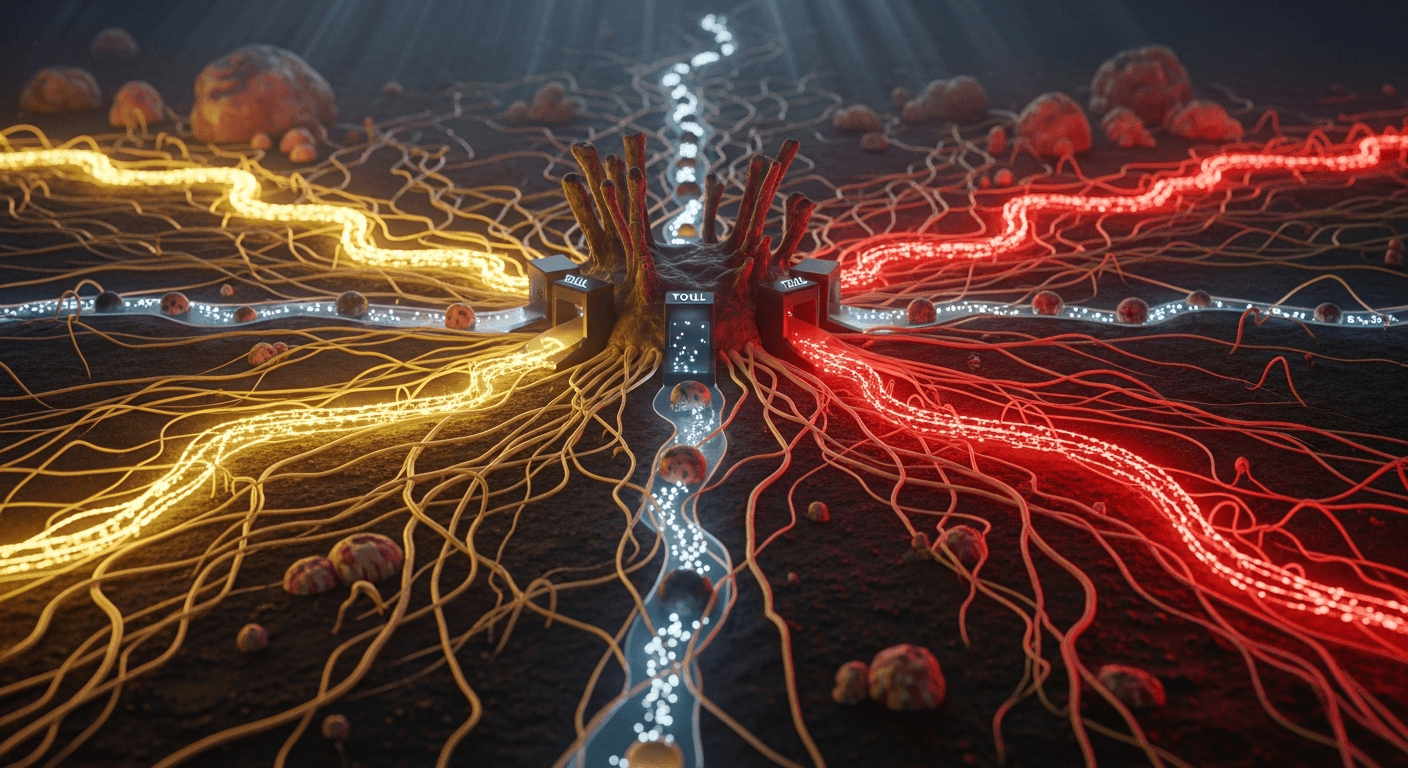
Forests sense. Individual roots sense soil chemistry, moisture, nutrient concentration, and the chemical signals from fungal partners. Leaves sense light, CO2, and temperature. Fungi sense root exudates, physical contact, and chemical gradients. Every node in the network is collecting information continuously.
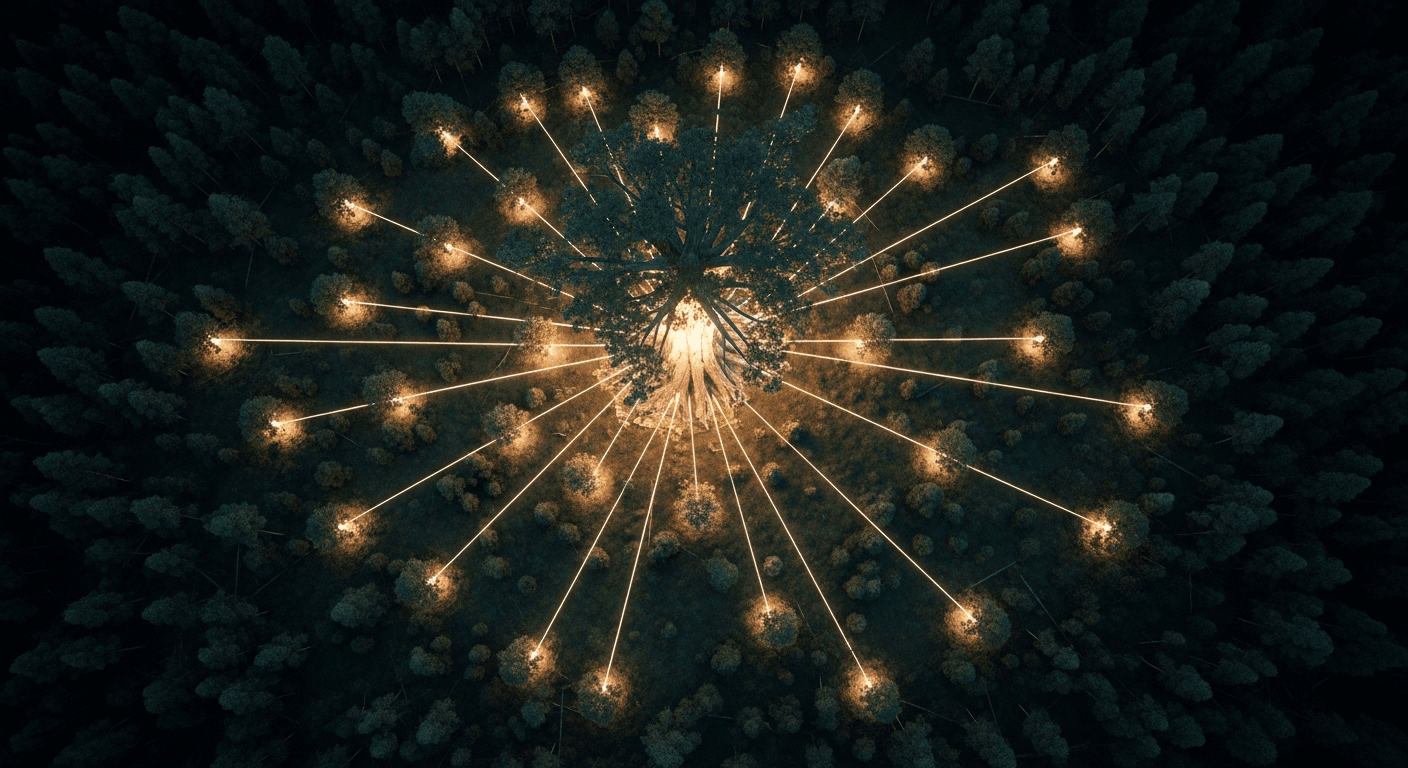
Forests integrate signals. A tree under attack by insects changes its root exudate chemistry, shifts carbon allocation, and modifies hormone levels. Those changes propagate through the fungal network to connected neighbors. The network integrates a local stress event into a system-wide state change.
Forests adapt. Mycorrhizal networks reconfigure over time. Fungal genets expand and contract based on carbon returns. Trees increase or decrease allocation to fungal partners based on nutrient delivery. The network architecture itself changes as conditions change.
Forests show memory-like behavior. The architecture of a fungal network, which genets dominate, which trees are central, which connections have persisted, reflects the history of the system. Past disturbances, past resource conditions, past species composition all leave structural traces.
None of that requires a brain. But all of it requires something.
Distributed Computation
Researchers like Anthony Trewavas and Paco Calvo have pushed this further with the concept of plant cognition. Their argument is that cognition shouldn't be defined by substrate. A brain is one way to do computation. A distributed network of cells, each responding to local signals and modifying neighboring cells through chemical exchange, is another way.
That second architecture is what plants and mycorrhizal networks run.
Trewavas uses the analogy of a neural network, not a biological brain specifically, but the mathematical structure. A system of interconnected nodes that each perform simple operations, connected in ways that allow the network to learn, adapt, and produce complex outputs from simple inputs. Forests aren't running backpropagation. But the functional parallel is real enough to be worth examining.
The strongest version of the forest cognition argument rests on a few observable capabilities:
Local sensing feeding into network-wide state changes. Check. Variable allocation responding to need and opportunity. Check. Defense responses propagating through the network before the threat arrives. Check. Structural reconfiguration after disturbance. Check.
What it doesn't have: anything resembling attention, working memory, or deliberate planning. The "computation" is embodied, chemical, and slow.
The Limits of the Metaphor
The distributed intelligence framing is useful until it isn't.
The risk is the same one that affected the altruism narrative. You start with a legitimate observation, "forests produce coordinated behavior without central control," and end up with a claim that overreaches the evidence, "forests are conscious," or "trees make decisions."
Suzanne Simard, whose work inspired much of the forest cognition conversation, has been careful about this. The behavior she documented is real. The network is real. The transfers are real. Whether any of that constitutes intelligence in a meaningful sense is a philosophical question she tends to leave open.
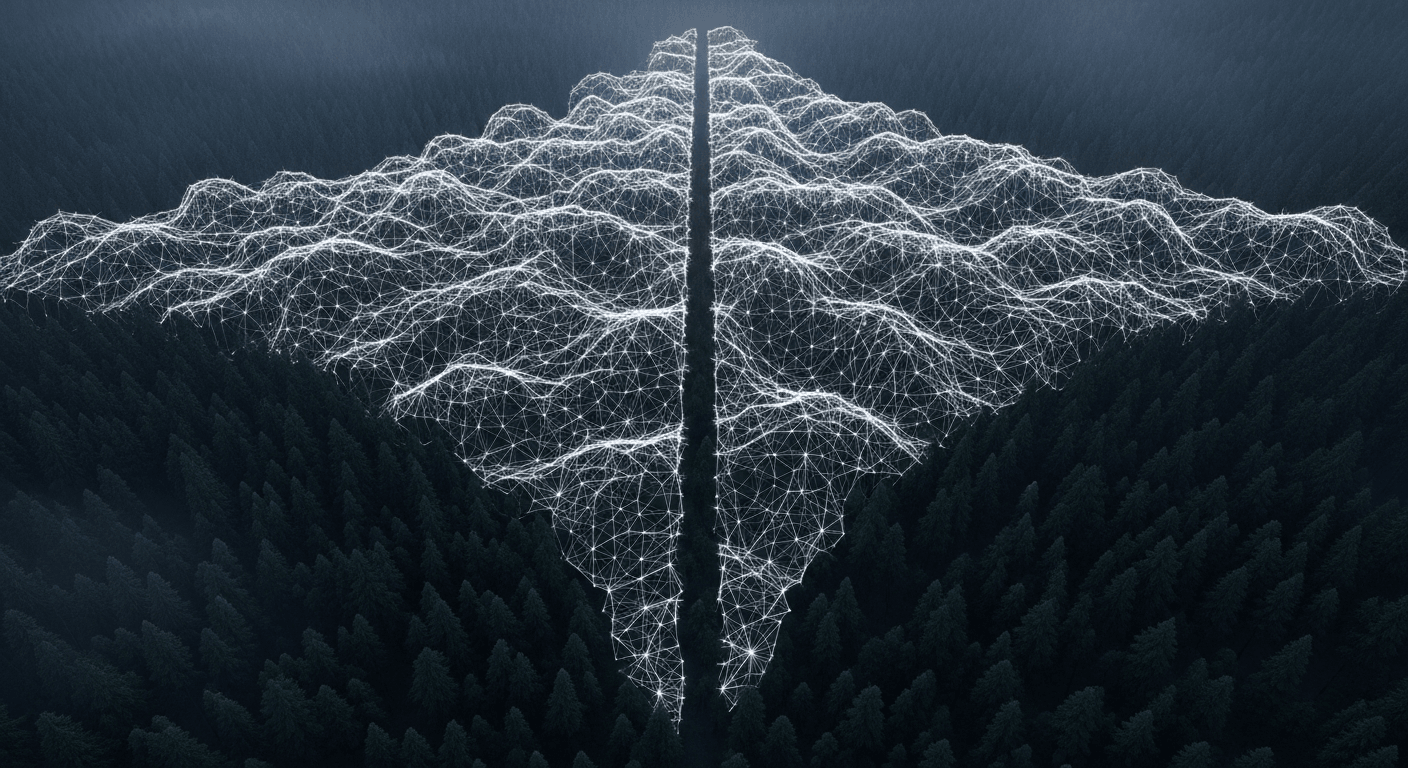
The more defensible claim is this: forests are distributed computing systems in the functional sense. They compute by changing flows. The outputs of that computation include adaptive resource allocation, network-wide stress responses, and structural reconfiguration that reflects history.
That's not consciousness. But it is something more than passive machinery.
Why This Matters Beyond the Philosophy
The distributed intelligence framing has practical implications for how we manage forests.
If a forest's adaptive capacity is a property of its network structure, then network fragmentation isn't just an ecological loss. It's a reduction in the system's computational capacity. A fragmented forest has fewer nodes, shorter path lengths, fewer redundant routes. It can sense less, integrate less, respond less.
Old-growth forests aren't just old trees. They're mature networks with rich connection histories, diverse fungal communities, and structural complexity that took centuries to develop. When they're cleared, the network history disappears. What grows back can be a forest by species composition but not by network architecture, not for a long time.
That argument doesn't require belief in forest consciousness. It just requires taking the distributed computation model seriously, which the data supports.
Sources
- Simard, S. W. et al. "Mycorrhizal networks: mechanisms, ecology and modelling." Fungal Biology Reviews 26(1), 39-60 (2012). (opens in new tab)
- Beiler, K. J. et al. "Architecture of the wood-wide web: Rhizopogon spp. genets link multiple Douglas-fir cohorts." New Phytologist 185(2), 543-553 (2010). (opens in new tab)
- Song, Y. Y. et al. "Defoliation of interior Douglas-fir elicits carbon transfer and stress signalling to ponderosa pine neighbors through ectomycorrhizal networks." Scientific Reports 5, 8495 (2015). (opens in new tab)
- Mayne, R. et al. "Propagation of electrical signals by fungi." BioSystems 229, 104933 (2023). (opens in new tab)
Part of the Wood Wide Web series. Previous: The Network That Predates Trees. Next: Science Caught Up to Something Many Cultures Already Knew.