Science Caught Up to Something Many Cultures Already Knew
Western ecology is excited about forest networks. Many Indigenous knowledge systems never needed the metaphor. They've been describing relational ecology for a long time.
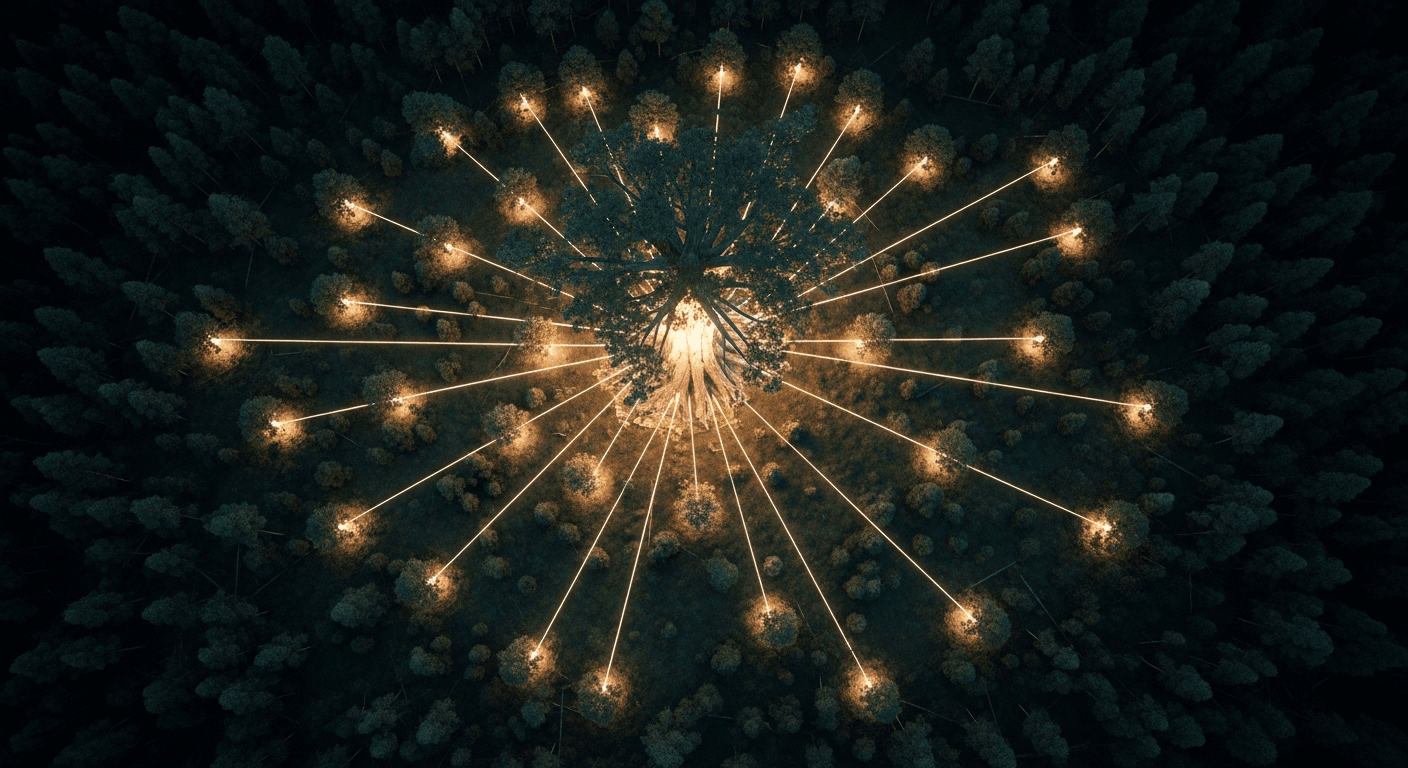
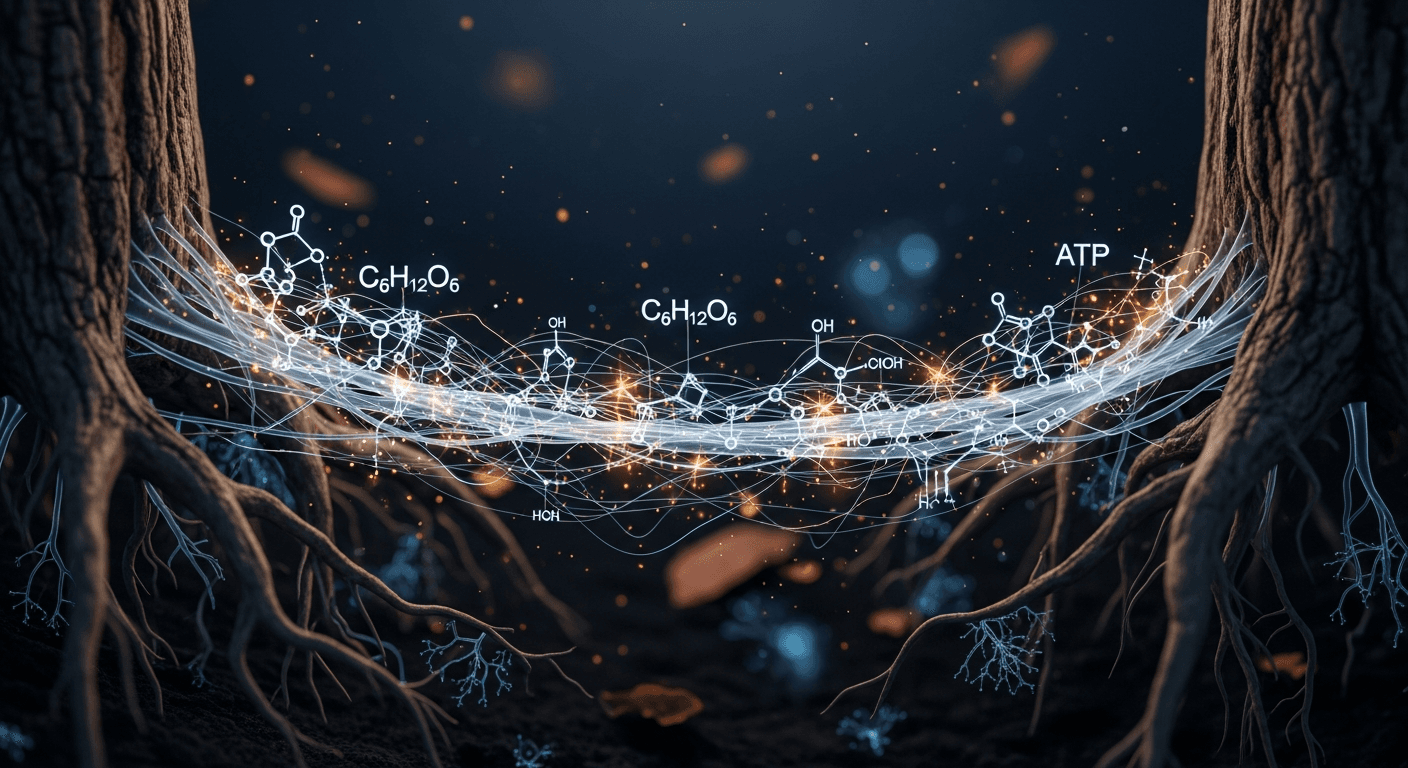
When the wood wide web story hit popular culture, a lot of people reacted with something like wonder. Trees are connected. Forests are communities. Life underground is as complex as life above.
That wonder is real and appropriate. What's worth adding: many Indigenous communities were not surprised.
The Gap Between Two Ways of Knowing
Modern Western science tends to describe nature in terms of mechanisms. You have an organism. It interacts with other organisms through specific, measurable processes. You identify the process, quantify it, publish it.
That framing is powerful. The isotopic tracing work, the network topology studies, the fungal electrophysiology. All of it depended on that mechanistic rigor. Nobody should minimize what that approach produced.
But the framing carries an assumption: nature is a collection of separate things that sometimes interact. The default state is separateness. The interesting finding is when connection emerges.
Many Indigenous knowledge traditions start from the opposite assumption. The default state is relation. Everything is already connected. The interesting question is how to live well inside those connections, not whether they exist.
That's not a softer version of the same idea. It's a structurally different starting point.
Robin Wall Kimmerer
The most influential bridge figure between these two frameworks is Robin Wall Kimmerer, a plant biologist, professor, and enrolled member of the Citizen Potawatomi Nation.
Her book Braiding Sweetgrass does something unusual: it holds traditional ecological knowledge and academic plant science in the same hands without flattening either one. She doesn't argue that Potawatomi plant knowledge is Western botany in different language. She argues they're distinct epistemologies that ask different questions and produce different kinds of understanding.
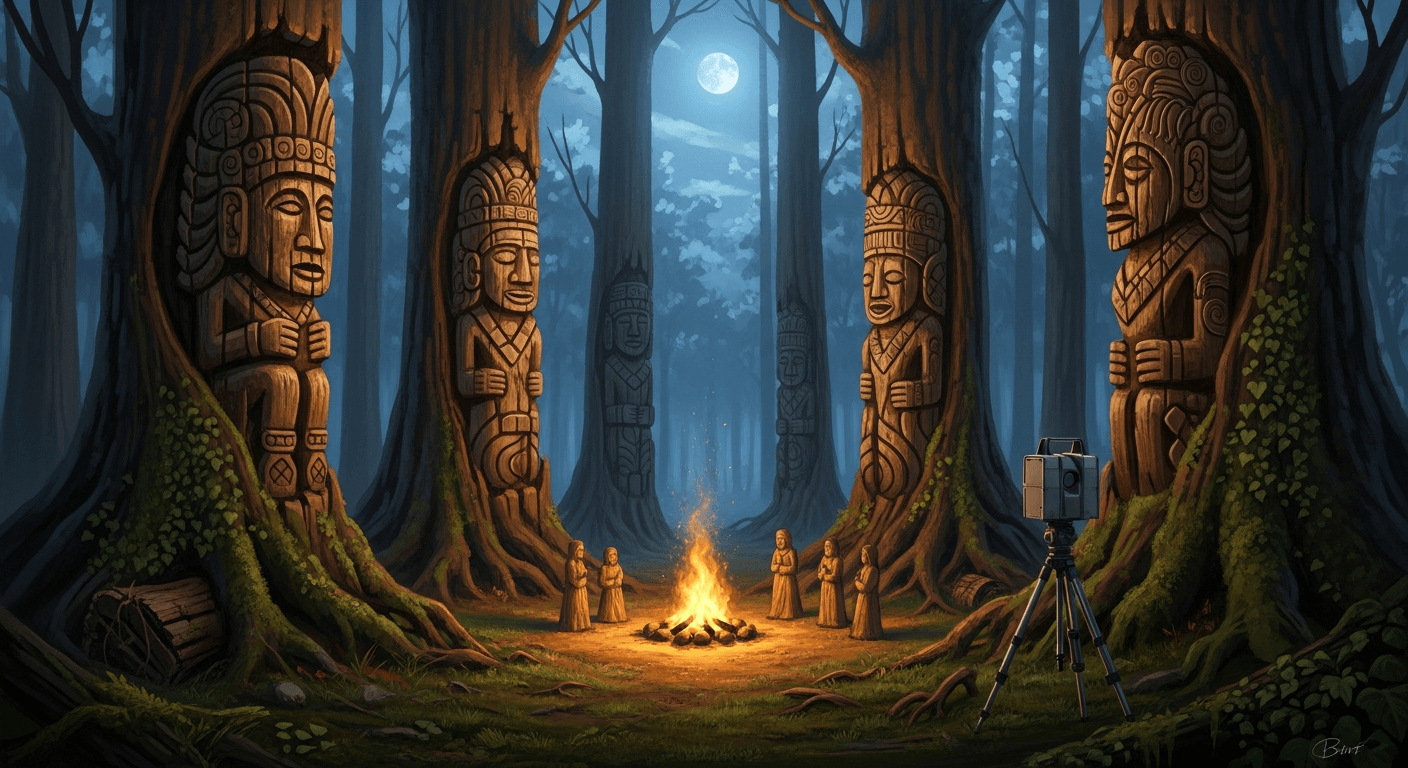
One of her core claims is about what she calls the "grammar of animacy." In Potawatomi and many other Indigenous languages, plants and animals are grammatically animate, referred to with pronouns that encode personhood. In English, a tree is an it. In languages structured around animacy, a tree is a being with agency, presence, and standing in the world.
That's not a mystical claim. It's a claim about how language shapes perception. If your language treats a forest as a collection of objects, you see objects. If your language treats a forest as a community of beings, you see community. What Western ecology is now measuring in mycorrhizal networks, Kimmerer would argue, is something that relational frameworks were already structured to perceive.
What This Isn't
This is where the framing has to stay careful.
It would be easy and wrong to say: "Indigenous people knew about mycorrhizal networks all along." They didn't. The specific mechanism, the ectomycorrhizal fungal genets, the carbon isotope flows, the hub nodes, those required Western scientific tools to detect and quantify.
What many Indigenous knowledge traditions had was a broader framing: forests are relational communities in which every member has obligations to others. That framing is compatible with what ecology now shows. It's not the same as having anticipated the specific biological mechanism.
Using Indigenous knowledge as decorative confirmation for Western findings is its own kind of appropriation. It flattens diverse traditions into a single generic "Indigenous worldview." It treats traditional knowledge as proto-science waiting to be validated, rather than as a distinct form of understanding with its own methods and purposes.
The actual relationship is narrower and more respectful. Western ecology, by measuring mycorrhizal networks, has built empirical support for a fundamentally relational view of forest ecology. That relational view is one that many Indigenous traditions have held for a long time, through different methods and for different reasons.
The convergence is real. The contexts aren't equivalent.
What Industrial Forestry Got Wrong
There is a practical implication here that goes beyond philosophy.
Industrial forestry, from the 19th century through much of the 20th, treated forests as timber inventories. Individual trees were the unit of value. A clear-cut followed by replanting made intuitive sense: remove the products, install new products.
That approach ignored everything the mycorrhizal network research is now measuring. It ignored that old trees are hub nodes whose removal fragments the network. It ignored that mixed-species stands have more robust transfer dynamics than monocultures. It ignored that seedling establishment depends on fungal partners that take decades to mature.
Many Indigenous forest management traditions, including the selective harvesting practices and long-fallow approaches documented across North America, did not make these errors. Not because the practitioners had mapped Rhizopogon genets. But because their knowledge systems were built to preserve relationships, not maximize individual-tree yield.
That's a different kind of intelligence, one that produced different practices. And those practices, in many cases, maintained the network infrastructure that industrial forestry dismantled.
The Honest Synthesis
Western ecology and Indigenous ecological knowledge don't need to merge to be mutually useful.
What they share is increasing recognition that forests are relational systems, not just stands of individual trees. The mechanisms differ. The epistemologies differ. The ethical frameworks differ. But both point at the same basic reality: a forest is not a collection of separate things that happen to grow near each other.
The mycorrhizal research gave Western science a way to measure that relational reality with carbon isotopes and graph theory. Many Indigenous traditions didn't need the measurement to hold the orientation. The measurement confirmed something their frameworks had always been built around.
The wood wide web story is still mostly told as a scientific discovery. It's also a convergence. Two very different ways of paying attention to forests, arriving at the same basic picture from different directions.
Sources
- Robin Wall Kimmerer. Braiding Sweetgrass. Milkweed Editions, 2013. (opens in new tab)
- Simard, S. W. et al. "Mycorrhizal networks: mechanisms, ecology and modelling." Fungal Biology Reviews 26(1), 39-60 (2012). (opens in new tab)
- Karst, J., Jones, M. D., and Hoeksema, J. D. "Positive citation bias and overinterpreted results lead to misinformation on common mycorrhizal networks in forests." Nature Ecology & Evolution 7, 547-556 (2023). (opens in new tab)
Part of the Wood Wide Web series. Previous: Is a Forest Smart? It Depends What You Mean by Smart.. Next: Climate Change Has a Target Underground.