Climate Change Has a Target Underground
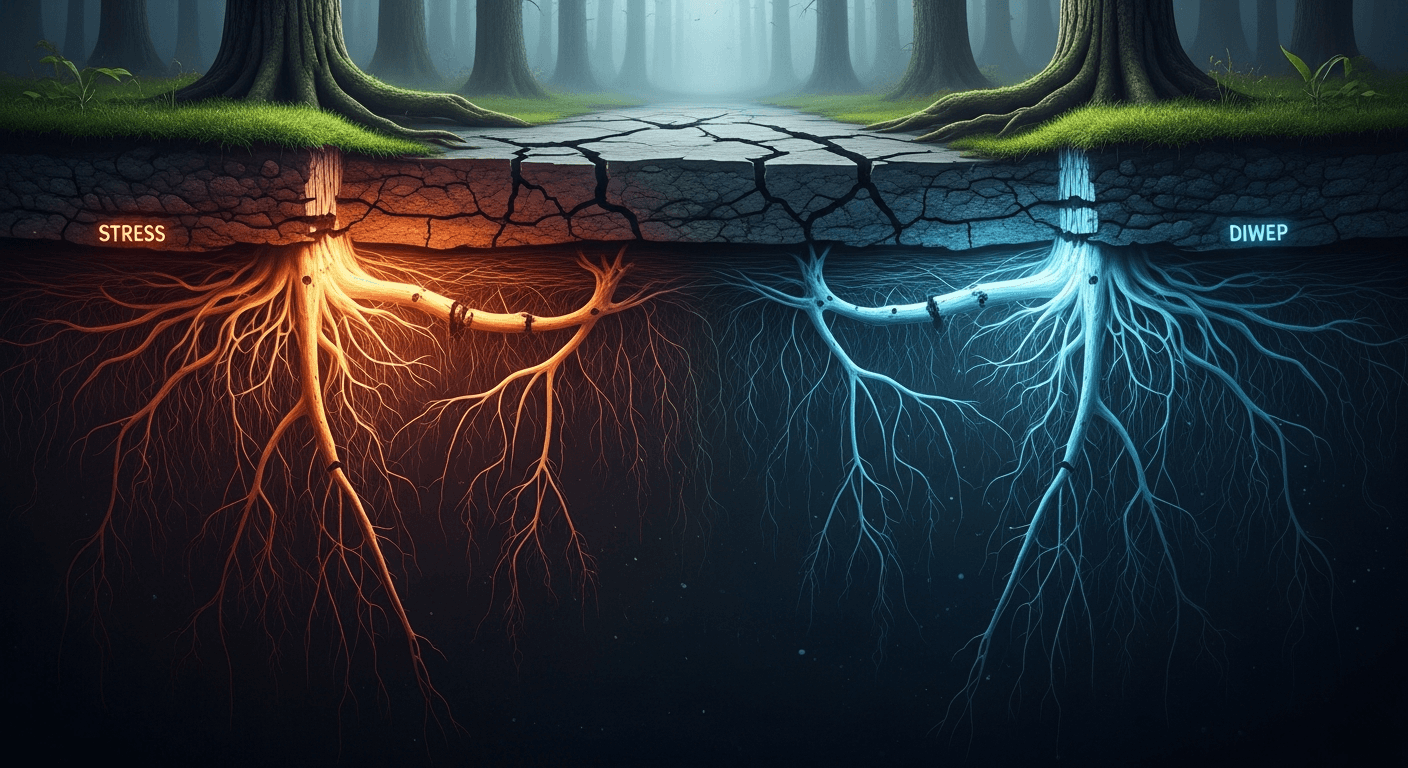
Mycorrhizal networks are infrastructure. Climate change is stressing them in four distinct ways. The consequences reach all the way to how forests store carbon.
Forest management conversations focus on what you can see. Tree cover. Species composition. Fire risk. Carbon in above-ground biomass.
The underground infrastructure rarely enters the conversation. But it's where some of the most consequential climate effects are landing.
Four Ways Climate Change Hits the Network
Warming and drought change partner performance.
Fungi and trees don't respond to stress identically. Under drought, the metabolic cost of maintaining long fungal hyphae can become prohibitive. Colonization rates can drop. The carbon surplus that plants normally allocate to fungal partners shrinks when the plant itself is water-stressed.
In some systems, mycorrhizal networks actually help under drought by redistributing water from wetter soil patches to drier ones. In others, stress reduces the surplus available for sharing. Whether the network buffers or amplifies drought effects depends on species, soil, and severity. The honest answer is that we don't yet have a clean general rule.
Mycorrhizal type determines carbon storage outcomes.
This one has direct policy implications.
Forests dominated by ectomycorrhizal trees, pines, firs, oaks, beeches, store carbon differently than forests dominated by arbuscular mycorrhizal trees. ECM forests tend to have slower decomposition rates and larger soil carbon pools. The thick, waxy organic layer in boreal and temperate forests isn't just dead leaves. It's the output of a fungal-mediated decomposition system that moves slowly by design.
A 2023 paper in Nature Climate Change tracked what happened to soil carbon as warming and nitrogen deposition changed in different forest types. In AM-dominated forests, soil carbon tended to decrease. In ECM-dominated forests, it tended to increase or stay stable. The network type is not a detail. It is part of the climate feedback architecture.
If warming shifts forest composition from ECM to AM species, which is already happening at some range margins, the carbon storage properties of those forests shift with it.
Fungal biogeography is climate sensitive.
Fungi don't all live everywhere. Leho Tedersoo and colleagues have shown through global surveys that climate, particularly temperature and moisture, is one of the strongest predictors of fungal community composition. Different fungal species have different temperature tolerances, different moisture requirements, different host preferences.
As climate zones shift, the trees may survive in place while the fungal community underneath them reorganizes. Or vice versa: trees may die and leave behind fungal networks with no hosts. The host trees and their fungal partners are moving at different speeds and by different mechanisms.
In network terms: the physical endpoints may persist while the routing layer changes. The result is connectivity disruption even without visible forest loss.
Disturbance removes hub nodes.
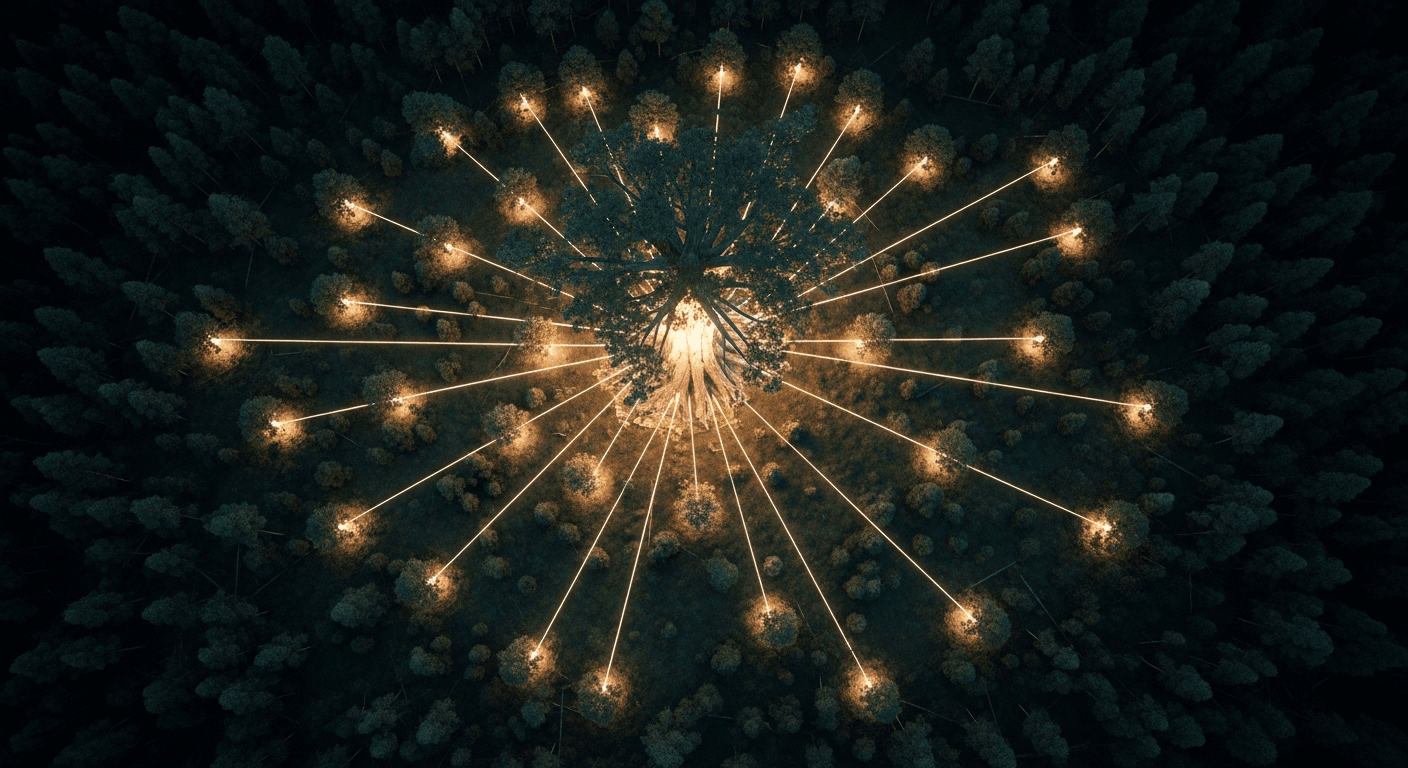
The Beiler network maps showed that some old trees are disproportionately connected, sitting at the center of the ectomycorrhizal network and linking dozens of other trees through multiple fungal genets.
Climate change increases the frequency and intensity of wildfire, insect outbreaks, and storm damage in many regions. Those disturbances don't hit the forest randomly. They often hit the oldest, largest trees hardest. Fires that would have been survivable in a cooler, moister climate now kill trees that survived for centuries.
Lose enough old trees and you're not just losing biomass. You're pulling hub nodes out of the network. In a scale-free topology, removing hubs has disproportionate effects on connectivity, far beyond what the raw biomass loss would suggest.
Mapping What We're Losing
Toby Kiers, a mycorrhizal biologist who also ran the biological markets research, co-founded a nonprofit called SPUN: Society for the Protection of Underground Networks. The ambition is to build global maps of underground fungal biodiversity, identify carbon-relevant hotspots, and flag regions where mycorrhizal communities are most at risk.
The framing is explicitly infrastructural. Kiers describes mycorrhizal networks as the hidden half of the forest. They regulate nutrient cycles, support tree establishment, and influence carbon storage at a global scale. If those networks shift or degrade under climate pressure, the trees above them are affected even if the warming itself doesn't directly harm the trees.
The SPUN project is essentially trying to do for fungal networks what satellite imagery did for surface vegetation: make the invisible visible so it can be managed, protected, or at least understood before it disappears.
What This Changes About Forest Policy
The carbon accounting for forests already underestimates their complexity. Above-ground biomass is measurable from satellites. Soil carbon is harder. Fungal biomass and its contribution to total ecosystem carbon are almost never included.
But fungal biomass is substantial. Mycorrhizal networks in temperate forests can contain significant carbon in their own right, separate from the trees they connect. And the soil carbon that ECM systems help accumulate is much more permanent than above-ground carbon in wood, which returns to the atmosphere within decades after a tree dies or burns.
If forest carbon policy ignores the underground network type, it may be optimizing for the wrong variables. Planting fast-growing AM-associated trees to sequester carbon may produce less long-term soil carbon storage than protecting existing ECM-dominated old growth, even if the above-ground biomass numbers look similar.
The infrastructure is invisible. That doesn't mean it's unimportant. In some ways, it's the most important part.
Part of a series on forest mycorrhizal networks. See also Science Caught Up to Something Many Cultures Already Knew.
Sources
- Wang, Y. et al. "Mycorrhizal type regulates trade-offs between plant and soil carbon in forests." Nature Climate Change (2023). (opens in new tab)
- Steidinger, B. S. et al. "Climatic controls of decomposition drive the global biogeography of forest-tree symbioses." Nature 569, 404-408 (2019). (opens in new tab)
- Tedersoo, L. et al. "Global diversity and geography of soil fungi." Science 346(6213), 1256688 (2014). (opens in new tab)
- Beiler, K. J. et al. "Architecture of the wood-wide web: Rhizopogon spp. genets link multiple Douglas-fir cohorts." New Phytologist 185(2), 543-553 (2010). (opens in new tab)
- Karst, J., Jones, M. D., and Hoeksema, J. D. "Positive citation bias and overinterpreted results lead to misinformation on common mycorrhizal networks in forests." Nature Ecology & Evolution 7, 547-556 (2023). (opens in new tab)
Part of the Wood Wide Web series. Previous: Science Caught Up to Something Many Cultures Already Knew. Next: Someone Is Building Computers out of Mushrooms.