Someone Is Building Computers out of Mushrooms
Researchers are using living fungal networks as sensing and computing substrates. They've already steered robots with mycelium. Here's what the frontier actually looks like.
In 2024, researchers published a paper in Science Robotics describing how they used living fungal mycelium to drive a robot.
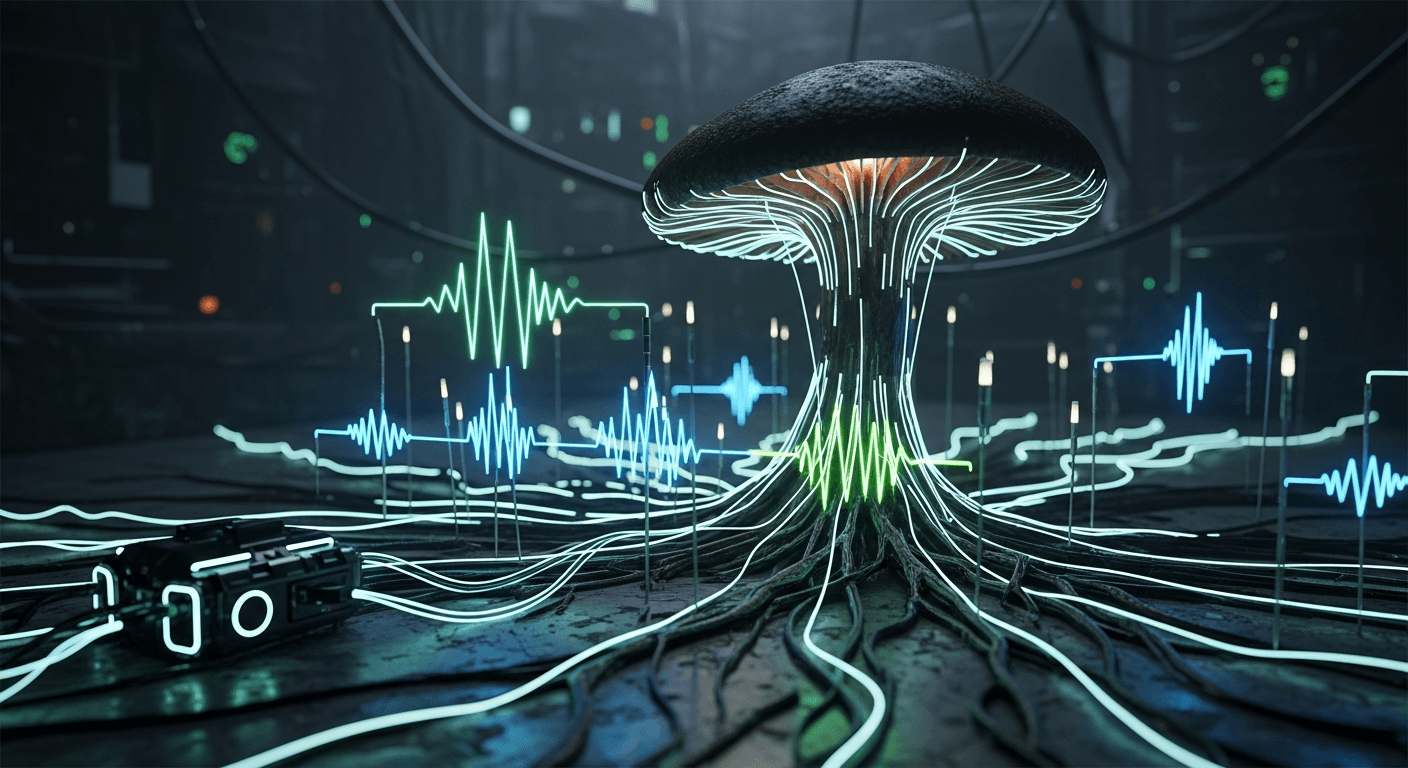
Not as a metaphor. Actual electrophysiological signals from actual mycelium, wired into a biohybrid robotic system, controlling its movement based on what the fungus sensed in its environment.
That paper didn't get the attention it deserved. But it represents the far edge of a research direction that has been quietly developing for years.
The Researcher Behind It
Andrew Adamatzky at the University of the West of England has spent the better part of a decade measuring electrical activity in fungi. His core claim: fungal mycelium is not just biological plumbing. It is a living material that senses, integrates, and responds.
The signals he measures are voltage spikes propagating through mycelial networks. They vary in frequency, amplitude, and pattern depending on environmental conditions. Temperature, chemical exposure, touch, light, humidity: the fungus responds to all of these with measurable changes in electrical activity.
In 2023, a paper in BioSystems summarized the broader case: living fungal networks exhibit memristive behavior, meaning their electrical properties change based on history. They show capacitor-like dynamics. They can be interfaced with conventional electronics. The paper described them as hybrid sensing-computing materials.
That's a specific technical claim, not a metaphor. Memristors are a class of electronic component whose resistance changes based on past current flow. They're of interest for neuromorphic computing, building systems whose architecture resembles biological neural networks. Fungi, apparently, already have some of those properties.
The Robot
The 2024 Science Robotics paper pushed this from characterization to application.
Adamatzky's group, with collaborators, attached electrodes to living Ganoderma mycelium growing on a substrate. The mycelium's electrical signals, continuously measured, were fed into a control system that drove a small robot with six legs. When the mycelium's activity changed based on environmental stimuli, the robot moved differently.
The system wasn't preprogrammed with specific responses. The behavior emerged from the mycelium's own electrophysiological dynamics, modulated by what the fungus was experiencing.
That's a biohybrid system in the strict sense. Part living organism, part machine, with the living component doing real computational work. Not as a passive sensor but as an active signal processor.
What Fungal Computing Is Actually Claiming
It's worth being precise about what this research is and isn't saying.
It is not saying fungi are intelligent in the conscious sense. It is not saying mycelium plans, reasons, or feels.
It is saying that mycelium, as a physical material, can transform environmental input into patterned electrical output. That transformation has properties useful for computing: it's adaptive, it has memory-like characteristics, it responds to multiple input types simultaneously, and it can drive action.
That's computing in the functional sense. The same way a silicon transistor computes by letting current flow or not flow based on a gate voltage, mycelium computes by producing spike patterns based on environmental conditions. The substrate is wet carbon instead of dry silicon. The timescales are slower. The architecture is massively parallel and three-dimensional.
The potential advantages over silicon aren't speed. They're energy efficiency, physical flexibility, self-repair, and the ability to interface directly with biological systems.
The Broader Implication
The forest and the lab are pointing in the same direction.
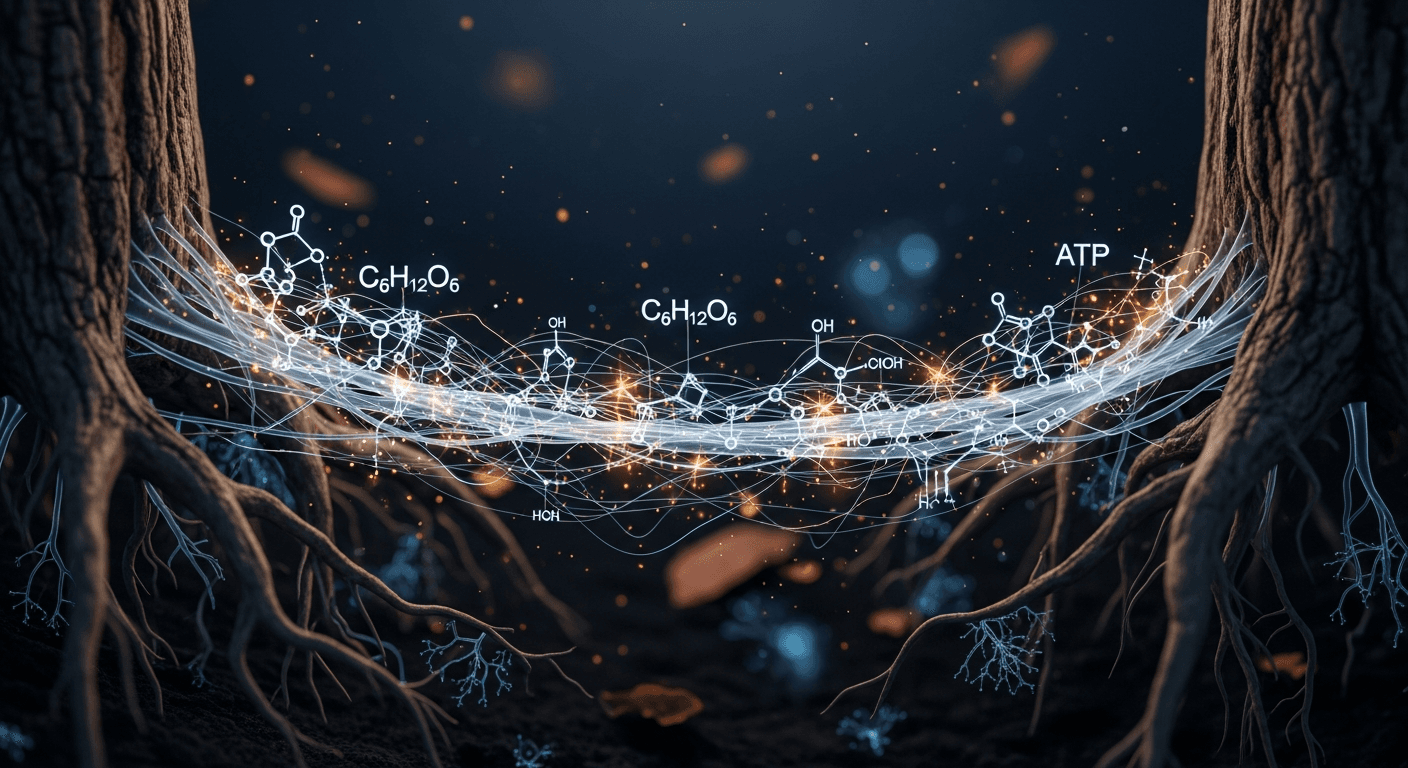
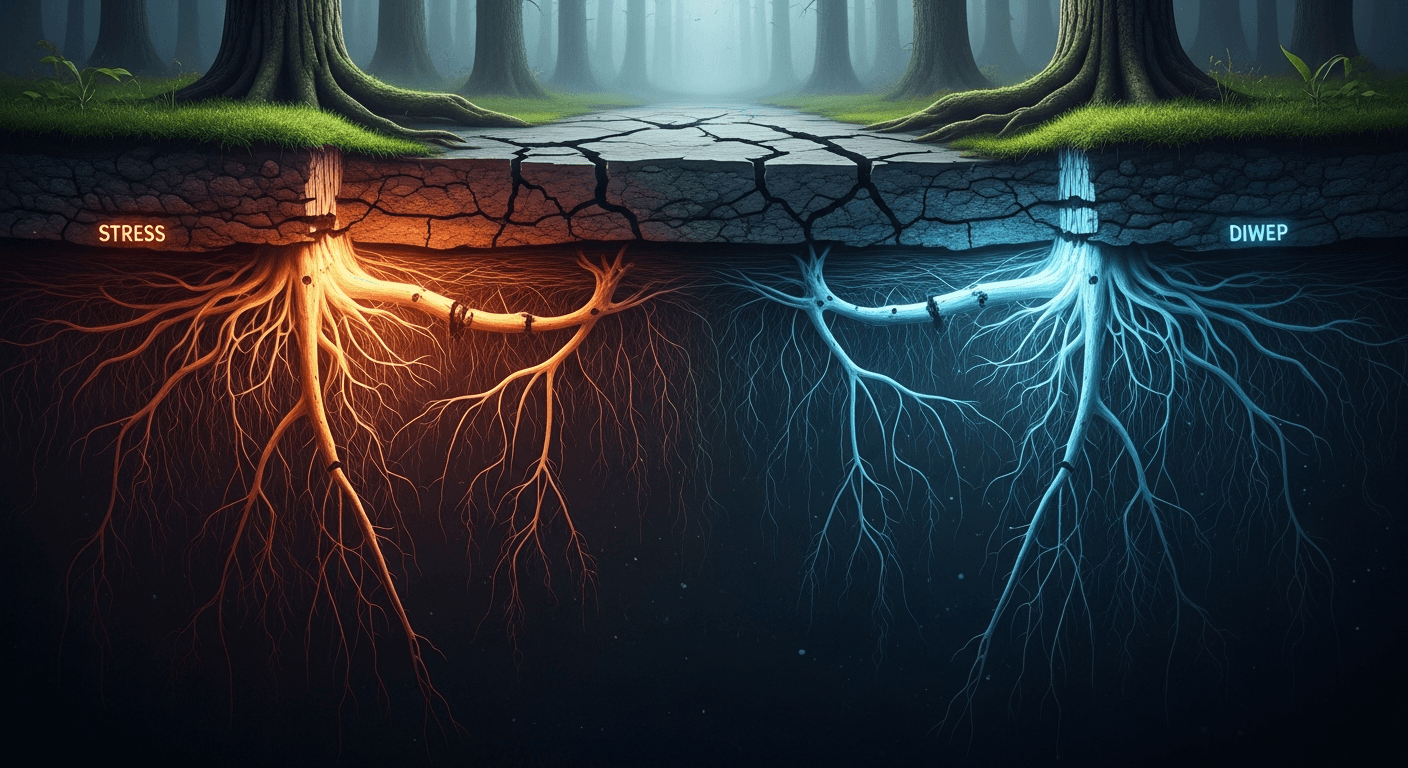
In forests, mycorrhizal networks route resources, propagate defense signals, and reconfigure structure based on conditions. In labs, mycelium is being measured as a sensor-computing material with measurable electrical properties and controllable interfaces with machines.
The combined picture is of a fungal architecture that does something we'd recognize as information processing in both contexts. The ecological version is slow, chemical, distributed across kilometers of soil. The laboratory version is fast enough to steer a robot in real time.
What connects them is the underlying architecture: a branching, self-organizing network of thin filaments that responds to local conditions and propagates those responses through the network.
That architecture is 400 million years old. Researchers are just starting to understand what it can do.
Where This Goes
The honest version of where this research leads is still speculative.
Near-term: fungal mycelium as biosensors in environmental monitoring. A living sensor network embedded in soil that detects pollutants, moisture, temperature gradients, or pathogen presence. Lower energy than electronic sensors, self-repairing, able to grow into irregular spaces.
Medium-term: biohybrid materials for soft robotics or structural sensing. Fungal networks grown into building materials or wearable substrates that provide environmental feedback.
Long-term: neuromorphic computing substrates that use the memristive properties of mycelium. Slower than silicon, but potentially more energy-efficient and capable of different classes of computation.
All of this is preliminary. The field is small, the applications are unproven at scale, and the biological complexity of living mycelium creates engineering challenges that silicon doesn't have. Fungi are alive. They have their own requirements, sensitivities, and life cycles.
But the science is real. The robot ran. The signals were measured. The mycelium computed.
Sources
- Mishra, A. K. et al. "Sensorimotor control of robots mediated by electrophysiological measurements of fungal mycelia." Science Robotics 9(93) (2024). (opens in new tab)
- Mayne, R. et al. "Propagation of electrical signals by fungi." BioSystems 229, 104933 (2023). (opens in new tab)
- Simard, S. W. et al. "Mycorrhizal networks: mechanisms, ecology and modelling." Fungal Biology Reviews 26(1), 39-60 (2012). (opens in new tab)
Part of the Wood Wide Web series. Previous: Climate Change Has a Target Underground. Next: Where the Wood Wide Web Analogy Holds and Where It Falls Apart.