73% Antibody Reduction. From Light.
Red light therapy on the thyroid produced some of the largest effect sizes in photobiomodulation research. Then a 2024 study found nothing. Both results make sense.
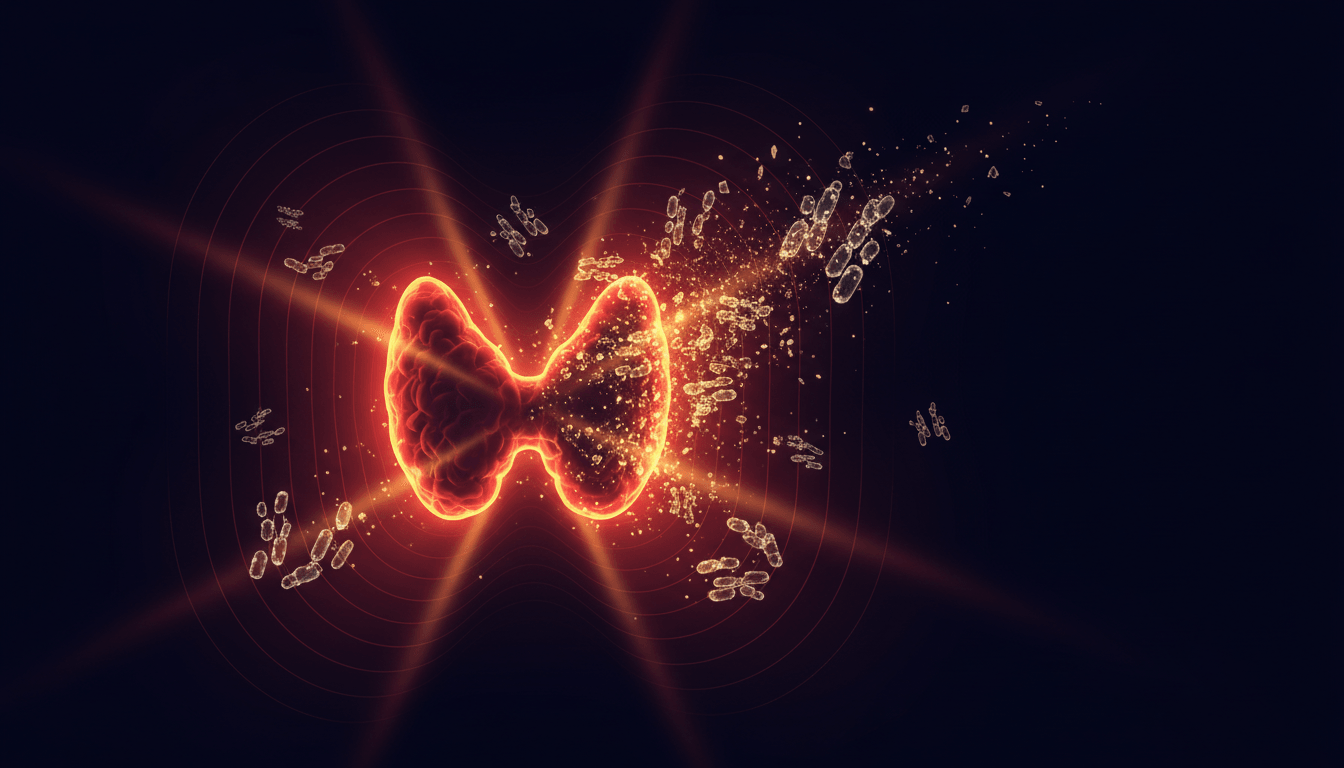
350 people with Hashimoto's thyroiditis. Six sessions of near-infrared light at 850nm over three days. The results: a 50% reduction in levothyroxine use, a 53% increase in T3 levels, and a 73% drop in thyroid peroxidase antibodies. The primary autoimmune marker. Down by nearly three-quarters.
Those numbers don't look like photobiomodulation research. They look like drug trial results.
That's exactly why this is the most polarizing application in the field. The effect sizes are so large that some researchers don't believe them. And a 2024 study using at-home devices found absolutely nothing. No thyroid function changes after 16 weeks.
Both results are real. And they don't contradict each other.
The Big Study
The 2020 study enrolled 350 participants with confirmed autoimmune hypothyroidism. Clinical-grade devices. 850nm near-infrared light applied directly over the thyroid gland. Not a panel across the room. A targeted, calibrated dose to a specific organ.
The headline numbers are striking enough. But the aggregate data across multiple thyroid PBM studies tells a bigger story: 30-50% of participants were able to stop taking thyroid medication entirely. Not reduce. Discontinue.
For anyone who's been told they'll take levothyroxine for life, that's not a minor finding.
The 2023 Trial
A 2023 clinical trial added another layer. Researchers compared two groups of Hashimoto's patients: one receiving photobiomodulation plus supplements, the other supplements alone.
The PBM group showed statistically significant improvements across every marker they measured. Weight loss and BMI reduction. Lower TSH (meaning more normalized thyroid function). Reduced anti-TPO and anti-thyroglobulin antibodies. Both autoimmune markers, down. And the PBM group needed lower doses of levothyroxine than the supplement-only group.
That's not just symptom management. That's measurable changes in the autoimmune process itself.
Long-Term Safety
One of the first questions anyone asks about shining light on a thyroid gland: what about nodules? What about cancer risk?
Fair question. A 2018 long-term follow-up study published in PMC examined exactly this. Patients who had received low-level laser therapy for autoimmune thyroiditis were tracked over extended periods. The conclusion: the treatment was safe and effective. No evidence of increased risk of malignant thyroid nodules, even with long-term use.
That addresses the biggest safety objection. You're not stimulating rogue cell growth. You're reducing the autoimmune attack on the gland.
Then Why Did the 2024 Study Find Nothing?
Thirty women. At-home device. Sixteen weeks. No changes to thyroid function.
This is the study that skeptics point to. And they're right that it showed no effect. But they're wrong about what it means.
The 2020 study used clinical-grade equipment delivering 850nm at therapeutic doses in a controlled setting. Calibrated irradiance. Known energy density at the tissue surface. The 2024 study used a consumer device. The kind you buy online and hold against your neck for 10 minutes.
These are not the same intervention.
I've written about the dose problem in every article in this series because it's the single most important variable in photobiomodulation. The relationship between dose and effect isn't linear. It's a bell curve. Too little light and nothing happens. The right dose and you get therapeutic benefit. Too much and you overshoot into inhibition.
Most consumer devices sit firmly in the "too little" zone. Especially for an organ like the thyroid, which sits deeper in the neck, under layers of tissue that absorb and scatter light before it reaches the gland. A panel that works fine for surface-level skin applications doesn't automatically deliver adequate energy to a deeper target.
The 2024 study didn't disprove thyroid PBM. It demonstrated that the wrong dose does nothing. Which is exactly what the biphasic dose response predicts.
The Gap Between Evidence and Products
The thyroid findings are potentially the most medically significant results in all of photobiomodulation. Reducing autoimmune antibodies by 73%. Allowing half of participants to cut their medication. Showing no safety concerns over long-term follow-up.
But "potentially" is doing work in that sentence.
The positive studies are few. The sample sizes are decent but not enormous. Independent replication with standardized protocols across multiple research groups hasn't happened yet. And the gap between clinical-grade delivery and consumer devices is wider here than in almost any other PBM application.
Hashimoto's is more common than most people realize. And the standard treatment — take this pill for the rest of your life — leaves a lot of people looking for anything that addresses the underlying autoimmune process rather than just replacing the hormone it destroys.
This research suggests something real is happening. The mechanism fits cleanly with what we know about PBM's anti-inflammatory cascade. Light reduces the immune system's attack on the thyroid. The gland recovers some function. Medication needs drop.
But I wouldn't tell anyone to buy a red light panel and expect these results. Not yet. Not with a consumer device. Not without clinical guidance on dosing.
The science is ahead of the products. That's a familiar problem in this field.
Part of the Red Light Therapy series. Previous: The Hair Loss Treatment That Doesn't Come in a Bottle.
Sources
- Safety and Efficacy of LLLT in Autoimmune Thyroiditis: Long-Term Follow-Up (2018, PMC) (opens in new tab)
- Hamblin MR. "Mechanisms and applications of the anti-inflammatory effects of photobiomodulation" (2017, AIMS Biophysics) (opens in new tab)
- Photobiomodulation: A review of the molecular evidence (2021, Journal of Plastic, Reconstructive & Aesthetic Surgery) (opens in new tab)
- Photobiomodulation Therapy on Brain (2024, Cells) (opens in new tab)