Your Retina Has More Mitochondria Than Any Other Tissue
A UCL neuroscientist found that 3 minutes of red light per week improved declining vision by 17%. The retina's extreme mitochondrial density makes it uniquely responsive to photobiomodulation.
Three minutes. Once a week. 670 nanometers of deep red light shined into aging eyes.
Result: 17% improvement in color contrast sensitivity. The ability to distinguish objects from their backgrounds, a function that degrades steadily after 40, got measurably better. Not marginally. Clinically perceptible.
That's from Glen Jeffery, Professor of Neuroscience at UCL's Institute of Ophthalmology. His research group has produced the most important studies on red light and vision, and the reason the retina responds so dramatically comes down to one thing: mitochondrial density.
The Most Energy-Hungry Tissue in Your Body
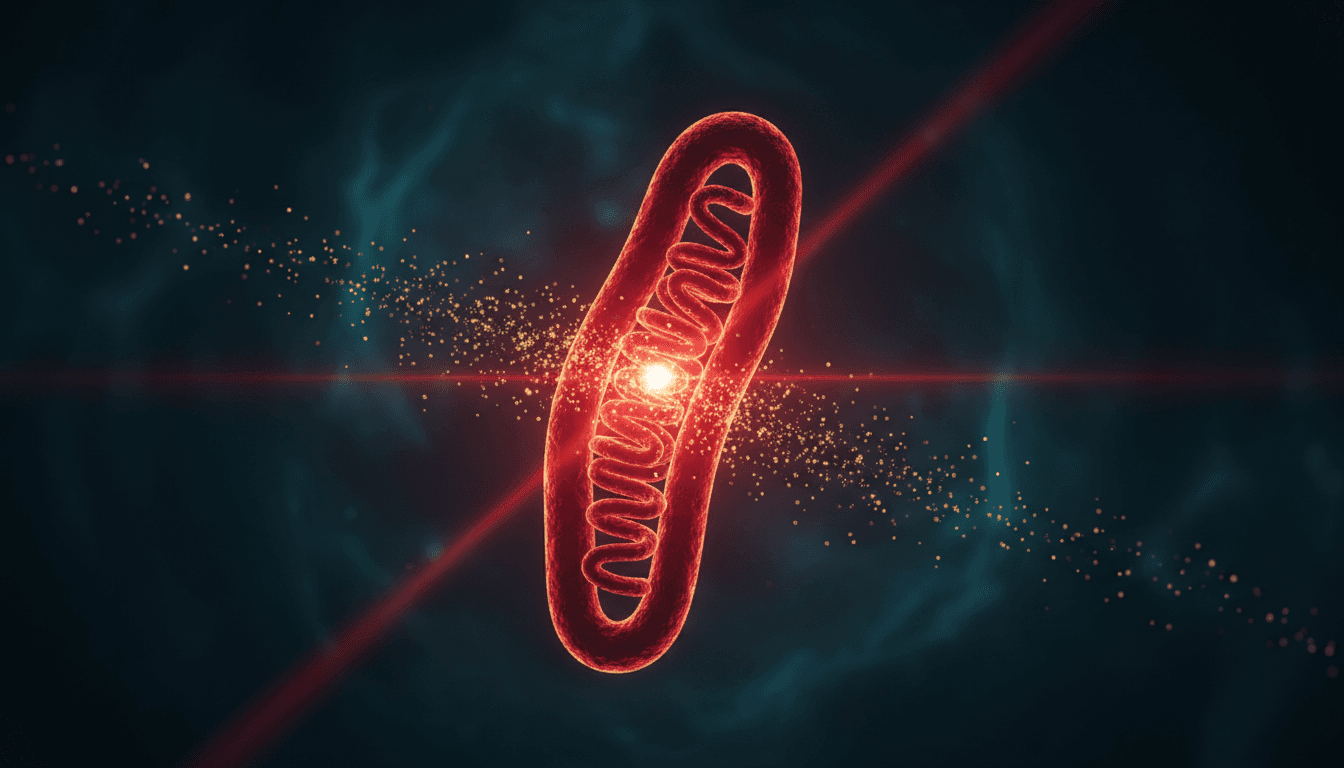
Your retinal photoreceptor cells, rods and cones, are among the most metabolically active cells you have. They burn through ATP at a staggering rate just to keep you seeing. To support that demand, they pack in more mitochondria per cell than any other tissue in your body.
Not the brain. Not the heart. The retina.
After about age 40, mitochondrial function in these cells starts declining. The inner membrane potential drops. Electron transport gets sluggish. ATP production falls. Your vision deteriorates not because the photoreceptors themselves are damaged, but because their power plants are failing.
If you've been following this series, you know that photobiomodulation works by interacting with cytochrome c oxidase, a key enzyme in the mitochondrial electron transport chain. Red light at 670nm essentially clears the bottleneck, restores membrane potential, and gets ATP production moving again.
The retina, with its extreme mitochondrial density, is the most logical target. And the most responsive.
The Three-Minute Protocol
Jeffery's foundational study was elegant in its simplicity. Participants over 40 looked into a 670nm deep red LED device for 3 minutes, once per week, in the morning.
The primary measurement was color contrast sensitivity. How well you can distinguish an object from its background. This isn't about reading an eye chart. It's about the richness and resolution of what you actually see. And it declines significantly with age. Most people don't notice because it happens gradually. You just stop seeing the world in the same detail.
After the protocol, participants averaged a 17% improvement in color contrast vision. The effect lasted at least a week.
Three minutes. Not thirty. Not an hour. Three.
Morning Beats Afternoon
Jeffery's group found that the same protocol applied in the afternoon produced significantly weaker results. Morning exposure was substantially more effective.
Why? Your circadian system regulates mitochondrial function. The interaction between light timing and your circadian phase affects how well the mitochondria respond to photobiomodulation. In the morning, your mitochondrial machinery is more receptive to the boost.
This is a broader principle that shows up across PBM research. Timing isn't just a nice-to-have variable. It's mechanistically relevant. But the eye studies make the case most clearly because the measurement is so straightforward: can you see better or not?
The AMD Question
Age-related macular degeneration is the leading cause of vision loss in people over 50. The wet form can be treated with anti-VEGF injections. The dry form, which is more common, has essentially no treatment.
Jeffery's group ran a pilot study on 18 patients with intermediate dry AMD. They applied 670nm light and measured outcomes at 12 months. They found regression of drusen (the protein deposits that characterize AMD) and improvements in visual function.
Eighteen patients. No control group. This is preliminary work. You cannot call this a treatment for AMD. What you can say is that the finding is consistent with the mechanism: if AMD involves mitochondrial dysfunction in retinal cells, and 670nm light restores mitochondrial function in retinal cells, then improvement is what you'd predict.
The clinical trials aren't at a stage where anyone should treat AMD with red light instead of seeing an ophthalmologist. But the direction is promising enough that larger trials are underway.
The Mechanism Is Clean
What makes the eye application compelling isn't just the results. It's how cleanly the mechanism maps to the outcome.
Retinal cells need enormous ATP. They have the most mitochondria. Mitochondria decline with age. Vision declines with age. Red light at 670nm restores mitochondrial function. Vision improves.
Each step in that chain has independent evidence. There's no hand-waving about "energy" or "healing." It's a specific wavelength acting on a specific enzyme in cells that happen to have the highest concentration of that enzyme's organelle. The anti-inflammatory effect of PBM, well-documented across tissues (opens in new tab), adds another layer, since retinal inflammation accelerates age-related degeneration.
I stare at code for hours a day. The idea that a few minutes of morning red light could offset some of the mitochondrial decline in my retinal cells is... appealing. Not proven for screen-related strain specifically. But the age-related mechanism doesn't care why your mitochondria are struggling.
A Real Safety Note
Do not look directly at powerful LEDs or laser sources. Jeffery's studies used specific therapeutic devices with carefully controlled irradiance: defined power output at a defined distance for a defined duration. Shining a random red LED panel into your eyes is not what this research tested.
The retina is uniquely responsive to red light therapy. It's also uniquely vulnerable to light damage. Respect both facts.
The eye research is still early. The studies are small. But the mechanistic logic is about as clean as it gets in photobiomodulation. 17% improvement from 3 minutes a week is the kind of finding that warrants bigger trials. They're happening.
Sources
- Shinhmar H, Grewal M, et al. "Optically Improved Mitochondrial Function Redeems Aged Human Visual Decline." The Journals of Gerontology: Series A, 2020. https://academic.oup.com/biomedgerontology/article/76/6/951/5905506
- Shinhmar H, Hogg C, et al. "Weeklong improved colour contrasts sensitivity after single 670 nm exposures associated with enhanced mitochondrial function." Scientific Reports, 2021. https://www.nature.com/articles/s41598-021-02311-1
- Hamblin MR. "Mechanisms and applications of the anti-inflammatory effects of photobiomodulation." AIMS Biophysics, 2017. https://pmc.ncbi.nlm.nih.gov/articles/PMC5523874/
- Markowitz SN, et al. "A Double-Masked, Randomized, Sham-Controlled, Single-Center Study with Photobiomodulation for the Treatment of Dry Age-Related Macular Degeneration." Retina, 2020. https://pubmed.ncbi.nlm.nih.gov/31136451/