Three-Quarters of Soldiers With Major Wounds Didn't Want Morphine
In 1946, an Army doctor discovered that soldiers with devastating injuries reported less pain than civilians with minor surgeries. The reason rewrites everything you think you know about how pain works.
Henry Knowles Beecher was an anesthesiologist stationed at the Anzio beachhead in World War II. He watched soldiers come in with compound fractures, penetrating abdominal wounds, shattered limbs. The kind of injuries that should have men screaming.
Most of them weren't screaming.
In 1946, Beecher published "Pain in Men Wounded in Battle" in the Annals of Surgery. He'd carefully documented the pain reports of 215 seriously wounded soldiers. Only 25% requested morphine. Three out of four men with major combat wounds reported moderate pain or no pain at all.
These weren't tough guys performing stoicism. Beecher specifically noted they weren't in shock. They weren't numb. They winced when he started IVs. They complained about a clumsy needle stick while ignoring the gaping wound in their abdomen.
Then Beecher went home and started treating civilians.
He compared his battlefield data to civilian surgical patients with equivalent tissue damage. The civilians reported significantly more pain. They demanded far more analgesics. Same injuries. Radically different pain experiences.
His conclusion was blunt: "The common belief that wounds are inevitably associated with pain, and that the more extensive the wound the worse the pain, was not supported by observations made as ninety per cent of the wounded as they were grueling surgery."
If pain were simply a readout of tissue damage, this is impossible. A compound fracture is a compound fracture. The nociceptors fire the same signals whether you're on a beach in Italy or in a hospital in Boston.
But pain isn't a readout. It's a decision.
The Brain Runs the Numbers
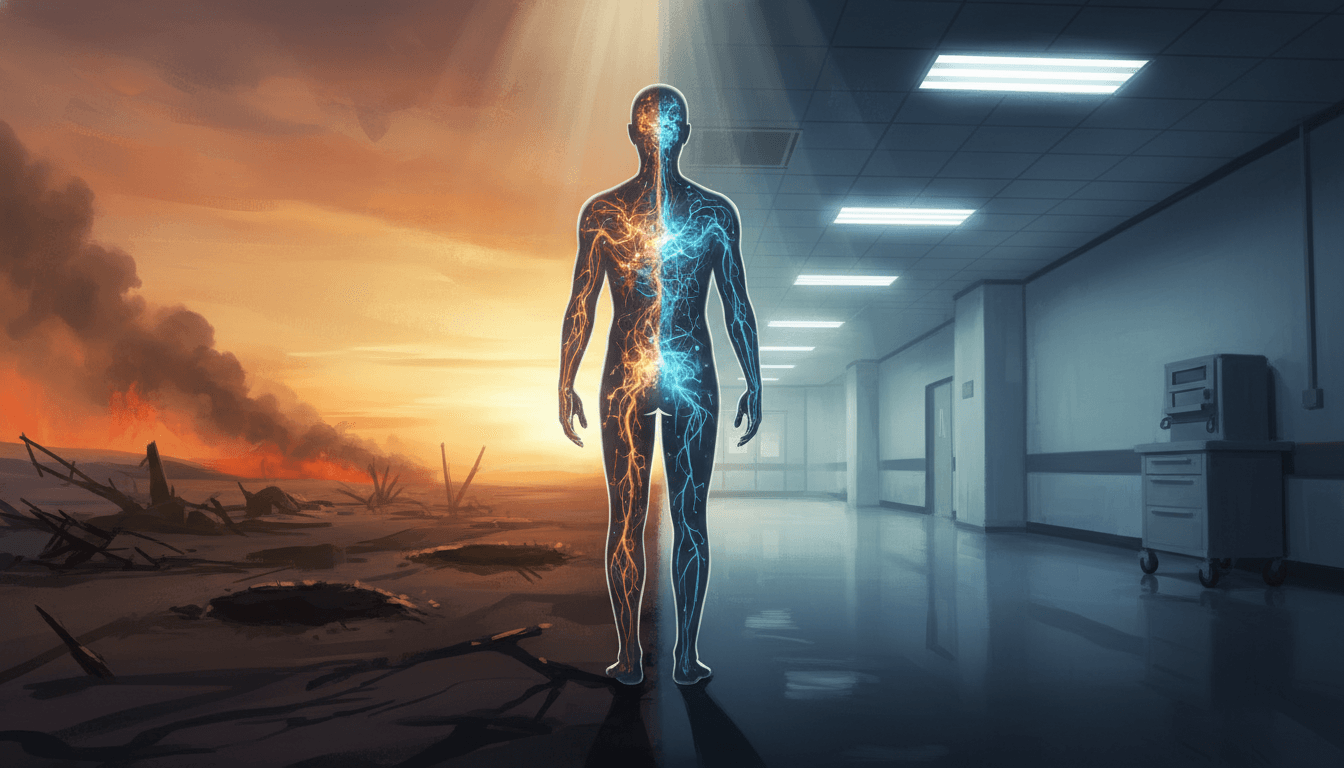
For the soldier, the wound carried a specific meaning: I'm alive. I'm leaving the battlefield. I'm going home. The injury was, in a strange way, good news. The brain evaluated the nociceptive input against that context and dialed the pain down.
For the civilian, surgery carried the opposite meaning: threat. Loss of income. Uncertainty. Vulnerability. Something is wrong with my body and I don't know how wrong. The brain evaluated the same type of tissue damage against that context and cranked the pain up.
Same input. Different meaning. Different pain.
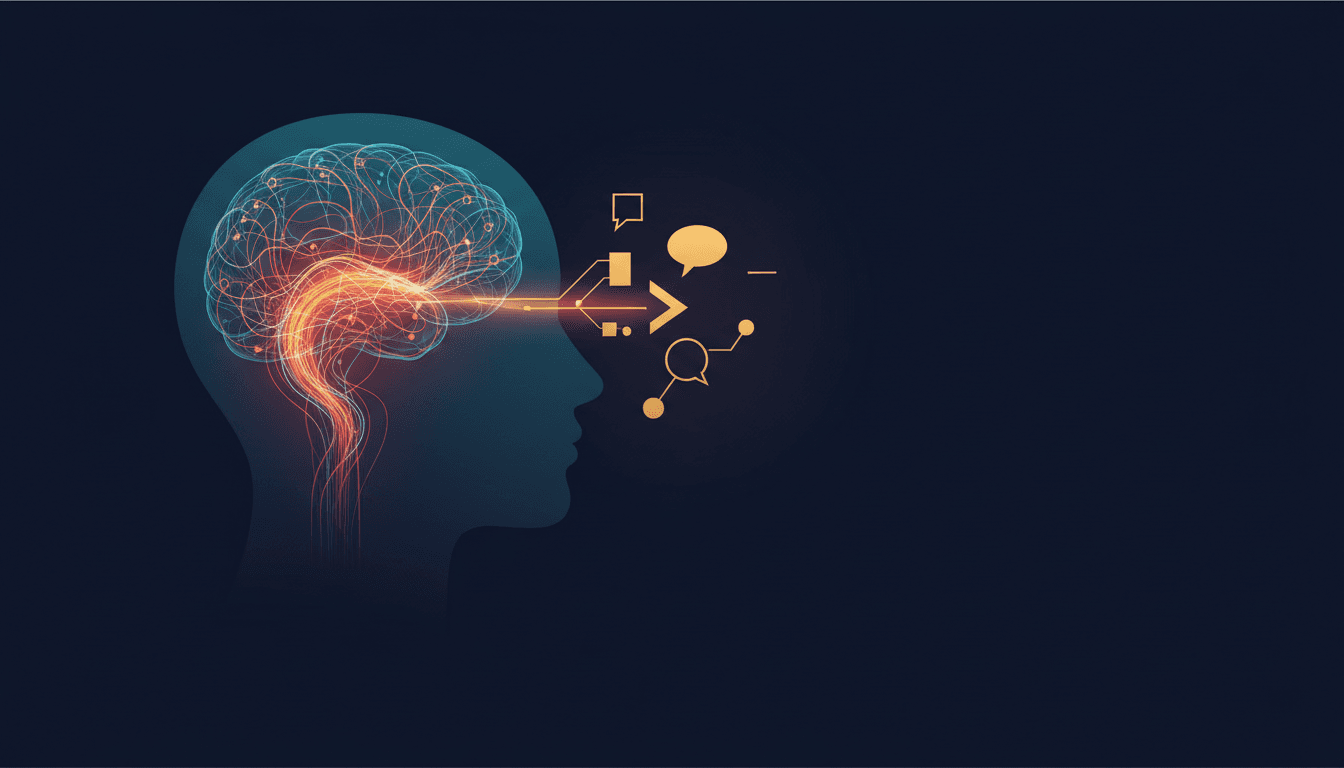
This isn't metaphorical. In 1965, Ronald Melzack and Patrick Wall proposed gate control theory in Science, arguing that the spinal cord contains neural "gates" that can amplify or dampen pain signals before they reach the brain. The brain doesn't just passively receive pain. It actively modulates what gets through based on cognitive and emotional factors.
Melzack later expanded this into the neuromatrix theory in 1990, published in Trends in Neurosciences. He argued that pain is generated by a widely distributed neural network in the brain. Not a single pain center. A whole system that integrates sensory data, emotional state, memory, and contextual meaning to produce the experience of pain.
Your brain is running a prediction model. And the prediction depends on what the injury means.
Words Change the Wiring
A 2004 study by Arntz and Claassens in Behaviour Research and Therapy demonstrated this with uncomfortable precision. They delivered identical electrical stimuli to participants. Same voltage. Same duration. Same location. But they told one group "this could be harmful" and another group "this is completely harmless."
The group told it could be harmful rated the pain significantly higher. The physical input was identical down to the millivolt. The only thing that changed was a sentence.
Fabrizio Benedetti and colleagues showed in 2007 that words don't just change pain perception. They change the neurochemistry underneath it. Their research published in Neuroscience found that negative verbal suggestions activated specific biochemical pathways. Words triggered the release of cholecystokinin, a neurotransmitter that amplifies pain. Telling someone "this is going to hurt" literally made their nervous system produce more pain chemicals.
Elaine Lang and colleagues confirmed this in clinical settings with their 2005 study in Pain. During invasive medical procedures, the specific words providers used measurably affected patient pain levels. Phrases meant to reassure, like "you're going to feel a big bee sting," actually increased pain and anxiety. The word "sting" activated threat processing regardless of the intended comfort.
Your brain doesn't distinguish between "warning about pain" and "experiencing pain" as cleanly as you'd think.
The Snake That Wasn't There
Lorimer Moseley is a pain neuroscientist at the University of South Australia. He tells a story that captures this whole phenomenon in thirty seconds.
He was hiking in the Australian bush when something scraped his leg. Searing pain. He looked down expecting a snake bite. It was a twig.
No venom. No puncture wound. A scratch from a stick.
But Moseley had been bitten by a venomous snake on a previous hike. His brain had stored that context. When it felt a sensation on his leg in the bush, it ran the prediction: snake territory plus leg sensation equals maximum threat. The pain it generated was real, intense, and completely disproportionate to a twig scratch.
Here's what's interesting. The first time Moseley was actually bitten by the snake, he barely felt it. He didn't realize what had happened until he saw the bite marks. His brain had no context for "snake bite" yet, so it didn't generate a major pain response. He nearly died because the pain system underreacted.
Same person. Same leg. One time a real snakebite felt like nothing. Another time a twig felt like agony. The difference was what his brain predicted based on context.
Your Pain Is a Guess
Irene Tracey, a neuroscientist at Oxford, has spent years mapping this process with fMRI. Her 2019 work published in Cerebral Cortex describes pain as a complex inference the brain constructs. Not a signal sent from the body to the brain. A guess the brain makes about what's happening to the body, informed by sensory data but also by expectation, memory, attention, and emotional state.
This reframes the 2020 revision of the International Association for the Study of Pain definition. Pain is now officially defined as "an unpleasant sensory and emotional experience associated with, or resembling that associated with, actual or potential tissue damage." That phrase "or resembling" is doing enormous work. It means pain doesn't require damage. It requires the brain to predict damage.
Michael Sullivan and colleagues established in 1995 in the Clinical Journal of Pain that a thinking pattern called catastrophizing, essentially the tendency to ruminate on pain, magnify it, and feel helpless about it, is one of the strongest predictors of pain intensity. Stronger than the actual tissue damage in many cases.
David Seminowicz and Karen Davis confirmed this in 2006 with brain imaging published in Pain. People who catastrophize show amplified cortical responses to the same painful stimulus. Their brains literally process identical input as more threatening.
The brain isn't a passive receiver. It's an active editor.
What Beecher Actually Discovered
Beecher thought he'd found something interesting about soldiers. He'd actually found something fundamental about all pain.
Every pain experience you've ever had was a construction. Your brain took sensory input, combined it with everything it knew about your situation, your history, your expectations, your emotional state, and produced an experience calibrated to what it thought you needed.
For the soldier at Anzio, the brain said: you're safe now, you don't need alarm signals. For the civilian in Boston, it said: something is wrong and you should be very concerned.
Neither was lying. Both were guessing.
A.V. Apkarian and colleagues showed in 2004 in the Journal of Neuroscience that chronic back pain is associated with decreased gray matter in the prefrontal cortex and thalamus. The brain physically changes when pain predictions get stuck in a loop. Baliki and colleagues followed up in 2012 in Nature Neuroscience, finding that the strength of connections between the prefrontal cortex and the nucleus accumbens could predict which acute pain patients would develop chronic pain.
The brain's prediction system doesn't just generate individual pain experiences. When it malfunctions, it can lock into a pattern where it keeps predicting threat long after the tissue has healed.
That's chronic pain. Not ongoing damage. An ongoing prediction.
But if pain is a prediction, predictions can be updated. Moseley demonstrated in 2004 in the European Journal of Pain that educating chronic pain patients about how pain actually works, explaining that pain is a brain output rather than a tissue readout, produced measurable reductions in pain and disability. Louw and colleagues confirmed this in 2011 in the Archives of Physical Medicine and Rehabilitation with a systematic review showing pain neuroscience education reduced pain, disability, anxiety, and stress across multiple chronic conditions.
Teaching people what Beecher discovered on a beach in Italy in 1944 literally changes their pain.
That's where this series is going. Not just understanding that pain is constructed, but understanding what follows from that. Because if the brain builds pain from predictions, and predictions can be wrong, then the entire landscape of chronic pain, placebo effects, heartbreak, and recovery looks completely different from what most people assume.
The soldiers at Anzio didn't have less tissue damage. They had different brains making different predictions about what that damage meant.
So does everyone else.
Sources
- Pain in Men Wounded in Battle (Beecher, 1946, Annals of Surgery)
- Pain Mechanisms: A New Theory (Melzack & Wall, 1965, Science)
- Phantom limbs and the concept of a neuromatrix (Melzack, 1990, Trends in Neurosciences)
- When words are painful: Unraveling the mechanisms of the nocebo effect (Benedetti et al., 2007, Neuroscience)
- Can words hurt? Patient-provider interactions during invasive procedures (Lang et al., 2005, Pain)
- Finding the Hurt in Pain (Tracey, 2019, Cerebral Cortex)
- IASP Revised Definition of Pain (2020, Pain)
- Theoretical perspectives on the relation between catastrophizing and pain (Sullivan et al., 1995, Clinical Journal of Pain)
- Cortical responses to pain in healthy individuals depends on pain catastrophizing (Seminowicz & Davis, 2006, Pain)
- Chronic Back Pain Is Associated with Decreased Prefrontal and Thalamic Gray Matter Density (Apkarian et al., 2004, Journal of Neuroscience)
- Corticostriatal functional connectivity predicts transition to chronic back pain (Baliki et al., 2012, Nature Neuroscience)
- Evidence for a direct relationship between cognitive and physical change during an education intervention in people with chronic low back pain (Moseley, 2004, European Journal of Pain)
- The effect of neuroscience education on pain, disability, anxiety, and stress in chronic musculoskeletal pain (Louw et al., 2011, Archives of Physical Medicine and Rehabilitation)
Part of the Pain Illusion series. Previous: There Are No Pain Receptors. Next: The Limb That Isn't There Still Hurts.