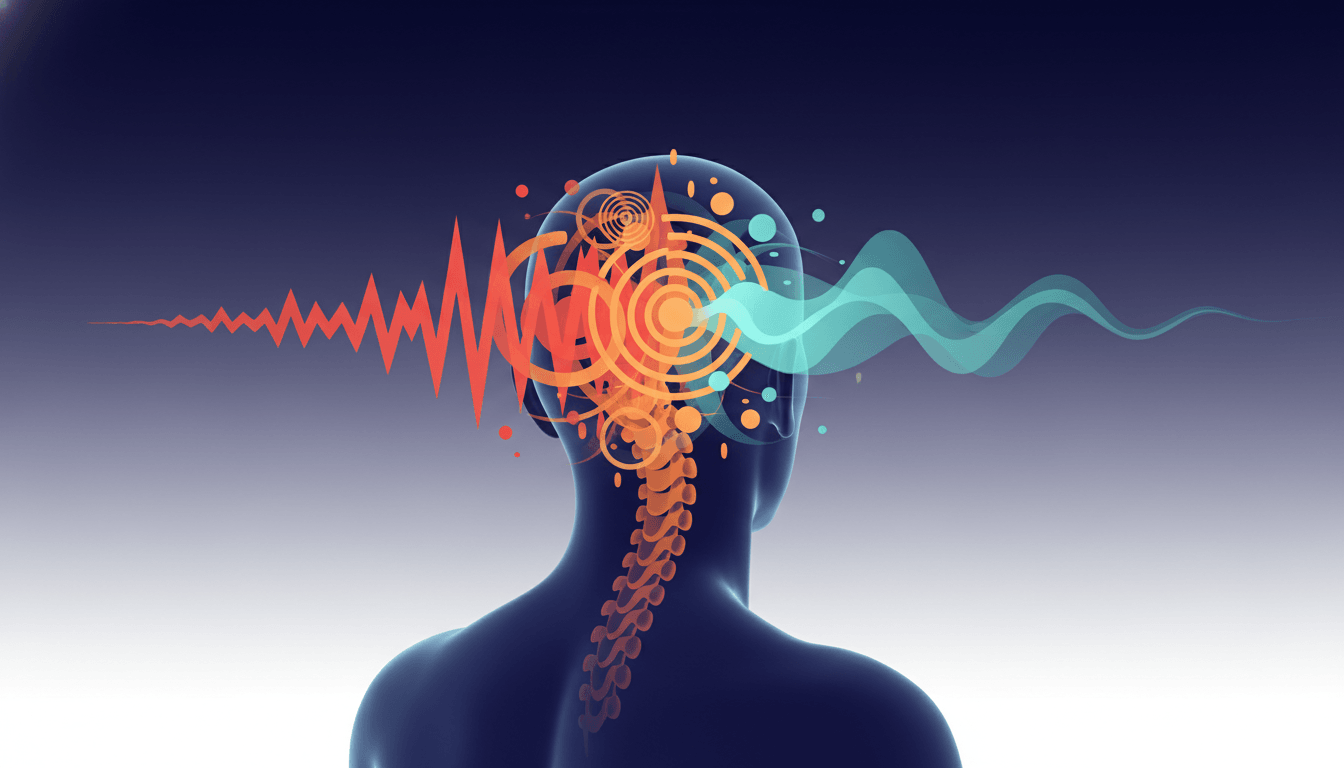
Words That Wound: How Language Changes Pain
A saline injection relieved real pain because a doctor said it would. The words activated the brain's own opioid system. If pain is a prediction, language is one of the most powerful things that can rewrite it.
A doctor injects you with saline. Salt water. Nothing. But he tells you it's a powerful painkiller. Your pain drops. Not because you're gullible or weak-minded. Because your brain heard the words, updated its prediction model, and released its own opioids in response.
That's not a metaphor. Fabrizio Benedetti at the University of Turin proved it in a 2003 study published in the Journal of Neuroscience. He gave patients inert saline injections with the verbal suggestion that the drug would reduce their pain. It worked. Pain dropped measurably. Then he secretly administered naloxone, a drug that blocks opioid receptors. The placebo effect vanished.
The words triggered a specific neurochemical cascade. Block the chemistry and the words stop working. The implication is hard to overstate. Language doesn't just change how you talk about pain. It changes the molecules your brain produces.
This is article eight in a series about how pain actually works. The core idea, supported by decades of research from Melzack and Wall's gate control theory in 1965 through the IASP's revised definition of pain in 2020, is that pain is not a signal your body sends to your brain. Pain is a prediction your brain constructs. And if pain is a prediction, then anything that changes the prediction changes the pain.
Words change predictions constantly.
The Dark Twin
Benedetti didn't stop with placebo. He studied the nocebo effect, which is what happens when words make things worse.
Tell patients "this might increase your pain" and their pain goes up. Not just subjectively. Their cortisol spikes. Their cholecystokinin system activates. CCK is a neuropeptide pathway that amplifies pain signaling. In a 2007 study in Neuroscience, Benedetti and colleagues showed that nocebo hyperalgesia could be blocked by proglumide, a CCK antagonist.
Read that again. A negative verbal suggestion created a measurable biochemical pain response. Block the biochemistry and the suggestion loses its power.
Placebo activates your brain's opioid system. Nocebo activates your brain's pain-amplifying system. Same mechanism, opposite direction. Words are the switch.
The Bee Sting Problem
This isn't just a lab curiosity. It plays out in hospitals every day.
A 2005 study by Lang and colleagues published in Pain tracked what happened when healthcare providers used different language before needle procedures. Telling patients "you're going to feel a big bee sting" significantly increased pain ratings compared to neutral language. The needle was the same. The procedure was identical. The only variable was the words spoken beforehand.
Think about how many times a doctor or nurse has told you "this is going to hurt." They meant well. They were trying to prepare you. But your brain took those words as evidence, fed them into its prediction model, and generated more pain than the stimulus warranted.
"You may feel some pressure" produces less pain than "this will sting." Saying nothing sometimes produces less pain than either. The words aren't decorating the experience. They're constructing it.
Catastrophizing Is Prediction Gone Wrong
There's a version of nocebo that you do to yourself every day. Researchers call it catastrophizing.
Michael Sullivan at McGill University developed the Pain Catastrophizing Scale in 1995 and published foundational work in the Clinical Journal of Pain identifying three components: rumination (I can't stop thinking about how much it hurts), magnification (something terrible is going to happen), and helplessness (there's nothing I can do). These aren't personality flaws. They're verbal and cognitive patterns that feed the brain's prediction engine.
Edwards and colleagues showed in a 2009 study in Arthritis and Rheumatism that catastrophizing predicted pain intensity in arthritis and fibromyalgia patients better than the objective severity of their disease. People with worse tissue damage but lower catastrophizing reported less pain than people with minor damage who catastrophized heavily.
Seminowicz and Davis found in a 2006 Pain study that catastrophizing literally changes how the brain's cortex responds to painful stimuli. High catastrophizers showed amplified activity in pain-processing regions. The internal narrative was rewriting the neural response.
Your inner monologue is doing what Benedetti's verbal suggestions did in the lab. Telling yourself "this is unbearable" or "it's never going to get better" is a nocebo you administer to yourself, on repeat, for free.
Words as Medicine
If language can make pain worse, it can make pain better. And not in a think-positive, manifest-your-healing way. In a measurable, clinical way.
Lorimer Moseley published a 2004 study in the European Journal of Pain showing that educating chronic low back pain patients about how pain actually works (explaining that pain is a brain output, not a damage signal) produced significant improvements in both pain and physical function. Not physical therapy. Not medication. Education. Words about pain changed the pain.
Louw and colleagues confirmed this in a 2011 systematic review in Archives of Physical Medicine and Rehabilitation. Pain neuroscience education, literally teaching people the science of how pain works, reduced pain, disability, anxiety, and stress across multiple chronic musculoskeletal conditions.
This is what the entire field now calls therapeutic neuroscience education. The treatment is information. The medicine is an updated mental model.
It works because the brain's prediction engine uses every available input. Verbal information from a doctor. Internal self-talk. Beliefs about what pain means. Cultural narratives about suffering. All of it feeds the model. All of it shapes the output.
The Practical Version
I think about this when I notice my own self-talk around discomfort. I'm a programmer. I sit for long hours. My back gets stiff. And there's a voice that wants to say "my back is messed up" or "this is getting worse."
That voice is updating a prediction model. Every time I frame stiffness as damage, my brain takes that as evidence and generates a pain response proportional to the perceived threat. When I reframe it as "my back is stiff because I've been sitting, and movement will help," the same sensation produces less suffering. Not zero. Less.
This isn't denial. It's accuracy. Apkarian and colleagues showed in a 2004 Journal of Neuroscience study that chronic back pain is associated with decreased gray matter in the prefrontal cortex, the region responsible for rational evaluation of threats. Chronic pain literally erodes the brain's ability to accurately assess whether something is dangerous. The catastrophizing fills the gap.
Accurate language fights that erosion. Not optimistic language. Not toxic positivity. Accurate language.
"This hurts and it's not dangerous" is a different prediction than "this hurts and something is wrong." Same sensation. Different words. Different brain output.
The Biggest Nocebo
Irene Tracey at Oxford, one of the leading pain neuroimagers in the world, wrote in a 2019 paper in Cerebral Cortex about how the entire context of a medical encounter shapes pain. The words on the prescription bottle. The confidence in the doctor's voice. The diagnosis itself.
Being told "you have degenerative disc disease" is a nocebo. The word "degenerative" implies progressive decay. It implies you're falling apart. Many people with degenerative disc changes on MRI have zero pain. But once they hear the label, the prediction changes. The brain now expects pain from a spine it has been told is damaged. And the brain delivers.
Nijs and colleagues argued in a 2014 Physical Therapy paper that combining pain neuroscience education with physical rehabilitation produced better outcomes than either alone. You need to move. But you also need to understand why you're moving and what the pain means. The words and the movement work together because they're both updating the same prediction model.
Language isn't everything. You can't talk your way out of a broken femur. But for the vast majority of chronic pain, where the tissue has healed but the pain persists, language is one of the most accessible and underused interventions available.
Every word you use about your body is a small act of programming. Your brain is listening.
Sources
- Pain Mechanisms: A New Theory (Melzack & Wall, 1965, Science)
- Conscious Expectation and Unconscious Conditioning in Analgesic, Motor, and Hormonal Placebo/Nocebo Responses (Benedetti et al., 2003, Journal of Neuroscience)
- When words are painful: Unraveling the mechanisms of the nocebo effect (Benedetti et al., 2007, Neuroscience)
- Can words hurt? Patient-provider interactions during invasive procedures (Lang et al., 2005, Pain)
- Theoretical perspectives on the relation between catastrophizing and pain (Sullivan et al., 1995, Clinical Journal of Pain)
- Catastrophizing and pain in arthritis, fibromyalgia, and other rheumatic diseases (Edwards et al., 2009, Arthritis and Rheumatism)
- Cortical responses to pain in healthy individuals depends on pain catastrophizing (Seminowicz & Davis, 2006, Pain)
- Evidence for a direct relationship between cognitive and physical change during an education intervention in people with chronic low back pain (Moseley, 2004, European Journal of Pain)
- The effect of neuroscience education on pain, disability, anxiety, and stress in chronic musculoskeletal pain (Louw et al., 2011, Archives of Physical Medicine and Rehabilitation)
- Chronic Back Pain Is Associated with Decreased Prefrontal and Thalamic Gray Matter Density (Apkarian et al., 2004, Journal of Neuroscience)
- Finding the Hurt in Pain (Tracey, 2019, Cerebral Cortex)
- A Modern Neuroscience Approach to Chronic Spinal Pain (Nijs et al., 2014, Physical Therapy)
- IASP Revised Definition of Pain (2020)
Part of the Pain Illusion series. Previous: Rejection Literally Hurts. Next: Your Brain Has a Volume Knob for Pain.