The Collagen Study That Wasn't Subjective
A 2014 trial used ultrasound to measure collagen density changes from red light therapy. The results were structural, not cosmetic.
In 2014, Alexander Wunsch and Karsten Matuschka published the trial that every red light therapy company now cites on their product page. 136 volunteers. Red light at 611-650nm or polychromatic light at 570-850nm. Twice a week. The part the marketing materials usually leave out: they didn't just ask people if their skin looked better.
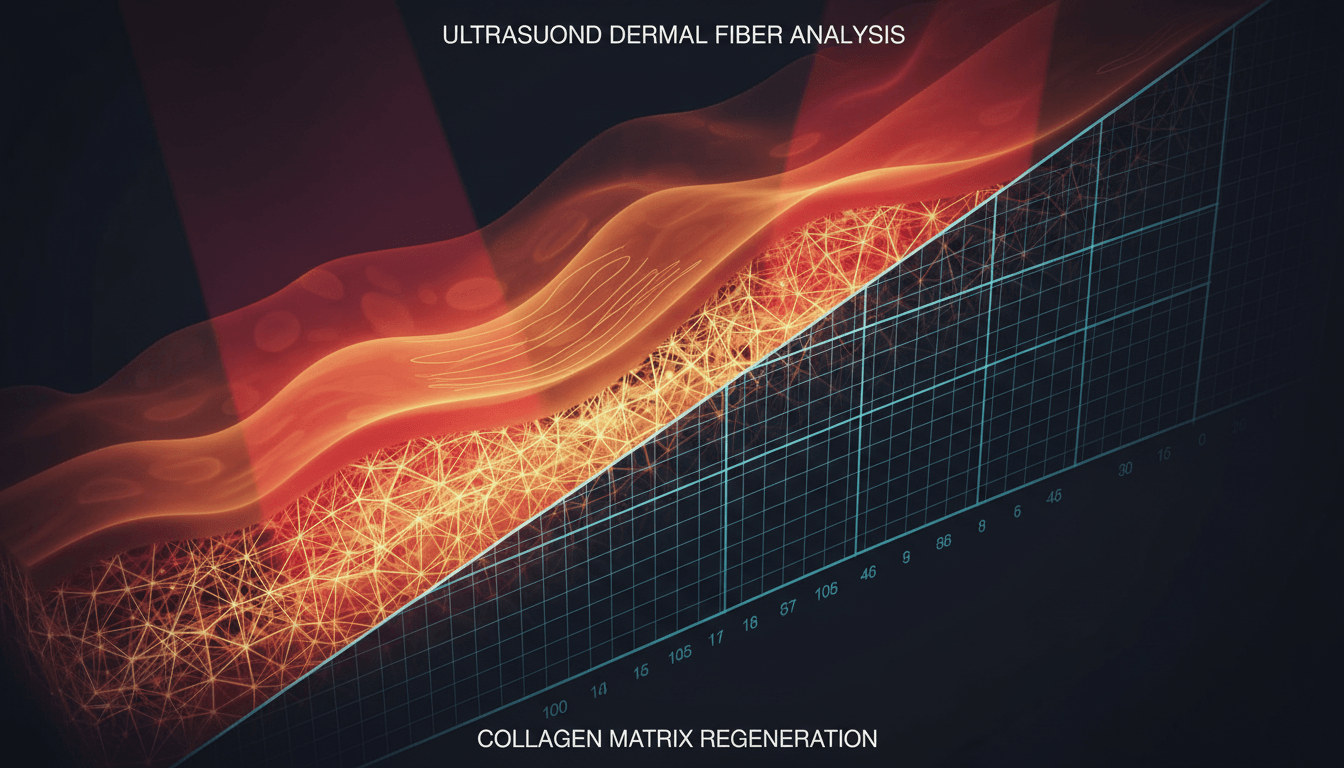
They measured collagen density with ultrasound.
Not a survey. Not a "rate your satisfaction on a scale of 1-10." An imaging technique that shows the structural density of protein fibers in the dermis. The treated group showed significantly increased collagen density compared to controls. Skin roughness improved on profilometry (a surface-measurement tool that maps the topography of your skin at the microscopic level). Complexion improved both subjectively and objectively.
That's not a beauty story. That's a tissue remodeling story.
Why Skin Is the Strongest Case
Of all the applications for red light therapy, skin has the most evidence. Strong enough that multiple FDA-cleared devices exist specifically for dermatological use. There's a reason for that. Skin is the first tissue the light hits. No bones, no muscle, no fat layers to penetrate first. The photons land exactly where the target cells live.
Those target cells are fibroblasts. They sit in the dermis and their entire job is producing the structural proteins that keep skin firm and elastic. Collagen. Elastin. Hyaluronic acid. When red light at 630-660nm hits fibroblasts, it activates their cytochrome c oxidase (the same enzyme I covered in article one). ATP goes up. Gene expression programs for collagen and elastin synthesis kick on.
Red wavelengths reach the epidermis and upper dermis. Near-infrared at 810-850nm goes deeper into the dermis. That's why a lot of clinical protocols use both. You're covering two layers with two wavelengths.
The Trials Keep Coming
A 2023 study used a 630nm LED mask. 12 minutes, twice per week, for 3 months. The researchers measured crow's feet wrinkle depth, skin firmness, dermal density, and pore diameter using dermoscopy, ultrasound, and surface profilometry. All four improved measurably.
Then a 2025 multi-center randomized controlled trial tested a combined 630nm and 850nm LED/IRED mask for crow's feet. Significant improvement versus sham control. The sham part matters. The control group used an identical-looking device that emitted no therapeutic light. That's how you know the result isn't placebo. It's not "I paid $300 for this mask so I'm going to believe it works." The people who thought they were getting treated but weren't? They didn't improve.
This is the kind of evidence that separates red light therapy from most things in the wellness space. Objective measurements. Sham controls. Replication across multiple trials and research groups.
Beyond Vanity
The fibroblast stimulation mechanism isn't just about looking younger. It's the same biology that drives wound healing.
Multiple studies document accelerated wound closure and reduced scar formation with photobiomodulation. The pathways include fibroblast activation (more collagen at the wound site), angiogenesis (new blood vessel formation through VEGF upregulation), and anti-inflammatory cytokine release. Michael Hamblin's 2017 review in AIMS Biophysics mapped these anti-inflammatory cascades in detail.
This has real medical applications. Diabetic ulcers that won't close. Surgical incisions that need faster recovery. Oral mucositis from chemotherapy (painful mouth sores that make it nearly impossible to eat). These aren't cosmetic concerns. They're clinical problems where accelerating tissue repair changes patient outcomes.
This biology isn't unique to light. Massage, compression, heat — they all work through similar downstream mechanisms: increasing blood flow, reducing inflammation, promoting recovery. Red light hits the same targets photochemically. Different input, same cascade.
The Catch
Strong evidence doesn't mean every product works. The Wunsch trial used specific wavelengths at specific doses delivered at specific distances. Consumer LED masks vary wildly in power output. Some deliver clinical-grade irradiance. Some are glorified nightlights.
The dose matters. As I covered in the first article, the biphasic dose response means too little does nothing and too much backfires. Most clinical skin studies use energy densities in the 3-10 J/cm² range. Whether your $200 mask actually delivers that depends on the LEDs, the distance from your skin, and the treatment duration. Most companies don't publish their irradiance specs in a way that lets you calculate this. (Funny how that works.)
The science on skin and collagen is genuinely strong. Controlled trials with objective measurements across multiple research groups over more than a decade. That's not hype. But the gap between what the research shows and what the average consumer device delivers is where most people get disappointed.
The mechanism is real. The collagen growth is measurable. The device you bought on Instagram might not be the one that produces either.
Part of the Red Light Therapy series. Previous: Your Mitochondria Have a Light Switch.
Sources
- Wunsch A, Matuschka K. "A Controlled Trial to Determine the Efficacy of Red and Near-Infrared Light Treatment" (2014, Photomedicine and Laser Surgery) (opens in new tab)
- Hamblin MR. "Mechanisms and applications of the anti-inflammatory effects of photobiomodulation" (2017, AIMS Biophysics) (opens in new tab)
- Photobiomodulation: A review of the molecular evidence (2021, Journal of Plastic, Reconstructive & Aesthetic Surgery) (opens in new tab)